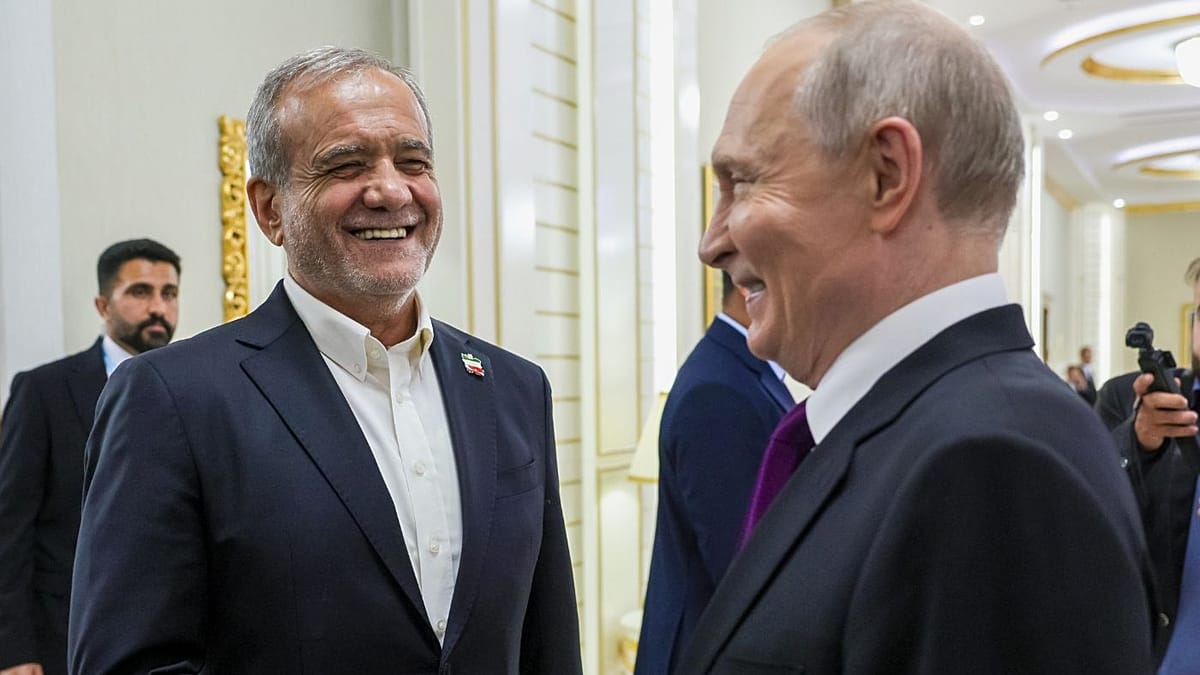
Vladimir Putin has offered to do “everything in our power” to help end the war between Iran and the United States, casting Moscow as a would-be mediator in the Middle East even as its own full-scale invasion of Ukraine enters its fifth year. The Russian president spoke on Thursday during a bilateral meeting with his Iranian counterpart, Masoud Pezeshkian, in the Turkmenistan resort town of Avazeh on the Caspian coast.
Putin praised Tehran for what he called “genuine efforts” to resolve the conflict, which began with joint US-Israeli strikes on 28 February. Pezeshkian said Iran and the US had exchanged proposals to end the war and reopen the Strait of Hormuz, and that Tehran was reviewing and amending them before passing them on through mediators. Despite ongoing US attacks, he insisted Iran would not walk away from negotiations.
“We are talking, but every time we negotiate with the United States, they attack again,” Pezeshkian said. “Nevertheless, we will not abandon the negotiating table and dialogue.”
The meeting was the seventh between the two presidents since Pezeshkian took office, following a phone call on 7 October — Putin's birthday — in which they discussed regional developments and the Iran-US talks. They last met in person on 1 September on the sidelines of the Shanghai Co-operation Organisation summit in Bishkek. Russia is not among the official mediators in the US-Iran negotiations; so far, Qatar and Pakistan have led those efforts.
A deepening partnership
Military, diplomatic and economic ties between Iran and Russia have strengthened considerably since Moscow launched its full-scale invasion of Ukraine in early 2022. The Iran war has prompted more frequent consultations between the two capitals on political and material support, as well as financial co-operation.
Since 2022, Iran has supplied Russia with Shahed drone technology — which Moscow has copied to produce its own Geran-type variant, a key weapon in daily attacks on Ukrainian civilian and infrastructure targets — and short-range missiles. Moscow also faces accusations of providing Tehran with targeting information for attacks on US interests in the Middle East.
Trade between the two countries rose by more than 21% in 2025 and continued on the same trajectory through the first seven months of 2026, Putin said, adding that relations were developing under a comprehensive strategic partnership agreement signed early last year. Pezeshkian described the current situation as an opportunity to deepen co-operation and said Tehran and Moscow should coordinate “with greater speed and strength.”
Billion-dollar loan stalled
Iranian state-run media reported in the days before the meeting that Russia was ready to extend a $1 billion loan to Tehran, described as the first tranche of a $20 billion package agreed at a meeting between Supreme National Security Council secretary Ali Larijani and Putin. The semi-official IRGC-affiliated Fars news agency said arrangements to disburse the sum were complete, but disagreements among Iranian authorities over how to spend the money prevented Tehran from providing the account number needed to complete the transfer.
Iran's Planning and Budget Organisation wants to use the funds to import cars and collect customs duties, the Oil Ministry wants them for oil equipment, and the Agriculture Ministry is seeking to allocate them to basic commodity imports, according to the same report.
While Putin positions himself as a peacemaker in the Gulf, his forces continue to bombard Ukrainian cities. A recent strike on Kramatorsk buses killed at least 12 people and wounded 19, and frontline cities are struggling to survive another winter. The contrast between Moscow's diplomatic overtures and its military aggression is stark, and European capitals are watching closely. The EU has also demanded transparency from Russia on other matters, such as the recent Siberian plague case, as trust in Moscow remains at historic lows.