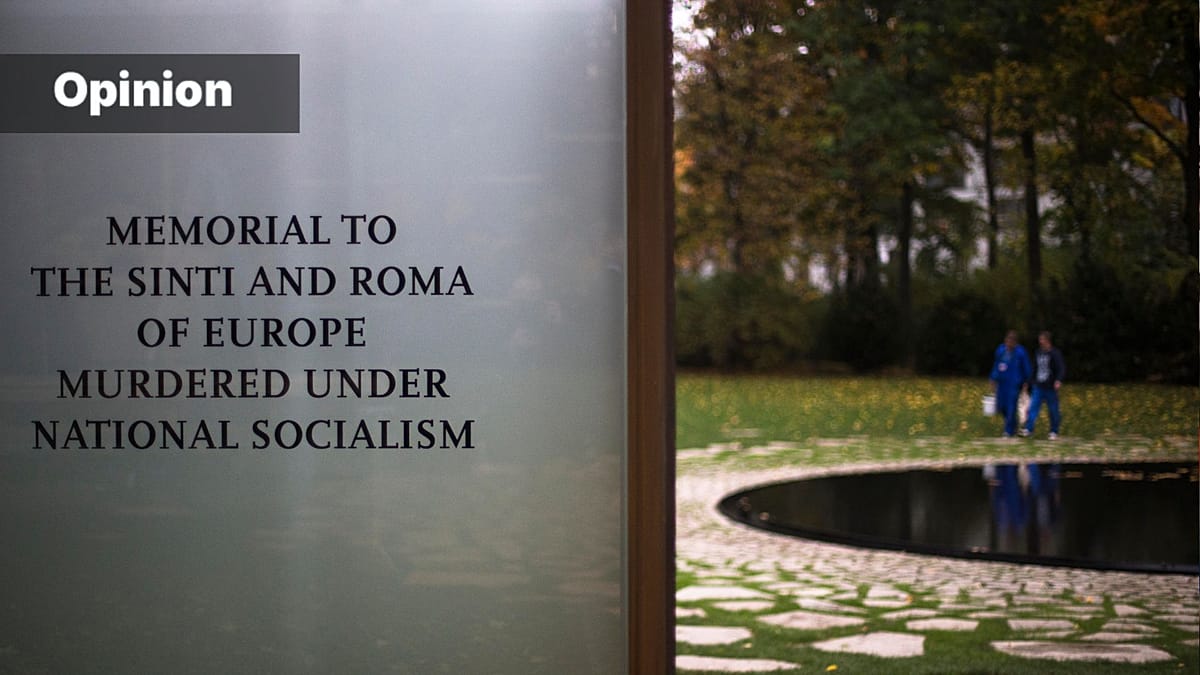
Every year on 2 August, Europe pauses to remember the hundreds of thousands of Roma and Sinti people who were persecuted and murdered under Nazi rule. The date marks the liquidation of the so-called “Gypsy family camp” at Auschwitz-Birkenau in 1944, when nearly 4,300 people were killed in a single night. But as Michaela Küchler argues, the real test of remembrance comes the following day – and every day after.
For decades, one of the most iconic images of Nazi persecution was a photograph of a young girl, her head wrapped in a scarf, peering through the doors of a cattle car at the Westerbork transit camp in the Netherlands. The picture was widely reproduced, but the girl remained anonymous, assumed to be Jewish. It took years of painstaking research to restore her identity: she was Settela Steinbach, a nine-year-old Sinti girl. She was deported with her family in May 1944 and almost certainly murdered at Auschwitz-Birkenau on the night of 2–3 August, along with her mother, two brothers, and two sisters. Only the photograph survived – and with it, the erasure of her name and her people’s history.
Settela’s story is a stark reminder that victims can be lost twice: first when their lives are taken, and again when their names are forgotten. The genocide of the Roma and Sinti remains one of the least recognised chapters of Nazi atrocities. They were subjected to racist laws, imprisonment, forced labour, mass shootings, and deportation across the continent. Yet for decades, survivors were denied recognition, compensation, and even a place in national histories. The prejudices that enabled the persecution did not vanish with the end of the war.
Recognition remains uneven
Progress has been made. Memorials have been erected, research has deepened, and organisations have worked tirelessly to recover names and testimonies. It was such work that gave Settela Steinbach her name back. But recognition is still patchy. In many classrooms and museums across Europe, the genocide is treated as an optional footnote to the history of the Nazi era rather than an integral part of it. Ask a student what happened to Roma and Sinti people under Nazi rule, and the answer may still be a blank look. That silence is not the fault of young people – they cannot know what they have never been taught.
Teaching this history is not merely about listing atrocities. Nazi crimes did not begin with mass murder; they began with stereotypes, exclusion, bureaucratic classification, and the steady removal of rights. Understanding that progression – from prejudice to paperwork to murder – is essential. It shows how discrimination can become institutionalised and eventually lethal. The lessons of other genocides echo here: silence and denial only deepen the wound.
It is equally important to present Roma and Sinti people as more than anonymous victims. They had families, professions, communities, and ambitions. They resisted persecution and rebuilt their lives afterwards. Settela was not just a frightened child in a film; she was a daughter and sister, her father a trader and violinist. These details restore the individuality that persecution tried to erase. They are not decorative – they are essential to a truthful history.
As the generation of living survivors and witnesses fades, responsibility shifts to institutions. Because recognition came so late, many Roma and Sinti voices were never recorded. The testimonies that remain are all the more precious. Archives must be opened, memorial sites protected, photographs correctly identified, and Roma and Sinti perspectives placed at the centre of education and commemoration. The morning briefing on the eve of this year’s memorial day noted the growing urgency of these efforts.
The International Holocaust Remembrance Alliance has developed practical recommendations for teaching about the persecution and genocide of the Roma during the Nazi era. These guidelines, aimed at governments, teachers, museums, and civil society, offer a framework for why this history should be taught, what students should learn, and how to approach it responsibly. They emphasise including Roma voices, resistance, and agency, and they stress the importance of involving Roma communities themselves. But as Küchler points out, recommendations cannot manufacture political will. They can, however, remove the excuse that nobody knows what practical action looks like.
Europe’s commitment to remembrance cannot be measured only by ceremonies held on 2 August, however moving they may be. It must be measured by what happens in classrooms, archives, museums, and public institutions throughout the year. The test is whether future students will still encounter silence where this history should be taught – and whether people like Settela Steinbach remain merely an anonymous face in an old film, or are remembered as the individuals they were.