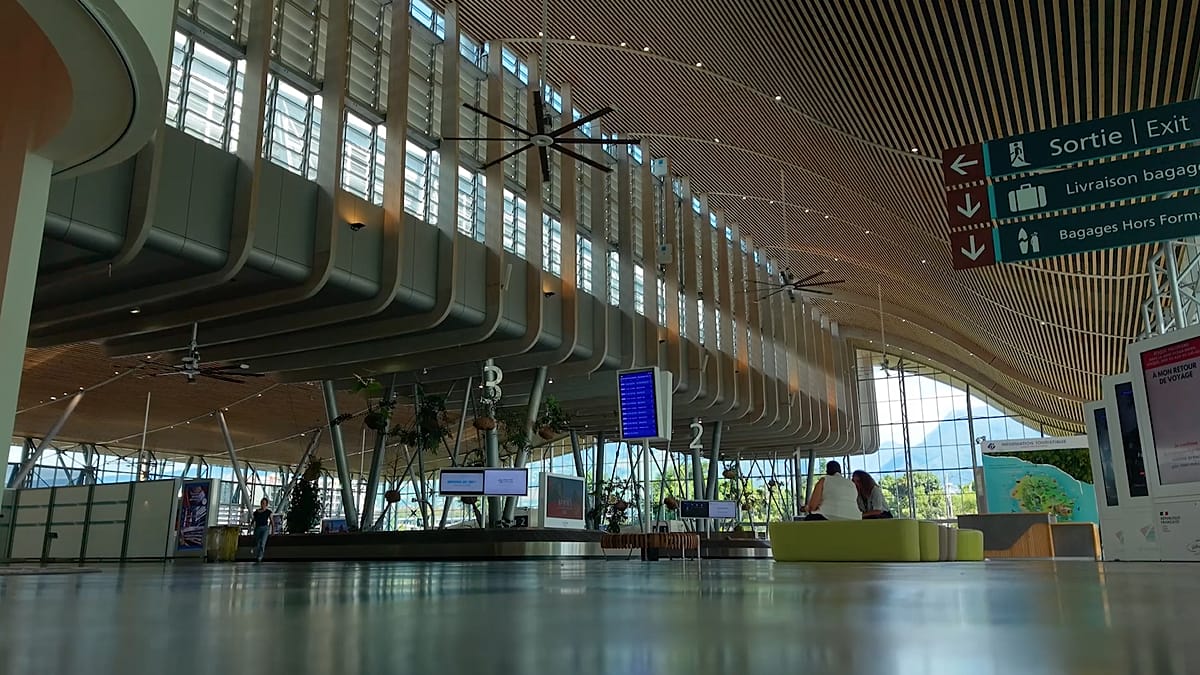
On the French overseas island of Réunion, Roland Garros Airport has opened what it calls the world's first bioclimatic terminal in a tropical climate. The new arrivals and baggage reclaim hall, a 13,000 m² cube of glass, metal, and wood, operates without conventional air conditioning. Instead, it relies on a sophisticated natural ventilation system that harnesses the island's trade winds.
Marc Delanoë, the airport's director of sustainable development, describes Réunion as "a pebble in the middle of the Indian Ocean, it is a bioclimatic laboratory." The project took eight to nine years from concept to completion, drawing inspiration from other naturally ventilated buildings in the region, including a bioclimatic amphitheatre in Saint-Denis and traditional Réunion houses.
How the Bioclimatic Canyon Works
The terminal's centrepiece is a "bioclimatic canyon" — a longitudinal structure 10 metres high and 10 metres wide that runs through the building. Éric Bussolino, architect and director of engineering and environment at AIA Life Designers, explains: "The wind is accelerated at the top of the roof, and this creates a suction effect, causing the air to enter through the outer facades and exit through the canyon." More than 800 automated louvred windows, known locally as ventelles, respond in real time to data from a weather station on the departures terminal deck. At a wind speed of one metre per second against the skin, the perceived temperature drops by about four degrees Celsius.
Thomas Dubus, chairman of the airport's board of directors, describes the interior as having a "cathedral effect" — a vast, light-filled space that blurs the boundary between indoors and outdoors. "We are indoors, but in a large space and in direct contact with nature outside," he says.
Nature is also present inside the terminal, with endemic plants selected by the botanical conservatory of Réunion. These species, some of which are endangered, grow in the nave and on the roof, reinforcing the sense of freshness and contributing to conservation efforts.
European Funding and Local Impact
The project was driven by the need to modernise baggage screening to European standards. Its total budget of around €65 million was partly financed by the European Cohesion Policy, which covered 58% of the costs. Notably, 91% of the companies involved in the construction were local, and the project created 1,000 direct and indirect jobs.
Sabrina Almar, who works at a tourism information stand in the terminal, notes the improvement: "The counter is ventilated, there is more space. We can also see nature. There is a transparent wall, and as soon as you arrive you can see the landscape of Réunion. It's much nicer to be here than where we worked before."
The airport's decarbonisation efforts extend beyond the new terminal. Dubus says the departures hall will be "completely overhauled," with the ultimate goal of achieving "energy autonomy for the airport by 2030." The airport has already received several awards, including the Versailles 2025 prize.
Aviation accounts for more than 13% of greenhouse gas emissions from transport, according to the European Commission. By focusing on infrastructure rather than operational changes, Réunion's airport offers a model for reducing the carbon footprint of air travel in tropical regions. For more on how the terminal uses trade winds to ditch air conditioning, see our in-depth analysis: Bioclimatic Architecture: How Réunion Airport Uses Trade Winds to Ditch Air Conditioning.
As European airports grapple with rising energy costs and climate targets, Réunion's experiment may inspire similar projects elsewhere. The island's approach — blending traditional building techniques with modern automation — demonstrates that comfort and sustainability can coexist, even in the tropics.