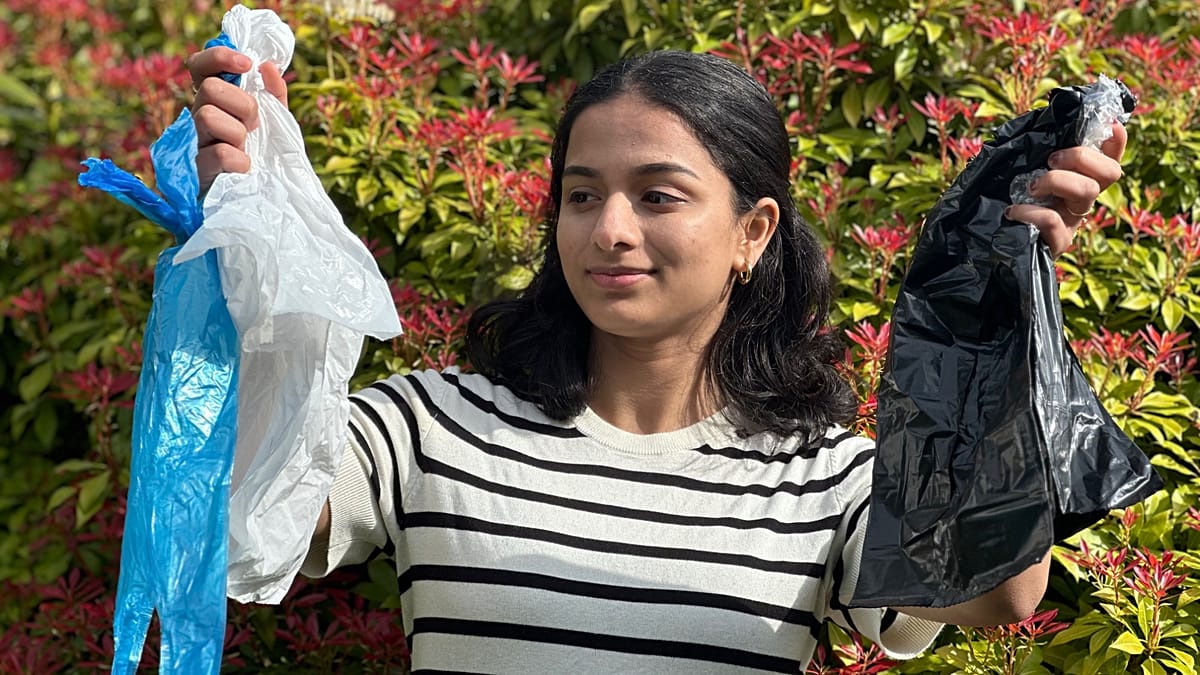
An 18-year-old student from Ireland has won the European edition of the 2026 Earth Prize for developing a biodegradable plastic that actively removes microplastics from the environment. Ayra Satheesh, who is still in secondary school, received the accolade on 11 May for her project Eco Purge, a plant-based material embedded with enzymes that degrade both the plastic itself and existing microplastic pollution.
The Earth Prize, billed as the world’s largest environmental competition for young people, awards mentorship and a total of $100,000 (€85,000) in funding. Satheesh’s European win comes with a $12,500 (€10,624) prize, which she plans to use to scale up her invention for real-world applications such as packaging and compost bags.
How Eco Purge Works
Satheesh’s innovation addresses a critical gap in current plastic pollution solutions. During an earlier project monitoring water quality, she discovered that while microplastics are easily detected, removing them remains a major challenge. “At that time, plastic and microplastics were a big common issue,” she said in an interview. “I just wanted to know what plastic was, and then I started my research on how microplastics and nanoplastics were formed, how they get into our body and the impacts they can have in our daily lives. Then I looked for solutions.”
Eco Purge is a biodegradable plastic made from plant-based materials. Inside it, Satheesh embedded special enzymes that remain stable until the plastic begins to degrade. As the material breaks down in environments like soil, fresh water, or salt water, the enzymes are released gradually and continue to break down other microplastics present in the surroundings. This three-phase biodegradation process is designed to work without leaving harmful residues.
The method involves genetically modifying a bacterium—E. coli—to produce the enzyme. Although the initial costs are high, Satheesh expects the process to become more cost-effective as production scales. She will use half of her prize money to test this theory by observing the growth and effectiveness of the modified bacteria. If successful, the remaining funds will go toward scaling up production; if not, she will return to the lab to refine the approach.
Satheesh has already collaborated with researchers at University College Dublin (UCD), Atlantic Technological University (ATU) Letterkenny, and the BiOrbic Bioeconomy Research Centre, all while completing her secondary education. She hopes to pursue a PhD in enzymatic engineering or biotechnology within the next decade.
Europe’s Plastic Problem
Satheesh’s work comes as Europe grapples with a plastic epidemic. Of the 240 million tonnes of plastic produced annually worldwide, only about 9% is recycled, according to industry data. The rest ends up in landfills, incinerators, or the natural environment, where it fragments into microplastics that have been found in drinking water, breast milk, and even human blood.
“It’s a dream come true,” Satheesh said. “I still can’t believe I’m the winner.” She urged multinational companies in the EU to stop using conventional plastic, acknowledging that such a shift would be “really hard” to achieve. She argues that recycling alone cannot solve the crisis, especially as fossil fuel giants continue to profit from plastic production, using petrochemicals in thousands of everyday items to sustain demand for oil and gas amid the rise of renewables.
Satheesh advocates for reusing materials and opting for biodegradable plastics wherever possible. Her invention, if successfully scaled, could offer a practical alternative for packaging and compost bags—two major sources of plastic waste.
For context, other European researchers are also exploring innovative solutions to microplastic pollution. A recent study found that moringa seed extract removes 98% of microplastics from water, highlighting the continent’s growing focus on this environmental emergency.