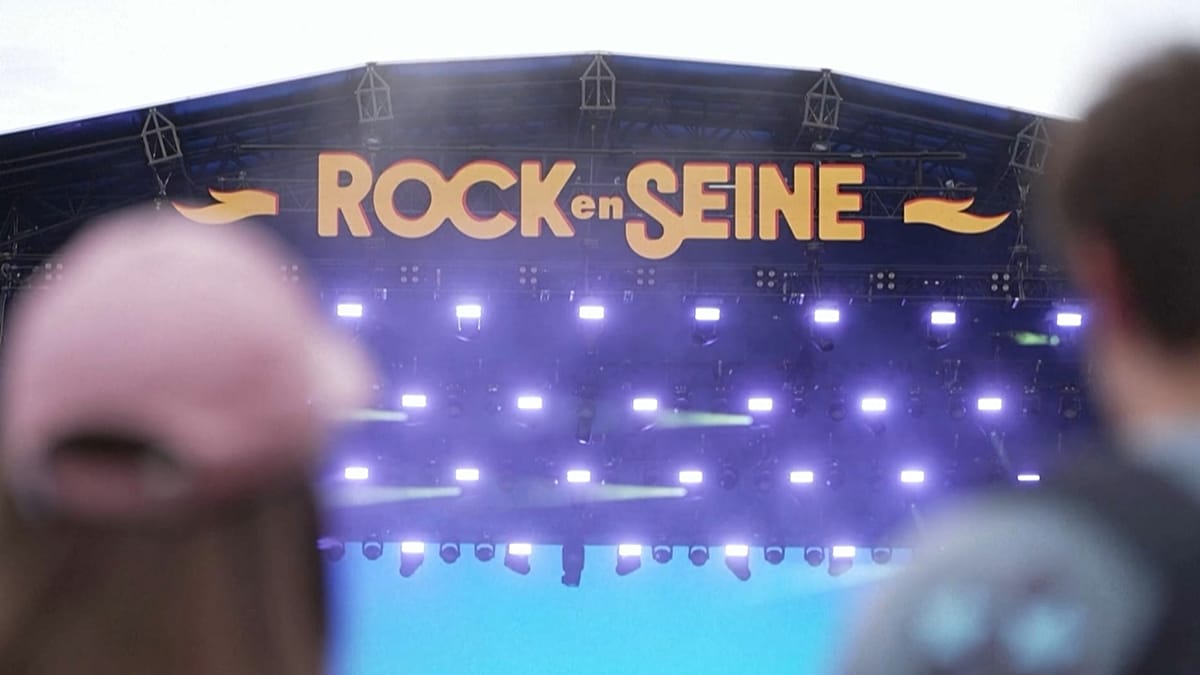
At Rock en Seine, the festival held on the Domaine national de Saint-Cloud just west of Paris, a concert is more than a soundtrack. The shifting lights, a singer's stride across the stage, a guitarist's grin, the surge of the crowd—these visual cues shape the atmosphere as much as the chords. For blind and partially sighted spectators, however, that layer of the experience has long remained out of reach.
This year, the festival is changing that. For the first time in its history, Rock en Seine is offering live audio description for select concerts on its Grande Scène. Five shows—Miki, Djo, Nick Cave & The Bad Seeds, Amyl & The Sniffers, and The Cure—are equipped with the system, developed in partnership with the Valentin Haüy Association, a French organisation supporting the visually impaired.
On a dedicated platform, festivalgoers wearing headphones hear the voice of an audio describer narrating the performance in real time. But this is not a running commentary. The art lies in knowing when to speak and when to stay silent, so that the music and the lyrics remain the centrepiece.
“I am the eyes of spectators who cannot see”
Raphaëlle Valenti, a voice actor, writer, and trainer in audio description, is one of the describers at the festival. She founded ZeugmaConcepts, a company dedicated to making cultural content accessible, and has spent years developing the practice. “I am the eyes of spectators who cannot see,” she explains. Her role demands intense concentration: she watches the stage, interprets the action, and finds the right words at the right moment—without intruding on the emotional peaks of a performance. “I mustn't force myself on the audience, I mustn't speak over a moment of emotion from the singer,” she says. Instead, she seizes the gaps to convey essential visual information: an artist's movement, their position, a gesture, a change in lighting. “I am going to say all that to convey the emotion.”
The result is a form of live narration that remains discreet, allowing the music to occupy its full space. For Saliha, a partially sighted spectator, the experience was revelatory. “She has a pleasant voice to start with... she was my eyes, I knew absolutely everything that was going on, it was brilliant.” Yet the exercise also demands a delicate balance. “On the one hand there is active listening to the description that is being given and on the other hand, if I want to listen to the lyrics, it's complicated,” she admits. Still, the “gymnastics” did not dampen her joy at returning to the festival circuit. “It's been so many years since I've been to a festival that now I fully intend to have a blast,” she smiles. “Because it's a system that is just... wow!”
Audio description is not meant to replace the music but to complement it—conveying the visual language that makes a concert a live performance. As the artists continue to sing and the lights dance, a voice in the headphones paints the pictures for those who cannot see them. The emotion, however, is universal: being there at last, part of the crowd, sharing the moment.
This initiative is part of a broader push across Europe to make cultural events more inclusive. In France, the growing focus on accessibility extends beyond festivals to everyday life, while elsewhere on the continent, similar efforts are underway in theatres and museums. Rock en Seine's move sets a precedent for other major festivals to follow.