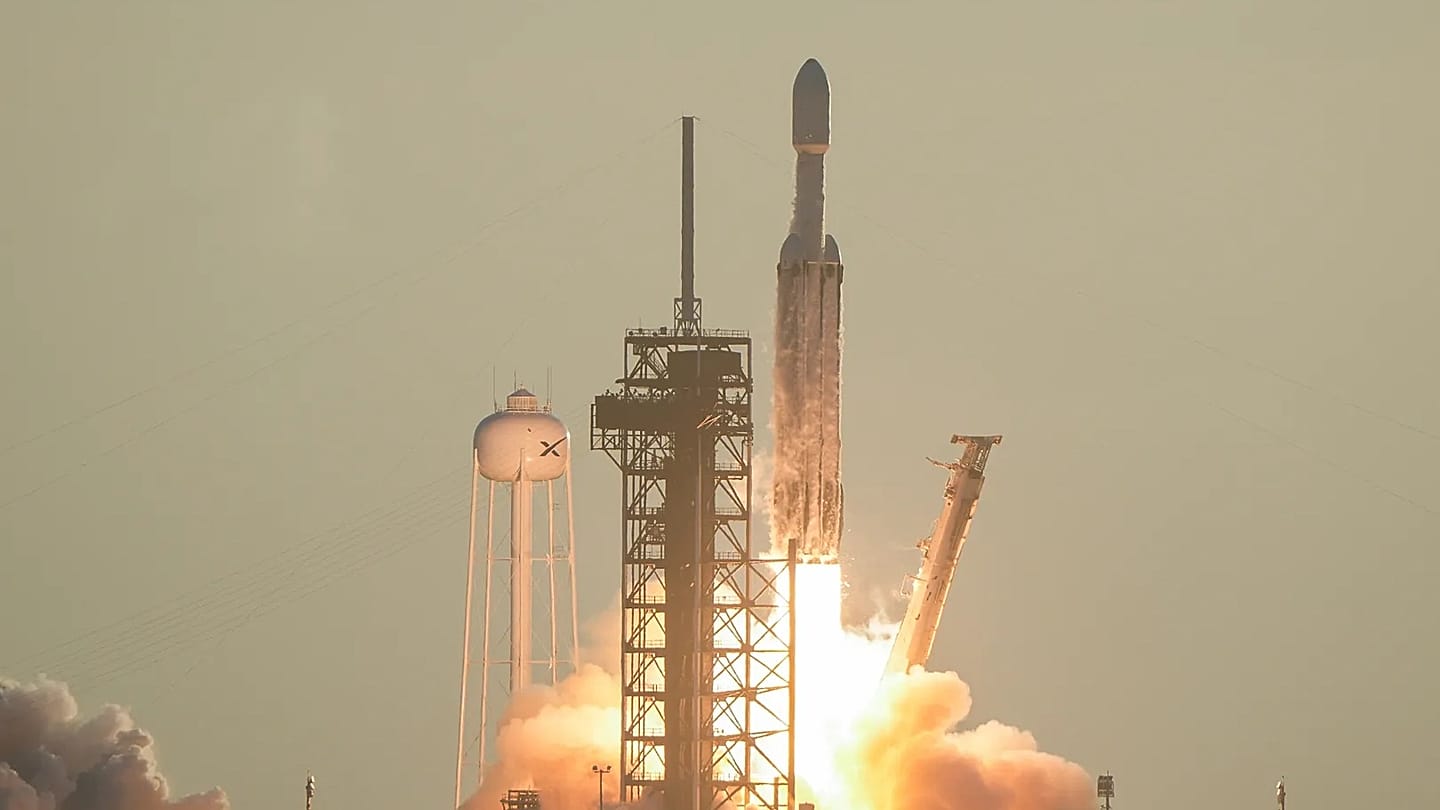
The Nancy Grace Roman Space Telescope, named after NASA's first chief astronomer, launched successfully from Cape Canaveral, Florida, on Sunday. The mission, which has been in development for over a decade, is set to create the largest map of the universe ever attempted, surveying billions of galaxies across vast stretches of cosmic time.
Roman's primary instrument, the Wide Field Instrument, has a field of view 100 times larger than that of the Hubble Space Telescope, allowing it to capture enormous swaths of the sky in a single observation. Over its planned five-year mission, the telescope will image more than a billion galaxies, measure the distribution of dark matter, and trace the expansion history of the universe.
A new test for cosmology
One of the mission's central goals is to test the standard model of cosmology, which describes a universe dominated by dark energy and dark matter. Recent measurements from other observatories, including the European Space Agency's Planck satellite, have hinted at discrepancies in the rate of cosmic expansion, known as the Hubble tension. Roman's data will provide an independent check, potentially reshaping our understanding of fundamental physics.
Astronomers across Europe are closely involved in the mission. The UK's Science and Technology Facilities Council has contributed to the mission's ground systems, while researchers at institutions in France, Germany, and Italy are part of the science teams that will analyze Roman's data. The telescope's wide-field surveys will complement the European Space Agency's Euclid mission, which launched in 2023 and is also mapping dark matter and dark energy.
"Roman and Euclid are two sides of the same coin," said Dr. Elena Rossi, an astrophysicist at the Max Planck Institute for Extraterrestrial Physics in Garching, Germany. "While Euclid focuses on a smaller area with higher sensitivity, Roman will cover a much larger region, providing a broader statistical sample. Together, they will give us the most precise picture yet of how the universe evolved."
The telescope also carries a coronagraph instrument designed to block starlight and directly image exoplanets. This technology demonstration could pave the way for future missions aimed at studying the atmospheres of rocky worlds in habitable zones.
Roman's launch comes at a time of renewed European interest in space. The recent successful Ariane 6 launch that completed Europe's new weather satellite trio, and the ESA's €158.9m award to PLD Space to boost MIURA 5 launches, signal a growing capability in independent access to space. While Roman is a NASA mission, its scientific returns will be shared globally, and European researchers are already preparing to mine its data.
The mission is named after Nancy Grace Roman, who was instrumental in the development of the Hubble Space Telescope and is often called the "mother of Hubble." Her vision for a wide-field survey telescope has finally been realized, and the scientific community is eager to see what the universe reveals.
As the telescope begins its commissioning phase, engineers will spend the next few months calibrating its instruments. First light is expected later this year, with initial science results to follow. For cosmologists, the wait is almost over.