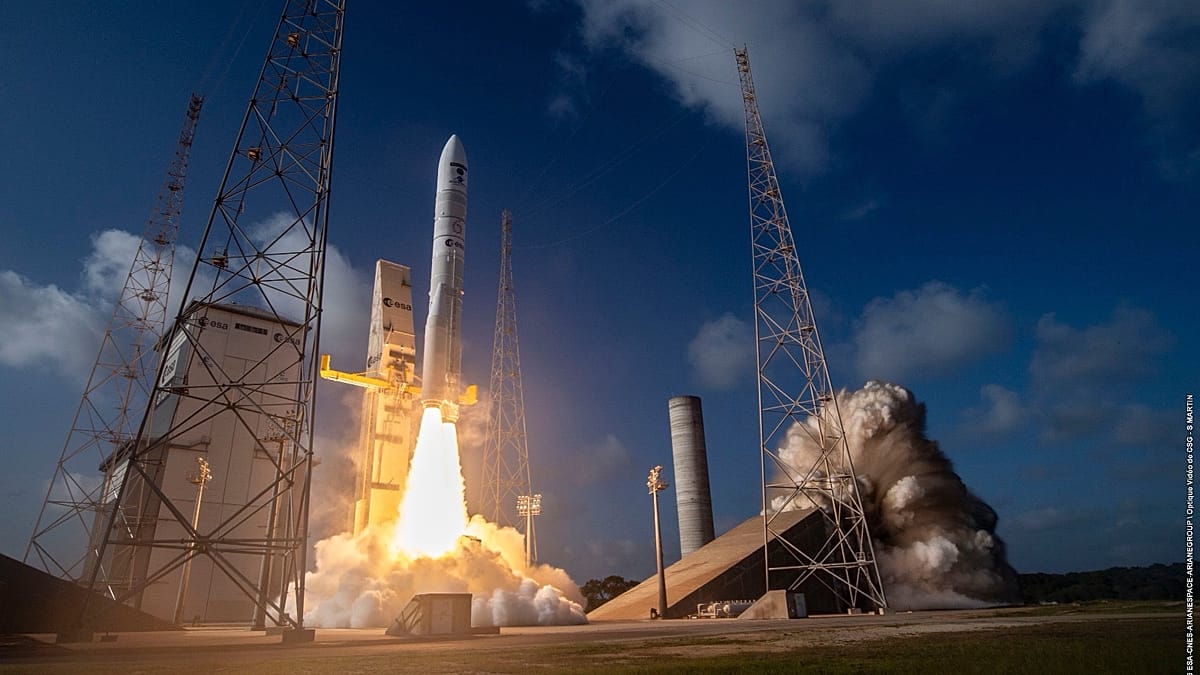
The European Space Agency (ESA) has marked a major step in Earth observation with the successful launch of the MTG-I2 satellite aboard an Ariane 6 rocket from the European Spaceport in Kourou, French Guiana. The mission, which lifted off on 27 July, completes the first trio of Meteosat Third Generation (MTG) satellites, a fleet designed to give meteorologists a far more detailed and rapid view of weather systems over Europe and Africa.
MTG-I2 is the second imaging satellite in the MTG series, joining the first imager launched in 2022 and the sounder that went up in 2025. Once commissioning is finished, the constellation will operate at full capacity, providing a continuous stream of data that is expected to transform short-term forecasting and the monitoring of extreme events.
A faster eye on the sky
Positioned in geostationary orbit about 36,000 kilometres above the equator, MTG-I2 will remain fixed over the same spot, acting as a sentinel for the continent. Its main instrument, the Flexible Combined Imager, is designed to scan Europe every 2.5 minutes at high resolution. That refresh rate is a significant upgrade from previous generations and marks a shift in how forecasters can track rapidly developing weather.
For nowcasting—the art of predicting weather over the next few hours—this speed is crucial. It allows meteorologists to follow atmospheric fronts in real time, spot the early signs of severe storms or DANA events (the Spanish acronym for isolated high-level depressions that often bring torrential rain), and monitor wildfires and air pollution plumes, particularly across the Mediterranean and North Africa.
The satellite also carries a Lightning Imager, a sensor that can detect and map individual lightning flashes both day and night. By combining data from the imager and the sounder, scientists will be able to build what they call a “weather cube”—a three-dimensional picture of lightning, winds, cloud dynamics, and greenhouse gas concentrations. This integrated view is expected to improve not only daily forecasts but also long-term climate research.
A milestone for Ariane 6
The launch was the ninth flight of Ariane 6 and the first time the heavy-lift rocket has delivered a satellite to a Geostationary Transfer Orbit (GTO). To reach that higher orbit, the rocket flew in a configuration with two P120C solid-fuel boosters, a setup that extends its performance envelope.
After separation, ground teams confirmed contact with the spacecraft. The next phase involves deploying the solar panels and gradually firing the propulsion system to raise the orbit’s perigee and fine-tune the trajectory toward the final geostationary slot. Once the satellite is properly oriented, the Launch and Early Orbit Phase (LEOP) will end, and the scientific calibration can begin.
This success is a boost for Europe’s independent access to space, coming at a time when the continent is seeking to strengthen its launch capabilities. The ESA’s recent investment in PLD Space’s MIURA 5 is another sign of that ambition, as Europe looks to diversify its launch options.
European cooperation in orbit
The MTG programme is a collaborative effort led by ESA, with a European industrial consortium headed by Thales Alenia Space and supported by OHB System and Leonardo. Once the calibration phase is complete, responsibility for operating the satellites and distributing data to the international scientific community will pass to Eumetsat, the intergovernmental organisation based in Darmstadt, Germany.
This fleet ensures continuity with the Meteosat Second Generation series, which operated from 2002 to 2015. Looking ahead, a second family of MTG satellites is planned to be launched in stages from 2033, guaranteeing that Europe maintains its edge in geostationary weather observation for decades to come.
The timing is significant. As climate change makes extreme weather more frequent and intense, the ability to issue early warnings is becoming ever more critical. The MTG constellation, with its rapid scanning and lightning detection, is a direct response to that challenge, offering forecasters the tools they need to protect lives and property across the continent.