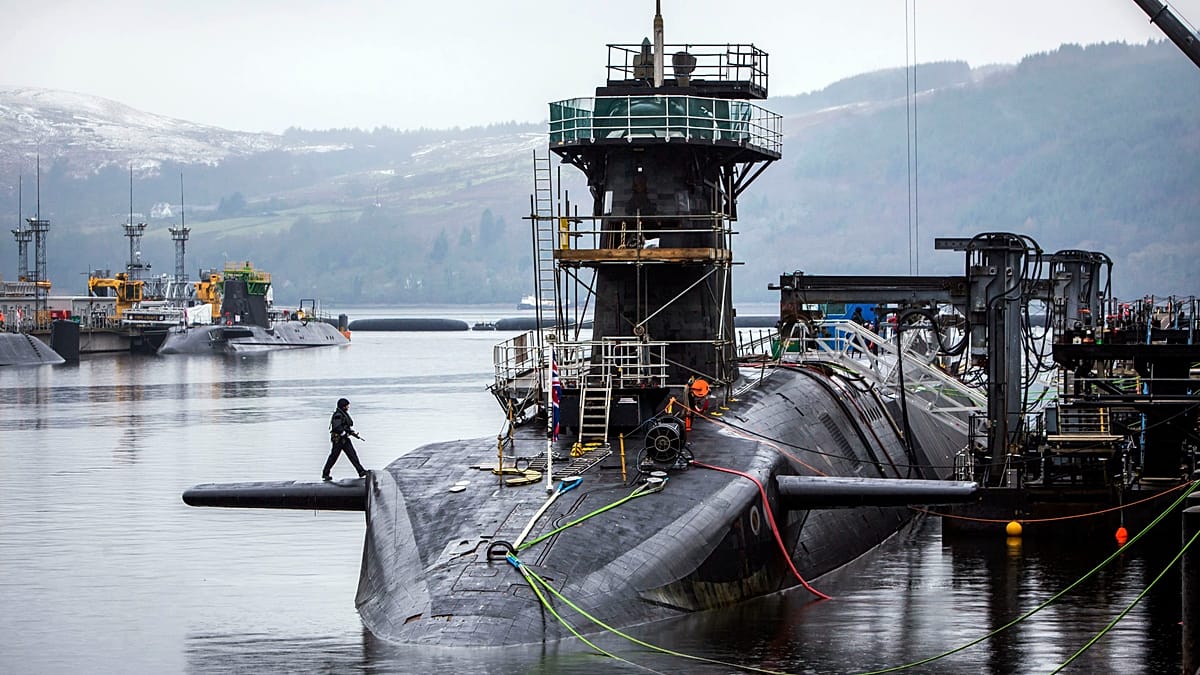
Britain's nuclear-armed submarines, the cornerstone of its strategic deterrent, may be poorly equipped to deal with the modern threat of drone attacks. According to a report in The Sun, sailors on Vanguard-class submarines have been trained to use high-pressure fire hoses to repel drones while the vessels are in port.
The Vanguard-class submarines, which cost around €6.5 billion each and carry Trident nuclear missiles, are reportedly defended against aerial threats primarily by water jets mounted on their decks. These jets are operated by crew members standing on the submarine's hull, aiming them at any drones that manage to breach land-based defences.
A Royal Navy spokesperson said that docked submarines benefit from multiple layers of protection, including “physical barriers, patrols, surveillance, monitoring, and counter-drone capabilities.” The fire hoses are intended as a last-resort measure against small and medium-sized FPV drones, while larger threats like Iranian Shahed or Russian Gerbera drones would be intercepted by Royal Air Force fighter jets.
“We always thought this would be for small spy drones or civilian dicking around — but the threats moved on a lot,” a Navy source told The Sun. The admission highlights a growing concern across European militaries about the proliferation of cheap, effective drones.
Faslane's vulnerability
The Faslane naval base, located on the Gare Loch in Scotland, is home to the UK's nuclear submarine fleet. Its position deep within a sea loch offers natural protection against submarine attacks, but the surrounding topography leaves it exposed to drone incursions. “There are lots of public roads, people can roam on the hills. If several drones were launched nearby, there is less time to react,” another Navy source said.
Charlie Williams, a defence analyst at the International Institute for Strategic Studies (IISS) in London, expressed surprise at the reliance on fire hoses. “It is very surprising they are relying on fire hoses to defend the submarines. We have to hope the Ministry of Defence is investing in the right kind of capability to defend it,” he told The Sun.
Williams noted that hostile states have shown a clear interest in European nuclear sites. Russia has flown hundreds of drones over nuclear installations across the continent, including France's Île Longue submarine base and Royal Air Force Lakenheath in Suffolk. The threat is not hypothetical, and the UK's approach may be outdated.
The issue is part of a broader European challenge. The EU has acknowledged that its counter-drone programmes are falling behind schedule, with only a third on track to meet 2030 goals. Meanwhile, drone attacks have become a staple of modern warfare, as seen in Ukraine and the Middle East.
Russia's use of drones has extended beyond the battlefield. A recent drone strike on a Yandex data centre in Ryazan underscores the reach of such attacks. European defence planners are increasingly concerned about the vulnerability of critical infrastructure.
At Faslane, the reliance on fire hoses is a stark reminder that even the most advanced military hardware can have surprising weaknesses. The base's location, while strategically advantageous, makes it difficult to defend against swarms of small drones launched from nearby public areas.
“Faslane is very clearly of interest to hostile states. We know it has been targeted before, and it would not be surprising if it was targeted again,” Williams said. The question is whether the Ministry of Defence will invest in more robust counter-drone systems before an incident occurs.
For now, the Royal Navy's last line of defence against a drone attack on its nuclear submarines is a stream of water. It may be effective against hobbyist drones, but as threats evolve, so too must the defences. The UK, like many European nations, is grappling with how to protect its most sensitive sites in an age of ubiquitous drones.