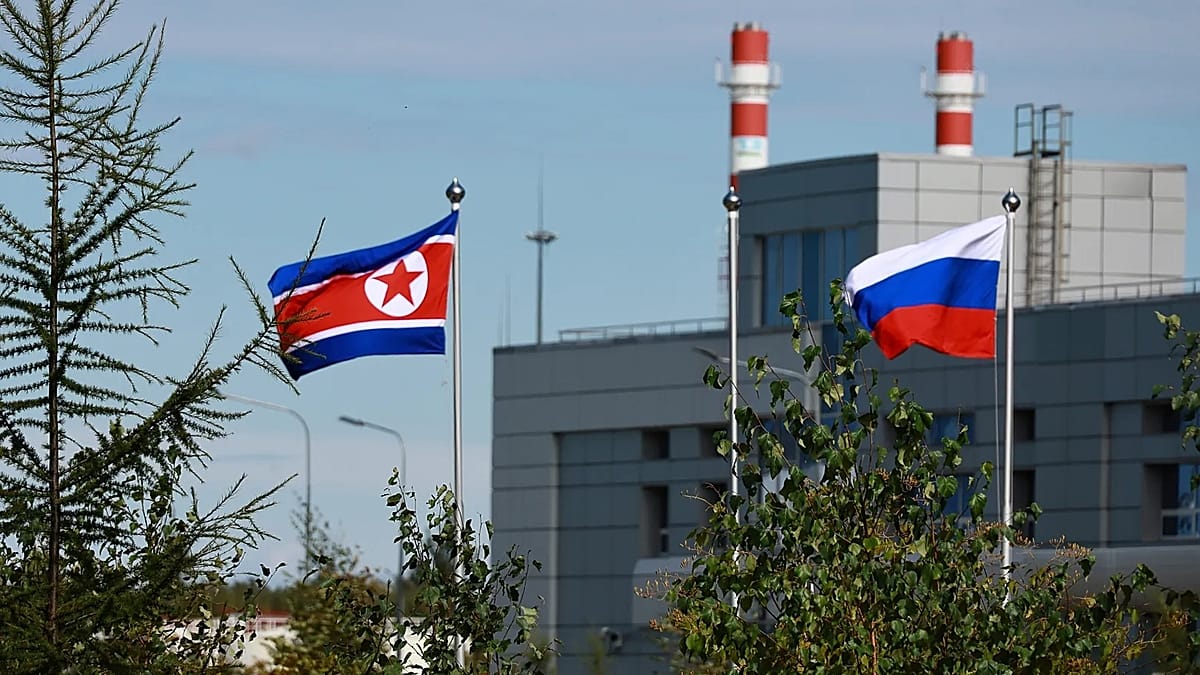
Russia announced on Tuesday that it had completed the connection of a road bridge linking its Far East with North Korea, with traffic expected to begin this summer. The bridge spans the Tumen River, which forms part of the border between the two countries.
Moscow’s foreign ministry described the project as a “truly landmark stage in Russian–Korean relations,” adding that its significance extends beyond engineering. The bridge is designed to handle up to 300 vehicles and 2,850 people per day, according to Russia’s transport ministry.
Deepening ties under sanctions
The announcement comes as relations between Russia and North Korea have intensified since Moscow launched its full-scale invasion of Ukraine in 2022. Both countries face extensive international sanctions: Russia for its war, and North Korea for its nuclear and missile programs. In 2024, the two signed a defence treaty requiring mutual military assistance if either is attacked. Pyongyang subsequently sent thousands of troops to Russia’s western Kursk region to help repel a Ukrainian counter-offensive.
South Korea warned last week that Chinese and Russian support was helping revive North Korea’s economy, which has long suffered under sweeping sanctions and near-total international isolation. North Korea does not publish official economic data, but Seoul estimates its nominal GDP at roughly $30 billion (€25 billion) in 2024—a fraction of South Korea’s economy.
Several senior Russian officials have visited Pyongyang recently, including Interior Minister Vladimir Kolokoltsev, who is currently in the country. Russia’s foreign ministry said the bridge would facilitate “trade, economic and humanitarian exchanges” between Russia’s Far East and North Korea.
The bridge’s opening also comes amid reports of severe food shortages in North Korea. A famine in the mid-1990s killed hundreds of thousands, and the COVID-19 pandemic pushed many more into extreme hunger. The new infrastructure may help alleviate some of these pressures, though it also raises concerns about further military cooperation.
For European observers, the bridge is a tangible symbol of the growing axis between Moscow and Pyongyang, which challenges the EU’s sanctions regimes and complicates efforts to isolate Russia. The European Union has imposed multiple rounds of sanctions on Russia and maintains its own restrictions on North Korea. The bridge could also affect regional security dynamics, particularly for South Korea and Japan, both key partners of the EU.
As the summer opening approaches, the project is likely to draw continued scrutiny from Brussels and Washington. The EU has been weighing further sanctions on Russia, including measures targeting its military supply chains, and may consider additional steps to counter the Russia-North Korea partnership.