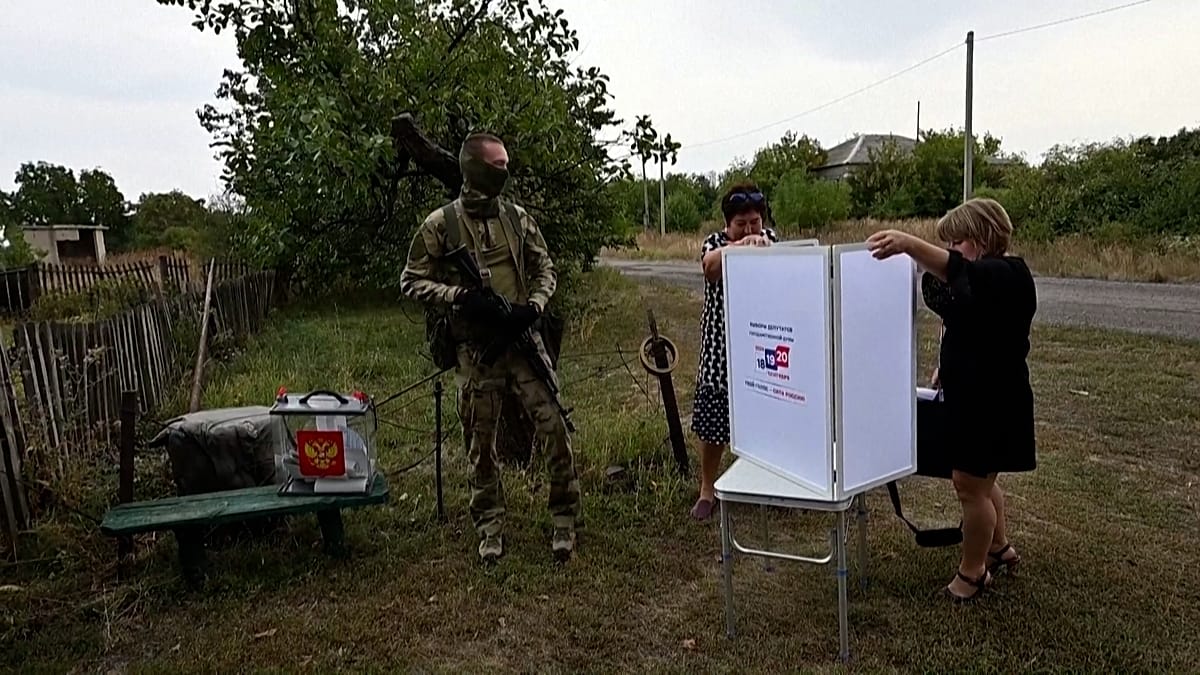
Russia has begun early voting in its parliamentary elections in the parts of Ukraine's Donetsk region it controls, a move that Kyiv and Western governments have condemned as an illegal attempt to legitimize its occupation. The voting, which started this week, is being conducted under the watch of armed personnel who accompany election officials and voters, according to reports from the ground.
The early voting is taking place ahead of the national election scheduled for September, in which Russians will elect members of the State Duma. In the occupied territories, Russian authorities have set up polling stations and are also going door-to-door in some areas, a practice that has been criticized as intimidating and coercive.
Ukrainian officials have dismissed the exercise as a sham. The foreign ministry in Kyiv called it "a cynical violation of international law" and said that any ballots cast in the occupied territories would have no legal validity. The European Union and the United States have also voiced opposition, with Brussels reiterating that it does not recognize Russia's annexation of Ukrainian territory.
The early voting comes amid heightened tensions in the region. In recent weeks, there have been reports of Russian strikes hitting Kyiv and Kharkiv, as well as drone attacks targeting a plant in Kursk. The conflict shows no signs of abating, and the election is being held against a backdrop of ongoing hostilities.
Armed escorts and restricted access
According to local sources, election officials in the Donetsk region are being escorted by armed guards, and voters are being transported to polling stations under military supervision. Independent observers have not been granted access, and international media have been largely barred from covering the process.
Residents in the occupied territories have reported that voting is not entirely voluntary. Some have said they were pressured to participate, while others feared reprisals if they stayed away. "They come to your door and tell you to vote. You don't have a choice," one resident told a European news outlet, speaking on condition of anonymity.
The Russian Central Election Commission has defended the process, saying it is ensuring that all citizens can exercise their right to vote, regardless of where they live. But critics point out that the occupied territories are not internationally recognized as part of Russia, and that the elections are a violation of Ukraine's sovereignty.
The vote is expected to cement the dominance of the ruling United Russia party and further entrench President Vladimir Putin's grip on power. As Russia's tightly controlled vote approaches, there are few doubts about the outcome, but the staging of the election in occupied Ukraine adds a new layer of provocation.
In a related development, Moscow has placed Nestlé and Auchan Russia units under state-appointed control, a move that signals the Kremlin's increasing willingness to intervene in the economy. This comes as Western sanctions continue to bite, and as some Russian citizens flee before the election ends, fearing a new mobilisation.
The early voting in Donetsk is part of a broader pattern of Russian attempts to integrate the occupied territories into its political and administrative system. Since the annexation of Crimea in 2014 and the full-scale invasion in 2022, Moscow has sought to impose its laws, currency, and institutions on the areas it controls.
European leaders have repeatedly called for a united response to Russian aggression. French President Emmanuel Macron has called for a G7 energy summit to counter Russian hybrid threats, and the EU has been working on a €90bn loan package for Ukraine, with Canada recently moving to join the initiative.
As the election proceeds, the international community will be watching closely. The staging of the vote in occupied Ukraine is not just a domestic matter for Russia; it is a direct challenge to the rules-based order that Europe and its allies have sought to uphold. The results, when they come, will be met with widespread condemnation, but the underlying issue—Russia's continued occupation of Ukrainian territory—remains unresolved.