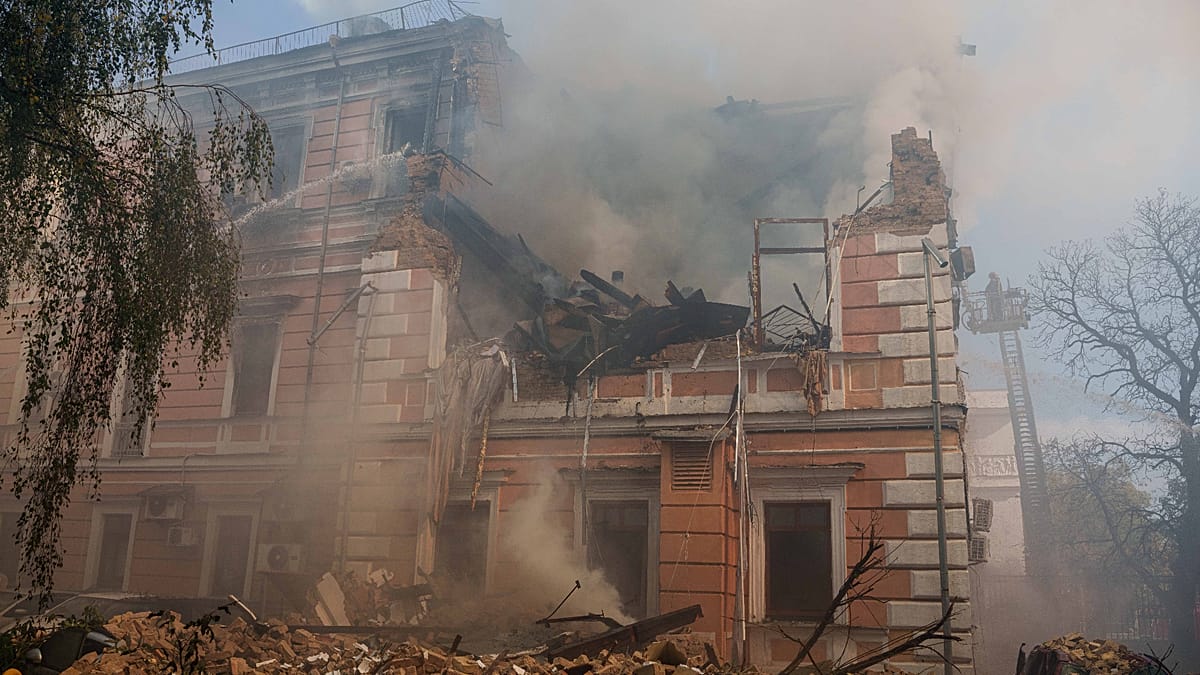
Russian forces struck the headquarters of Ukraine's National Academy of Sciences in Kyiv on Monday, part of a fresh wave of attacks that killed at least seven people and wounded dozens more across the country, according to Ukrainian officials.
Andrii Butenko, Ukraine's Minister of Education and Science, confirmed that a fire broke out at the academy's main building following the strike. “People remain inside, and rescue workers are conducting a rescue operation,” he wrote on social media. Ukraine's State Emergency Service (DSNS) reported at least one fatality and six injuries from the attack.
Video footage posted on X showed the building engulfed in flames and thick smoke, with debris scattered around as firefighters battled the blaze. The academy, a venerable institution founded in 1918, is a cornerstone of Ukrainian scientific research and education.
Butenko condemned the assault, saying, “By destroying educational and scientific infrastructure, Russia is attempting to intimidate children, parents, educators, and scientists, and to disrupt the educational process and the normal operations of our institutions.” The strike underscores Moscow's broader campaign against civilian infrastructure, a pattern that has drawn repeated international condemnation.
Wider attacks across Ukraine
Kyiv Mayor Vitali Klitschko reported that attacks on the capital on Monday left 19 people injured, including three children. In the wider Kyiv Oblast, overnight strikes killed three people, among them an Azerbaijani national, and wounded eight others, local authorities said.
In Dnipro, eastern Ukraine, a drone attack killed three people and wounded 12. The DSNS said the strike ignited a fire in an administrative building, and rescuers evacuated people trapped on upper floors. The city, a frequent target, has seen repeated attacks since Russia's full-scale invasion began in February 2022.
These attacks come amid ongoing discussions among EU defence ministers about closing Ukraine's funding shortfall, a critical issue as the war enters its third year. The strikes also echo previous assaults on civilian areas, such as the Kharkiv apartment block attack that injured 25 people, including nine children.
Ukraine strikes back at Russian targets
Earlier on Monday, Ukrainian President Volodymyr Zelenskyy announced that Ukrainian forces had targeted two “defence plants” in Russia's Tula and Voronezh regions overnight. Units from Ukraine's Security Service also carried out strikes on Russian oil facilities in the Krasnodar region over the past day, he said.
“Sanctions were also launched against facilities that the Russians use for drone terror against Ukraine in the Kaluga and Oryol regions,” Zelenskyy wrote on social media. “In the Bryansk region, our forces worked directly against the occupying contingent. A target was also hit in the Black Sea.”
These Ukrainian counterstrikes aim to degrade Russia's military-industrial capacity, a strategy that has gained momentum in recent months. The attacks on Russian soil, while not officially acknowledged by Moscow, have become a regular feature of the conflict.
The European Union has been grappling with how to sustain support for Ukraine, with ministers seeking a joint response to Russian hybrid sabotage and other threats. Meanwhile, the human toll continues to mount, with Monday's attacks adding to a grim tally that has seen thousands of civilians killed since the invasion began.
As rescue operations continue in Kyiv and Dnipro, the international community faces renewed pressure to bolster Ukraine's air defences and hold Russia accountable for its strikes on civilian infrastructure. The attack on the National Academy of Sciences, a symbol of Ukrainian intellectual life, is a stark reminder of the war's far-reaching impact on the country's future.