Ukraine's publishing industry is reeling from a wave of targeted Russian attacks that have destroyed millions of books and inflicted hundreds of millions of euros in damage. The strikes, part of a broader assault on Ukrainian culture, have raised fears that the country's literary future is at risk.
According to Ukraine's Ministry of Culture, more than 13 million books—roughly a third of the country's annual print output—were destroyed in just two months this summer, causing at least €34.2 million in damage. The attacks have hit at least 40 publishing houses and numerous bookstores, crippling an industry already struggling to meet surging demand for Ukrainian-language titles since Russia's full-scale invasion in 2022.
“This is a deliberate policy of Russia because they understand that culture is what makes us feel resilient, what makes us feel the owners of our land, of our destiny,” said Tetiana Berezhna, Ukraine's culture minister, in an interview with European Pulse.
Waging war on Ukraine's book industry
One of the most devastating strikes came in Kharkiv, where a Russian missile destroyed the Ranok publishing house's automated warehouse, which had opened in 2013 and could process tens of thousands of books daily. The attack obliterated 8 million books, including 620,000 textbooks that Ranok supplies to nearly all of Ukraine's schools.
“This is a huge blow to the industry and if we don't move quickly to put strategic support measures in place … the industry could collapse entirely,” said Viktor Kruglov, Ranok's head. He described the book industry as an “element of Ukraine's national security.”
Kruglov noted that while Ranok had weathered the 2008 financial crisis and the COVID-19 pandemic, “no one could have imagined that almost a year's turnover for Ranok could be destroyed at once.” The company has backup warehouses and stores its files in the cloud, allowing it to reprint books and retain its team, but the financial toll is immense.
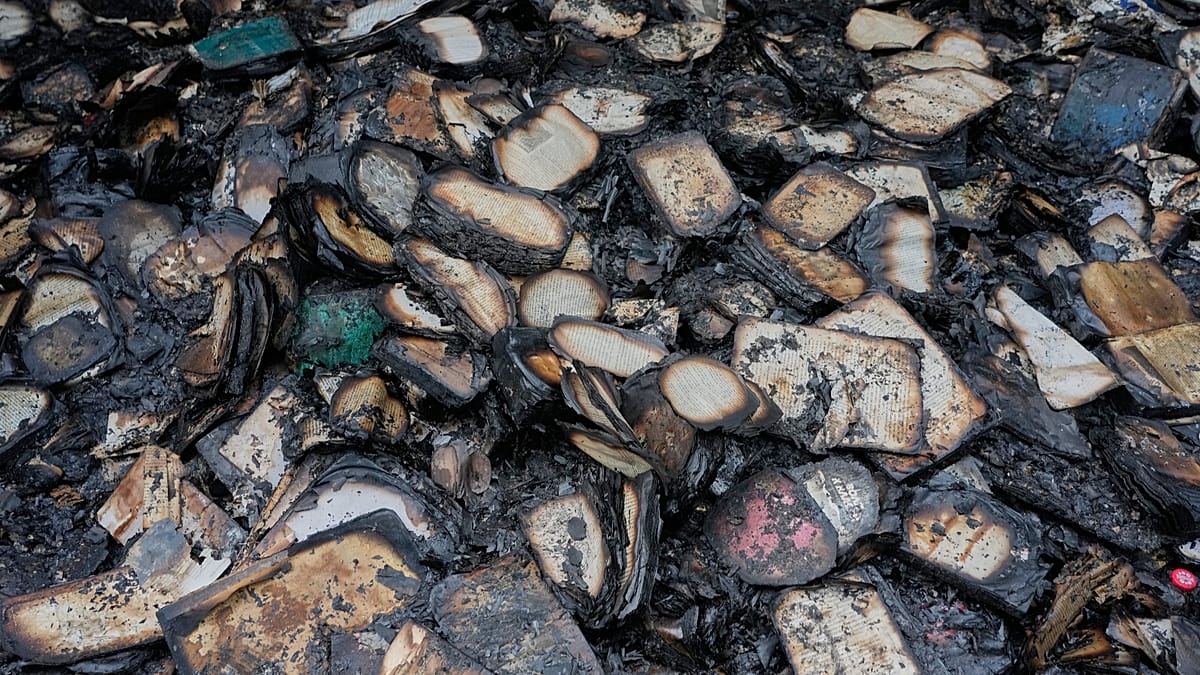
In Kyiv, a missile strike on the country's largest book market in August left charred volumes scattered across the ground, a stark symbol of the cultural devastation. The Konvi print shop, which specialized in fiction, educational material, and scientific literature, was hit in July, destroying millions of books and leaving the facility in ruins.
Viktoriia Haidai, Konvi's commercial director, said replacing the printing press will cost €1.2 million and take four to five years to fully restore capacity. “The Russians are striking shops like hers because we are critical infrastructure, because we shape the future, we work on education, on culture. We work to preserve history. Without this, no nation has a future,” she said.
Future of Ukrainian literature at risk
The attacks have had a chilling effect on the industry's willingness to invest in new authors. Debut writers are costly to publish compared with the safer bet of bestsellers and established translated literature. Culture Minister Berezhna warned that this could stifle the next generation of Ukrainian voices.
“These newcomers, debut literature, in 100 years will become Ukrainian classics that will tell the world about Ukraine,” she said, expressing fear that young authors will receive less support.
The ministry is preparing a financial support package that includes state purchases of Ukrainian books for school libraries, grants for small publishers to cover printing costs, rent compensation for bookstores, and a war-risk insurance program for print runs. But many in the industry say these measures are insufficient.
Haidai noted that textbook printing, which once took three to four months, will now stretch to six to seven months, threatening deadlines for the coming academic years. “It's not just the large printing houses that are suffering,” she said. “Many small printers, who don't make themselves known publicly, have also been destroyed.”
The destruction is part of a broader pattern of cultural erasure. Nearly 5,000 cathedrals, churches, museums, theatres, and other cultural sites have been damaged or destroyed, and 35,000 art objects looted. Berezhna pointed to historical precedents, including 19th-century Russian Empire decrees that banned or severely restricted Ukrainian-language publishing and public speaking.
“But still, the Ukrainian language exists. Ukrainian literature exists. We have the books in our libraries, which were kept in secret from the very old ages and they still exist,” she said. “It shows us the hope that Ukraine will stay strong.”
As the war grinds on, the resilience of Ukraine's literary community remains a testament to the enduring power of culture. The international community has a role to play in supporting this vital sector, which is not just about books but about the very identity of a nation.