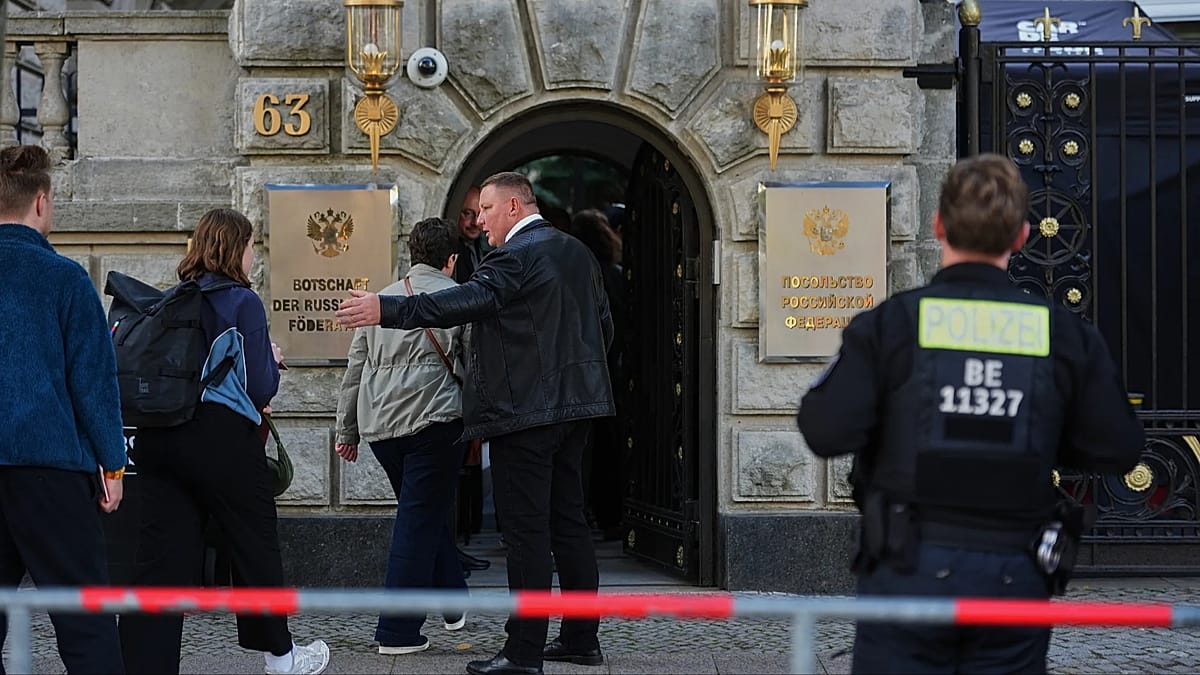
Russians voting at embassies and consulates across Europe and beyond delivered a resounding rebuke to the Kremlin in this weekend's State Duma elections, according to two independent exit polls. The surveys, conducted by the Vote Abroad project and the opposition movement Vesna, found that expatriate voters backed the liberal New People party over Vladimir Putin's United Russia by a margin of roughly eight to one — the exact opposite of the official results inside Russia, where United Russia claimed nearly 58% of the vote.
The Vote Abroad project, which polled almost 15,700 voters at 27 polling stations in 22 countries, put New People at 43%, the Communist Party at 18.3%, and United Russia at just 5.5%. In ten countries, including Germany, Finland, and Armenia, United Russia failed to clear the 5% threshold required to win seats in the Duma. A separate exit poll by Vesna and the Progress project, covering 18 stations in 17 countries, placed New People first at every location with 47.3%, the Communist Party second at 19.2%, and United Russia at a mere 2.8%.
The contrast with the Central Election Commission's official figures — which gave United Russia nearly 58%, the Communist Party 14%, the LDPR almost 9%, and New People below 8% — could hardly be starker. Ivan Zhdanov, director of the Progress project and a former head of Alexei Navalny's Anti-Corruption Foundation, told Euronews: "The contrast is indeed very stark. 83.5% of those who answered our question on trust do not fully or mostly trust the official results." He acknowledged that "in purely arithmetic terms, votes cast abroad are hardly going to determine the composition of the Duma," but stressed their importance: "They show a completely different reality and destroy the image of supposed support for the authorities."
Why expatriates turned to New People
Many Russians who left the country after the 2022 invasion of Ukraine oppose the war, and the only anti-war party, Yabloko, was barred from the election on a procedural pretext and excluded from the federal ballot entirely. With no Yabloko option, opposition-minded voters abroad predominantly chose New People, according to exit poll workers. Irina Kh, part of the active core of Vote Abroad, explained: "The aim of our civic initiative is to provide a truthful picture of the electoral process abroad. We use no party symbols and have no affiliation with political organisations — we carry out our surveys impartially and independently."
The Vote Abroad project, launched in 2021, has conducted exit polls at Russian elections since, including the 2024 presidential vote. Volunteers use anonymous written questionnaires of five questions, drawn up and analysed by professional sociologists, including at a German university. The project is self-funded.
Voting abroad was largely calm, in contrast to reports from inside Russia of ballot stuffing and obstruction of observers. Russia's ambassador to Switzerland branded exit poll participants "anti-Russian agitators" and "representatives of foreign organisations designated as undesirable in Russia." In Geneva, local authorities required volunteers to stand at least 150 metres from the consulate entrance after bowing to the consulate's wishes. In Bern, a Russian embassy guard approached one volunteer, pointed at the passport of the person being interviewed, and jabbed a finger at her computer screen — apparently intended as a warning about consequences.
At some embassies, volunteers were recognised from previous elections and admitted without difficulty; at others they had to make themselves known. "In most diplomatic missions, the Russian authorities try not to attract attention and to ensure everything runs smoothly, since they are in another country," Irina Kh said. "For the Kremlin, the image matters, the facade." Volunteer Milena, who worked in Geneva, said the exit poll "precisely disrupts this idyllic picture," pointing to the ambassador's reaction as evidence of how much the Kremlin wanted to control appearances.
Supporters of United Russia who turned up at polling stations were often smartly dressed — "in the best Soviet traditions," one volunteer observed. Most were either young tourists abroad by chance or people over 45 who had left Russia long ago. Some were hostile to the volunteers, demanding to know whether they held Russian passports and telling them to "get a proper job." Others who had voted for United Russia saw the exit poll as an opportunity to confirm the CEC's figures.
In a number of European cities, voters arrived carrying apples, which they handed to other voters and left at polling stations — a symbol of protest against the authorities. Most told exit poll workers that opposition to the war was their main criterion and that they had voted New People because Yabloko had been removed from the federal ballot. "Many spoke warmly with us, said they follow the Vote Abroad community and welcome the exit polls, as they do not trust elections in Russia," Irina Kh said. Some, having voted and answered the questionnaire, returned with friends or family members.
In Helsinki, a grandmother arrived wearing a T-shirt bearing Putin's portrait and spoke to all the volunteers. "I'll collect my pension in Finland and then go to Russia to live out my years," she told them.
The expatriate vote, while numerically small, offers a glimpse of a different Russia — one that the Kremlin's carefully managed electoral machine cannot easily erase. As the final ballots were cast amid the largest drone attack on Moscow, the gap between the diaspora's choices and the official tally underscores the fragility of the regime's claim to popular support. For many Russians abroad, the vote was not just about electing a parliament; it was a statement against the war and the system that wages it.