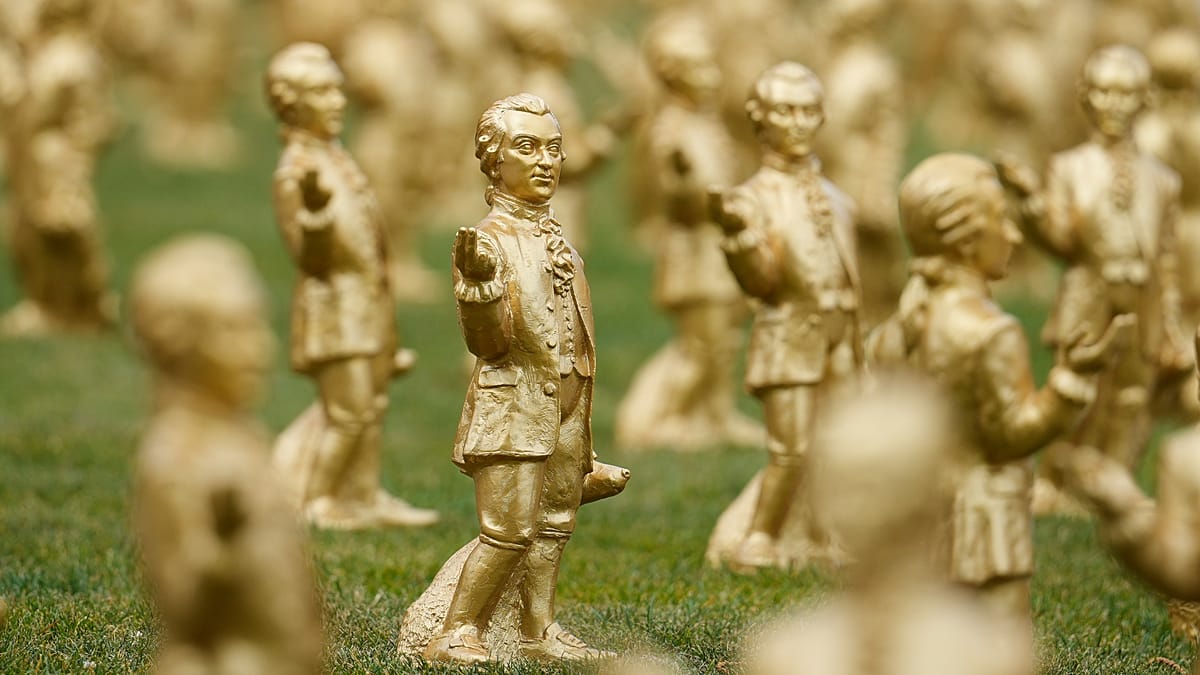
To commemorate the 270th anniversary of Wolfgang Amadeus Mozart's birth, the Austrian city of Salzburg has unveiled a striking open-air exhibition: 300 gold-coloured statuettes of the composer, each accompanied by a small dog. The installation, a collaboration between German conceptual artist Ottmar Hörl and the Mozarteum Foundation, transforms public spaces in Mozart's hometown into a shimmering tribute to one of Europe's most enduring musical figures.
The statuettes, each about 80 centimetres tall, depict Mozart in his characteristic powdered wig and period attire, now rendered in a uniform golden hue. Hörl, known for his large-scale public art projects—including a 2007 installation of 500 pink plastic garden gnomes in Kassel—has previously created similar Mozart-themed works. In 2006, for the 250th anniversary of the composer's birth, he placed 1,000 blue Mozart figurines across Salzburg. This year's edition adds the dog, a nod to Mozart's known fondness for pets, though historical records remain ambiguous about the specific breed.
The exhibition is free and accessible, scattered across key locations in Salzburg's historic centre, including the Residenzplatz and the banks of the Salzach River. Visitors can encounter the golden Mozarts while exploring the city that shaped his early years. Salzburg, which consistently ranks among Europe's top cultural destinations—alongside Florence and Prague in Travel + Leisure's European city rankings—leverages its Mozart heritage to attract millions of tourists annually.
Art as Public Dialogue
Hörl's work often blurs the line between homage and kitsch, inviting viewers to question how societies memorialise cultural icons. The gold colour, he explains, symbolises both the value and the commodification of Mozart's legacy. "The golden surface reflects the way we turn artists into brands," Hörl said in a statement. "Mozart is not just a composer; he is a global industry." The Mozarteum Foundation, which manages Mozart's legacy and archives, supported the project as a way to engage younger audiences. "We want people to encounter Mozart in unexpected ways," said foundation director Dr. Johanna Senft. "Art can make history feel immediate."
The exhibition runs through October 2025, coinciding with the Salzburg Festival, the city's annual summer celebration of music and drama. The festival, founded in 1920, remains a cornerstone of European classical music, drawing performers and audiences from across the continent and beyond.
Mozart's Enduring European Legacy
Mozart, born in Salzburg in 1756, spent much of his adult life in Vienna, where he composed many of his most famous works, including The Marriage of Figaro and Don Giovanni. His influence permeates European culture, from concert halls in Berlin to opera houses in Milan. The 270th anniversary comes at a time when European cultural institutions are grappling with funding pressures and shifting audience demographics. Yet the appetite for Mozart remains robust: the Salzburg Festival reported record ticket sales in 2024, and streaming platforms report steady interest in his catalogues.
For Salzburg, the golden statuettes are both a tourist draw and a conversation starter. "Mozart belongs to the world, but he is ours first," said Salzburg's mayor, Bernhard Auinger, at the unveiling. "This exhibition reminds us that his music is alive, not just in concert halls but in the streets where he walked."
The installation also reflects a broader trend in European public art: using accessible, often playful interventions to make history tangible. Similar projects have appeared in other cities—such as the cow parades in Zurich and the painted pianos in London—but Hörl's Mozart series remains uniquely tied to Salzburg's identity. As the golden figures catch the Alpine light, they offer a moment of reflection on how Europe honours its past while navigating the present.