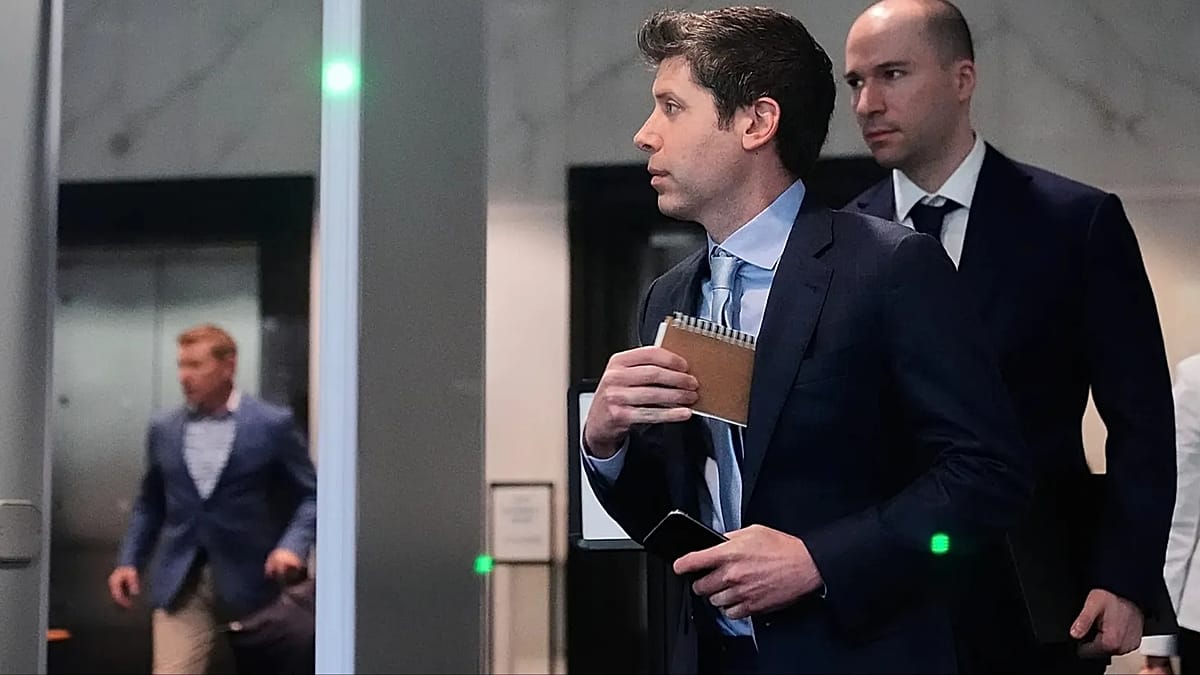
OpenAI CEO Sam Altman took the witness stand on Tuesday in a trial that pits him against Elon Musk, defending his leadership and rebutting claims that he misled the Tesla founder. The trial, now in its third week, could determine the future structure of the ChatGPT maker, which has raised billions in investment.
Musk's lawsuit alleges that Altman persuaded him to donate $38 million to OpenAI when it was a nonprofit, only for the company to later shift to a for-profit model in 2018. Musk argues his funding was intended for a charity. Under questioning by Musk's lawyer, Altman denied being dishonest. “I believe I am an honest and trustworthy businessperson,” he said.
The Altman-Musk Relationship
Altman testified that he had concerns about Musk's attempts to control OpenAI in its early years, as both men vied for the CEO role in 2015. The company was then trying to build artificial general intelligence (AGI) — a system smarter than humans. “Part of the reason we started OpenAI is we didn’t think AGI could be under the control of any one person, no matter how good their intents are,” Altman said.
He recalled a “particularly hair-raising moment when my co-founders asked Mr. Musk about, well, ‘If you have control, what happens when you die?’” According to Altman, Musk replied that control of OpenAI “should pass to my children,” a prospect Altman said he was uncomfortable with.
When OpenAI was founded in 2015, Altman and co-founder Greg Brockman initially aimed to raise $100 million (€85.4 million). Musk encouraged them to target $1 billion (€854 million) in funding commitments, offering to cover whatever others did not provide, according to a 2024 OpenAI blog post. However, to achieve AGI, the company realized it needed “billions of dollars per year,” more than a nonprofit could raise.
With Musk, they decided to create a for-profit entity, but Musk wanted majority equity, board control, and to be CEO, the blog post alleges. While negotiations dragged on, Musk reportedly withheld dedicated funding. Musk also often tried to have Tesla absorb OpenAI, a move that would have conflicted with the company's mission. OpenAI said in 2024 that Musk walked away to build a competitor to Google's DeepMind.
Near the end of his testimony, Altman said he had thought highly of Musk during his early involvement, before things soured. “I felt like he had abandoned us, not come through on his promises, put the company in a very difficult place, jeopardised the mission, didn’t really care about the things I thought he cared about,” Altman said.
The trial's outcome could have broader implications for AI governance, especially as Europe grapples with its own AI regulation. The EU's AI Act, for instance, aims to set rules for high-risk systems, and the case highlights tensions between nonprofit ideals and commercial pressures. For more on Europe's AI challenges, see Europe's AI Dilemma: Can the EU Keep Its Industrial Giants at Home?.
A jury that has heard about Altman's character from former allies and adversaries will decide the verdict. The repercussions could extend beyond the courtroom, influencing how AI companies balance mission and profit.