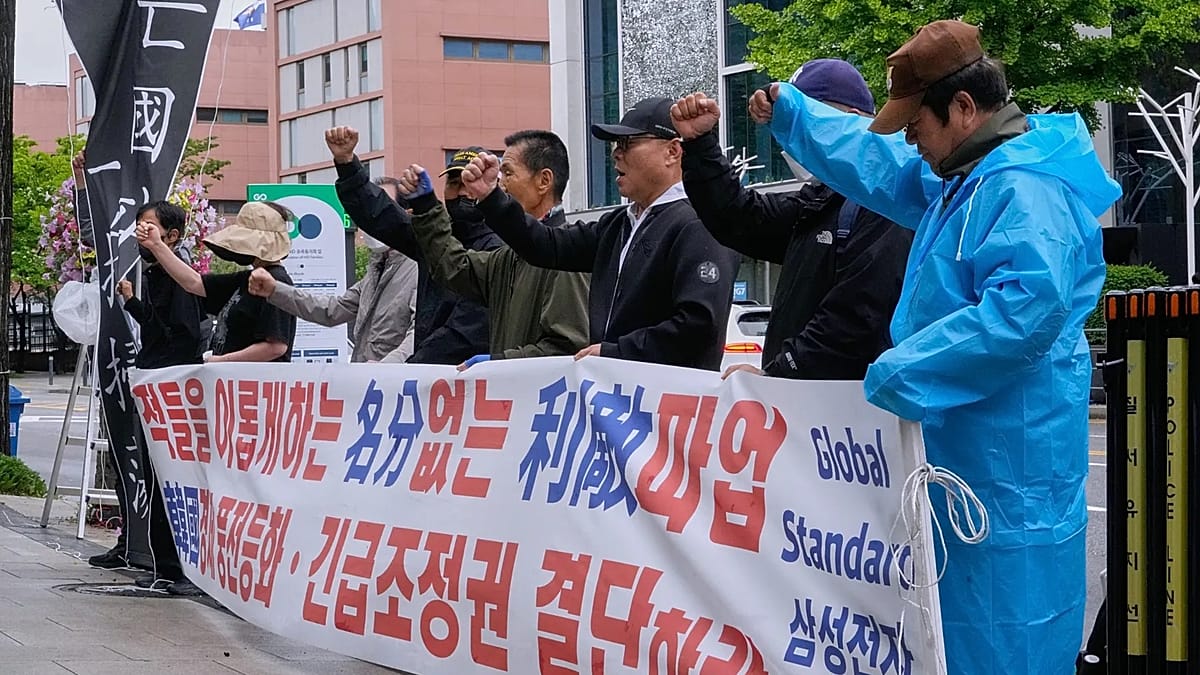
Employees at Samsung’s semiconductor division, which produces chips for artificial intelligence applications, have approved a profit-sharing agreement that could see some workers receive bonuses of up to €350,000. The deal, struck after an 18-day strike, marks a significant milestone in labor negotiations within the tech industry.
Two unions representing Samsung’s chip workers in South Korea announced that 74% of their members—over 60,000 people—voted in favor of the agreement. Under its terms, semiconductor employees will receive a performance bonus equivalent to 10.5% of the company’s earnings, paid out in stock, according to the Korean news agency Yonhap.
If Samsung’s operating profit surpasses the 300 trillion won (€172 billion) projected for this year, more than 28,000 workers at the chip division could each receive up to 600 million won (€346,750). The deal was finalized less than 48 hours after a Korean court overturned an injunction sought by five employees to suspend the collective bargaining process, as reported by the Korea Herald.
Labor and Management Unite
“Starting with the conclusion of this wage agreement, labour and management will work together with one mind to strengthen global competitiveness,” said Yeo Myung-gu, vice-president of Samsung Electronics, in a statement following the vote. “I thank the labour union and all employees for engaging in negotiations with sincerity and never letting go of the thread of dialogue until the end.”
The strike, which began in December 2023, initially demanded a 7% wage increase. The new profit-sharing structure goes beyond base pay, tying bonuses directly to the company’s financial performance in the booming AI chip market.
Samsung is only the second company known to have struck such a profit-sharing agreement with AI workers, according to local reporting. Its Korean rival SK Hynix had already allocated 10% of its operating profit to bonuses last year, with some chip workers receiving up to 3,000% of their base salary in bonuses.
Ripple Effects Across Asia and Europe
The deal has sparked similar demands elsewhere. Employees at LG and Kakao in South Korea are now threatening strikes unless they receive AI-related bonuses, local media report. Meanwhile, Taiwanese semiconductor giant TSMC has promised employees an average 30% increase in profit-sharing bonuses this year, according to Bloomberg.
In Europe, unions are also mobilizing. The Communications Workers of America (CWA) and the UK’s Trade Union Congress (TUC) are calling for workers to receive a “fair share” of profits from the AI boom. The Uni Global Union, which represents workers across the continent, is advocating for global and national policies to ensure that the economic prosperity created by AI “is distributed broadly and equally, to benefit all of humanity.”
This trend highlights a growing tension between the rapid adoption of AI technologies and the distribution of their financial rewards. As European companies like ASML in the Netherlands and Infineon in Germany expand their AI chip production, labor groups are watching closely. The Samsung deal could set a precedent for negotiations in Europe’s own semiconductor sector, where workers are increasingly aware of the enormous profits generated by AI hardware.
The broader implications extend beyond tech. In sectors from healthcare to finance, AI-driven productivity gains are prompting unions to demand a larger slice of the pie. A recent study found that 29.5% of Europe’s health and social care workers face cancer risks, underscoring the need for fair compensation in high-stress jobs. Meanwhile, initiatives like those of Cyprus neighbourhood social workers show how personalized support can combat poverty, but such efforts require adequate funding—often tied to broader economic gains.
As the AI revolution accelerates, the Samsung agreement may be a harbinger of more widespread labor activism. For now, it has averted a prolonged strike at one of the world’s largest chipmakers, but the underlying questions about profit-sharing and worker rights remain unresolved across the globe.