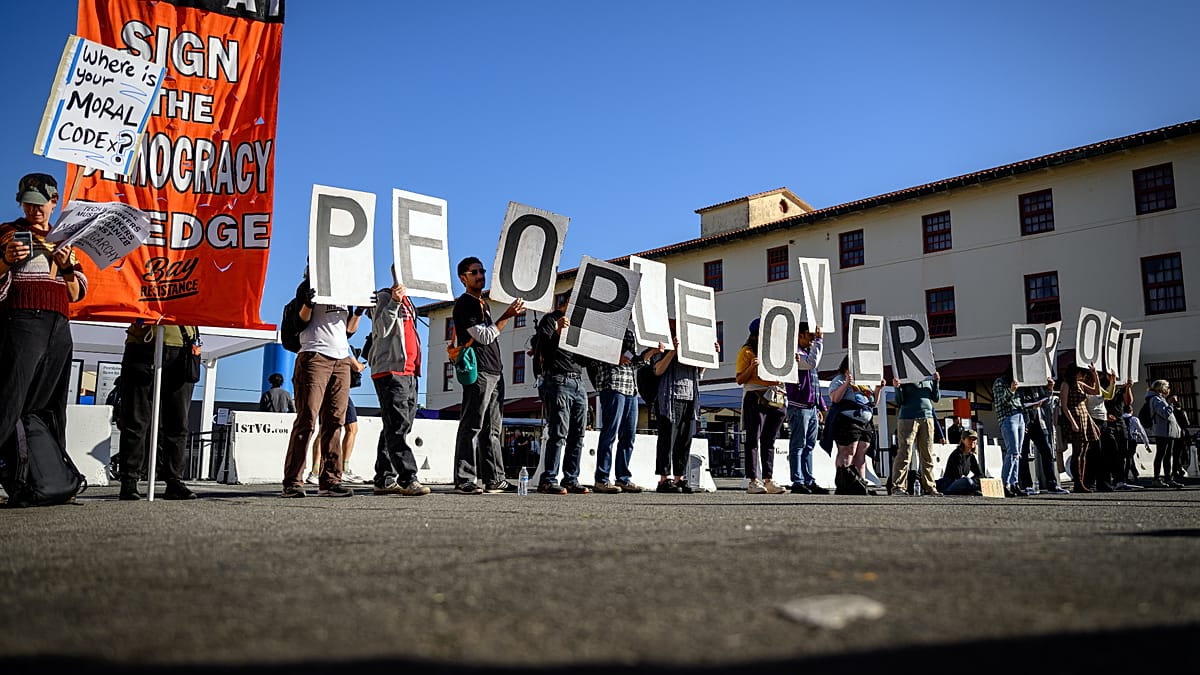
Dozens of activists gathered outside OpenAI's developer conference in San Francisco this week, pressing the company to sever ties with the US military and Immigration and Customs Enforcement (ICE). The demonstration, which drew a small but vocal crowd, also demanded stronger regulatory oversight of artificial intelligence—a theme that resonates well beyond American shores.
Workers' voice in AI governance
Chanting slogans such as “Let workers have a say,” protesters argued that those who build AI systems should have a meaningful role in deciding how they are deployed. The rally reflects a growing movement among tech employees to influence the ethical direction of their employers, a trend that has also surfaced in European tech hubs like Berlin and Paris.
OpenAI, the company behind ChatGPT, has faced mounting criticism from its own staff and external observers over its partnerships with defense and law enforcement agencies. The protesters contend that such contracts contradict the company's stated mission of ensuring AI benefits all of humanity.
The demonstration comes at a time when AI regulation is a hot topic in Brussels. The European Union's AI Act, which entered into force last year, imposes strict requirements on high-risk AI systems, including those used in law enforcement and border control. European lawmakers have repeatedly pointed to the need for transparency and human oversight, principles that the San Francisco protesters are now echoing.
“We are seeing a global conversation about the ethics of AI,” said one protester, who declined to give her name. “What happens in Silicon Valley affects people in Warsaw, Lisbon, and Tallinn. We need a say in how these technologies are used.”
The protest also highlighted concerns about the militarization of AI. While OpenAI has stated that it prohibits the use of its technology for weapons development, critics argue that contracts with the Pentagon and ICE blur the line between defensive and offensive applications.
In Europe, similar debates are unfolding. The payment sovereignty debate has shown how technological choices carry geopolitical weight, and AI is no exception. European startups and research institutions are increasingly wary of relying on American AI giants, fearing that their values and priorities may not align with European norms.
The protesters' demands for greater worker input are not new. In recent years, employees at major tech companies have staged walkouts and signed open letters to influence corporate policy. The movement has gained traction in Europe as well, with workers at companies like SAP and Spotify calling for more ethical AI practices.
OpenAI has not yet responded to the protest. However, the company has previously defended its partnerships, arguing that they help ensure AI is developed safely and in line with democratic values. Critics remain skeptical, pointing to the lack of transparency in these agreements.
The San Francisco protest is part of a broader pattern of activism targeting AI conferences. Similar demonstrations have occurred at events in London and Berlin, where activists have warned about the spread of fake AI-generated content and its potential to fuel far-right sentiment. The issue of AI disinformation is particularly acute in Europe, where elections are often targeted by foreign interference.
As the AI industry continues to grow, the question of who controls these technologies becomes more urgent. The protesters in San Francisco are not alone in their concerns. Across the Atlantic, European policymakers are grappling with similar issues, seeking to balance innovation with fundamental rights.
The demonstration also comes amid broader scrutiny of OpenAI's practices. Earlier this year, the company delayed the release of its GPT-6.1 Astra model amid safety concerns and industry scrutiny, a move that some saw as a concession to critics.
For now, the protesters have made their point: workers want a seat at the table. Whether OpenAI and other tech giants will listen remains to be seen, but the debate is far from over.