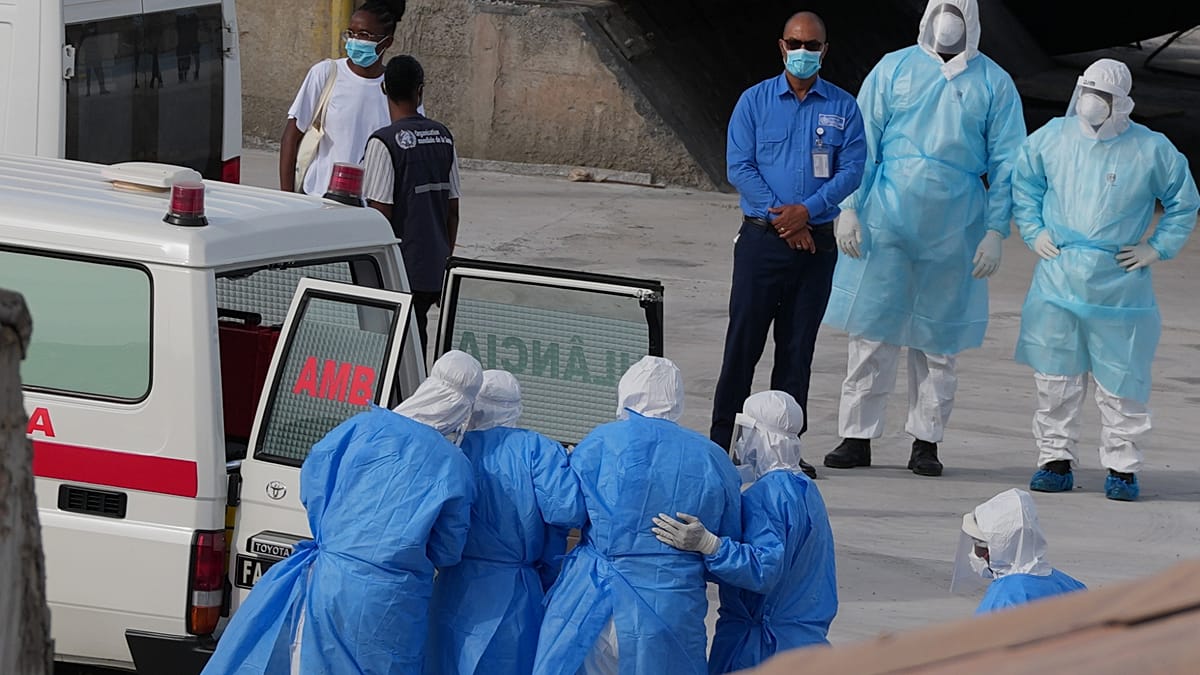
Russian officials moved on Monday to contain public alarm after reports that a laboratory assistant in Siberia had died of plague, insisting that the situation is under control and that post-mortem tests found no trace of the disease. The conflicting messages, however, have done little to ease concerns in the Irkutsk region, where hospitals and a research institute remain under quarantine.
The alarm was raised on Friday following the death of 28-year-old Daria Shipilova, a staff member at the Irkutsk Anti-Plague Research Institute. The regional news outlet People of Baikal, citing unnamed sources close to the security services, reported that she may have contracted pneumonic plague after a test tube was smashed in the laboratory. Other Russian media speculated about a possible link between her death and an earlier incident at the institute.
Quarantine measures spread across Irkutsk
In the wake of Shipilova's death, more than 60 employees of the anti-plague institute were confined to the building, according to sources cited by Siberia.Realii. A relative of one employee, identified only as Roman, described the conditions: “They locked everyone in for isolation from Friday. More than 60 people – by Saturday there was not a single positive test result. They sleep there – on the floor, on chairs. There are, of course, no beds. Food parcels from relatives were allowed through the checkpoint.”
Local authorities also placed three city clinical hospitals, the Ivano-Matreninsky children's hospital, and the city maternity hospital under quarantine. Staff at one medical facility told the Caution news channel that quarantine had been imposed on all the city's hospitals. People of Baikal reported that the restrictions could last three weeks, while its medical sources spoke of a possible plague outbreak.
The Central District Hospital in Shelekhov, a satellite town of Irkutsk where Shipilova died, has also been closed for quarantine. Sources told People of Baikal that since 1 October, ambulances bringing people who had contact with Shipilova for examination have been escorted by FSB officers. At the Irkutsk Aluminium Plant (IrkAZ) in Shelekhov, a mask mandate has been introduced. Plant director Artem Fominykh described the move as a precaution: “Better safe than sorry.”
Even the Irkutsk Regional Psychoneurological Dispensary has reportedly been closed for quarantine, according to a patient quoted by People of Baikal. The measures have disrupted daily life, with one family complaining that a husband was refused entry to the maternity ward despite having paid for a contract for partner-assisted childbirth.
Authorities shift their story
The official narrative has been anything but consistent. Initially, the head of neighbouring Buryatia, Alexey Tsydenov, confirmed that Shipilova had died of plague, only to later add the word “possibly.” On Friday, Irkutsk governor Igor Kobzev spoke of a case of “a particularly dangerous infection.” On Saturday, the authorities of the Baikal region asked citizens not to travel to Shelekhov because of plague, but subsequently deleted the message.
By Monday, Kobzev had adjusted his stance again, saying that checks by a special expert commission had shown that “the cause of death was pneumonia of unknown aetiology.” Rospotrebnadzor, the national consumer and health watchdog, reported that tests of biomaterial from the deceased laboratory assistant had not found “microorganisms linked to her professional activity,” and that no accidents involving work with pathogenic micro-organisms had been detected at the institute. Among people who had contact with Shipilova, two cases of COVID-19 and two cases of rhinovirus infection were detected; no other infectious agents were found.
Kobzev added that no new cases of staff from the anti-plague institute seeking medical assistance had been recorded, and described the public health and epidemiological situation in Irkutsk as “stable.” “The situation remains under our control and under the control of experts,” the governor concluded.
Kremlin spokesman Dmitry Peskov urged journalists “to focus on official statements by Rospotrebnadzor, and not on... various rumours, various speculations,” adding that “highly qualified professionals work at Rospotrebnadzor in this field.”
Yet Rospotrebnadzor has not explained why, despite negative test results, it was necessary to isolate dozens of staff at the anti-plague institute and impose restrictions on several medical facilities at once, as reported by Current Time. The lack of transparency has fuelled speculation and undermined trust in the official version of events.
Plague is a bacterial disease that can manifest in various forms, including pneumonic plague, the most contagious type. According to the World Health Organization, pneumonic plague is transmitted from person to person and is fatal if antibiotic treatment is not started in time. The potential for an outbreak in a major Siberian city has raised concerns across Europe, with EU health authorities reportedly tracking the suspected case.
The incident comes amid broader worries about Russia's handling of public health emergencies, as the country continues to grapple with the COVID-19 pandemic. The conflicting statements from officials, combined with the heavy-handed security presence, have done little to reassure residents of Irkutsk or the wider international community. As the quarantine continues, the world watches to see whether the official reassurances hold or whether the situation escalates into a full-blown health crisis.