Skopje, the capital of North Macedonia, is a city that has learned to rebuild. Situated on a seismic fault line between the African and Eurasian tectonic plates, it was devastated by major earthquakes in 518, 1555, and most recently in 1963. That last quake destroyed more than 80% of the city, prompting an unprecedented global relief effort involving 78 countries—including troops from both the United States and the Soviet Union, who met here for the first time since Elbe Day in 1945.
That moment of Cold War cooperation earned Skopje the nickname “city of international solidarity.” Its legacy is visible in the city’s many brutalist buildings and in street names that honour the nations and organisations that helped rebuild. But another, more controversial transformation came in the 2010s: the Skopje 2014 project. Conceived as an attempt to restore the city’s pre-1963 appearance, it instead gave several modernist structures neo-classical makeovers, erected hundreds of statues, and installed three fake galleons on the Vardar River. The result earned Skopje a less flattering moniker: Europe’s “capital of kitsch.”
Now, with Skopje set to become one of three European Capitals of Culture in 2028, the city is once again in flux. I visited in May to see what visitors can expect—and to explore the layers of history that make this Balkan capital so distinctive.
What to See and Do in Skopje
Macedonia Square and the Alexander the Great Statue
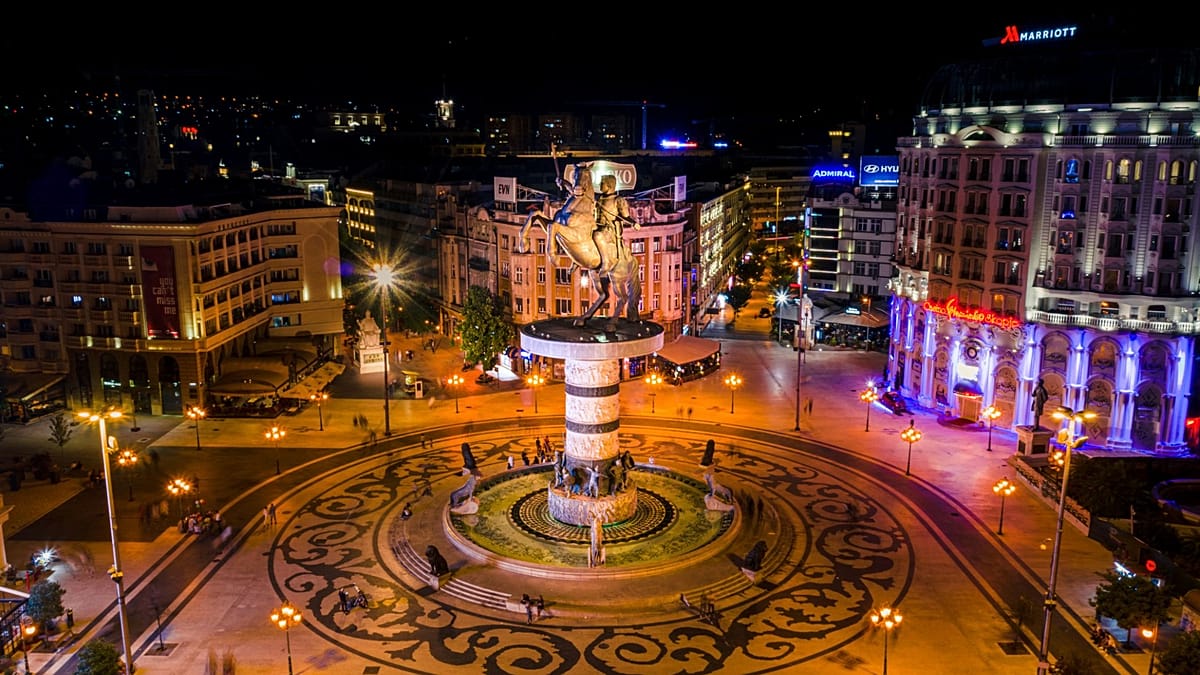
The heart of the city is Macedonia Square, on the banks of the Vardar. Dominating the square is a 12-metre bronze statue of Alexander the Great, officially titled “Warrior on a Horse,” mounted on a 10-metre pedestal surrounded by fountains. The statue was a centrepiece of Skopje 2014, but its subject also stirred a long-running dispute with Greece over the use of the name Macedonia. The 2018 Prespa Agreement resolved the issue, renaming the country North Macedonia, and a plaque now states that Alexander “belongs to ancient Hellenic history and civilisation.”
The Bridges of Skopje
The Vardar River splits the city into old and new. The Stone Bridge, a symbol of Skopje dating from the Ottoman period, contrasts with the Art Bridge and the Bridge of Civilisations in Macedonia, both built during Skopje 2014. The Art Bridge is lined with statues of famous creatives, while the Bridge of Civilisations honours rulers and historical figures. Both are prime examples of the city’s eclectic—and sometimes bewildering—public art.
The Old Bazaar
Skopje’s main tourist draw is the Old Bazaar, a 12th-century market district developed under Byzantine and Ottoman rule. It still contains mosques, caravanserais, and hammams, though many have been repurposed. The National Gallery now occupies the former Daut Pasha Baths, and the Kapan Han houses a restaurant serving traditional local dishes. For souvenirs, this is the place to go—but bring cash, as few retailers accept cards.
Museum of Macedonian Struggle
This museum covers the country’s 19th- and 20th-century history, including resistance against the Ottoman Empire, the Balkan Wars, and both World Wars. Exhibits use wax figures and historical artefacts to tell the story of North Macedonia’s path to independence.
The Old Railway Station
One of the few buildings to survive the 1963 earthquake, the Old Railway Station now houses the Museum of the City of Skopje. Its clock is frozen at 5:17 am, the exact moment the quake struck. Inside, the museum covers the city’s history from earliest settlements to the present, with sections on archaeology, ethnology, and art history.
Brutalist Architecture Tour
While many building façades were altered by Skopje 2014, the city still has striking brutalist architecture, much of it outside the main tourist areas. Local guide Aleksandra Georgieva leads tours that highlight examples like the Macedonian Academy of Sciences and Arts. These buildings offer a different, more austere view of the city’s post-earthquake reconstruction.
As Skopje prepares for its 2028 culture year, it remains a city of contrasts: solidarity and kitsch, ancient and modern, rebuilt and still evolving. For travellers willing to look beyond the statues, it offers a fascinating window into the Balkans’ layered history.