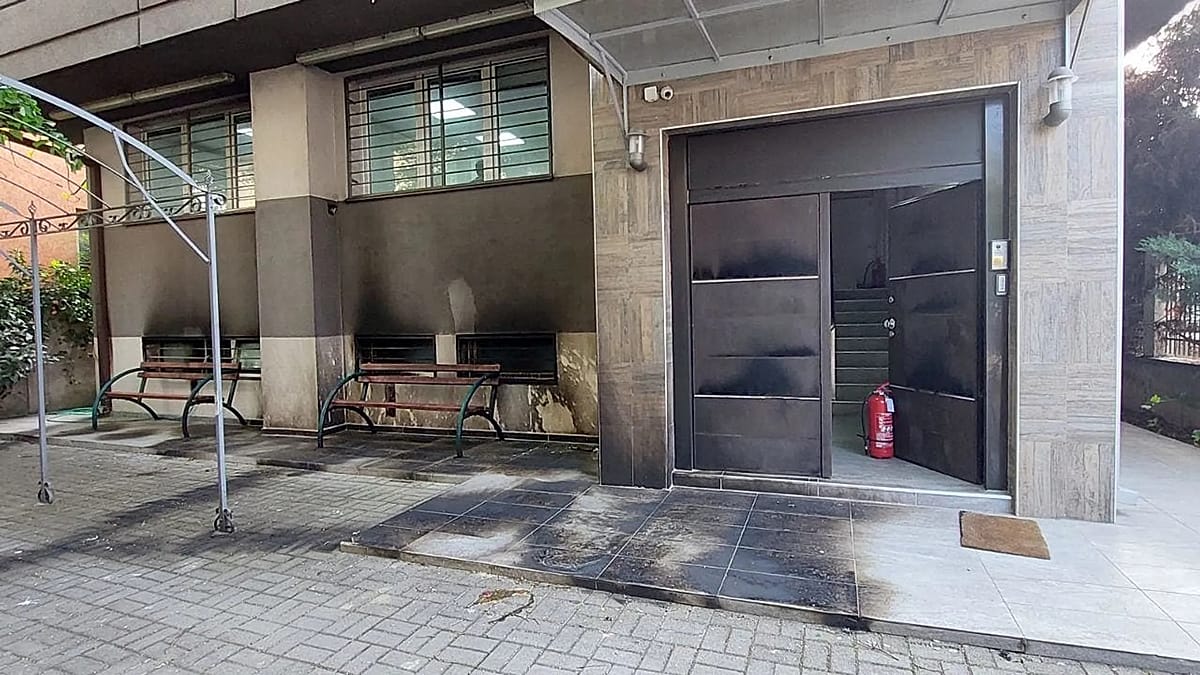
North Macedonia’s intelligence service announced on Friday that an arson attack on a synagogue in Skopje last month was connected to the so-called Islamic State (IS) group. The assault, which occurred on 12 April—Orthodox Easter—left the entrance of the building scorched but resulted in no injuries.
The Agency for National Security reported that raids on several properties led to the arrest of seven individuals, described as “part of a radical group ideologically linked to the global network of the Islamic State.” Police spokesperson Goce Andreevski stated in a video that a 21-year-old and a 38-year-old have been charged with terrorism-related offences and are being held for further proceedings.
Details of the Attack
Surveillance footage shared by the Israeli embassy, purportedly showing the incident, depicts two men in motorcycle helmets jumping a fence, pouring fuel outside the building, and setting the front courtyard ablaze. The local Jewish community later confirmed that the structure suffered only minor damage.
Israeli Foreign Minister Gideon Sa’ar expressed gratitude to North Macedonian authorities for their swift action. “Their swift and determined action to hold the perpetrators accountable underscores North Macedonia’s commitment to safeguarding the Jewish community,” Sa’ar wrote on X.
The Islamic State group has long harbored a profoundly hostile opposition toward Jews, framing Judaism as the primary enemy of Islam in its ideology. While the group has rarely directly confronted Jewish communities in the Middle East, this incident highlights its reach into the Balkans. The attack in Skopje follows a pattern of extremist violence targeting Jewish institutions across Europe, including recent incidents such as the stabbing of two Jewish men in Golders Green and the attempted knife attack on the Israeli embassy in London.
North Macedonia, a small Balkan nation of about two million people, has a modest Jewish community centered in Skopje. The country has generally maintained good interfaith relations, but this incident underscores the persistent threat of extremist ideologies even in relatively stable European states. The arrests signal a proactive security response, though questions remain about how the suspects were radicalized and whether they had broader networks.
The European Union, which North Macedonia has been seeking to join for years, has increasingly focused on counterterrorism cooperation with candidate countries. This case may reinforce calls for stronger intelligence-sharing mechanisms across the continent, particularly as extremist groups exploit online platforms to recruit followers. The attack also comes amid heightened tensions in the Middle East, which have sometimes spilled over into Europe, as seen in the EU’s relaxation of state aid rules to mitigate energy crises linked to regional instability.
For now, the Skopje Jewish community can breathe easier, but the incident serves as a stark reminder that antisemitic violence remains a concern across Europe. The swift arrests by North Macedonian authorities may deter further attacks, but the ideological roots of such extremism require sustained attention from policymakers and civil society alike.