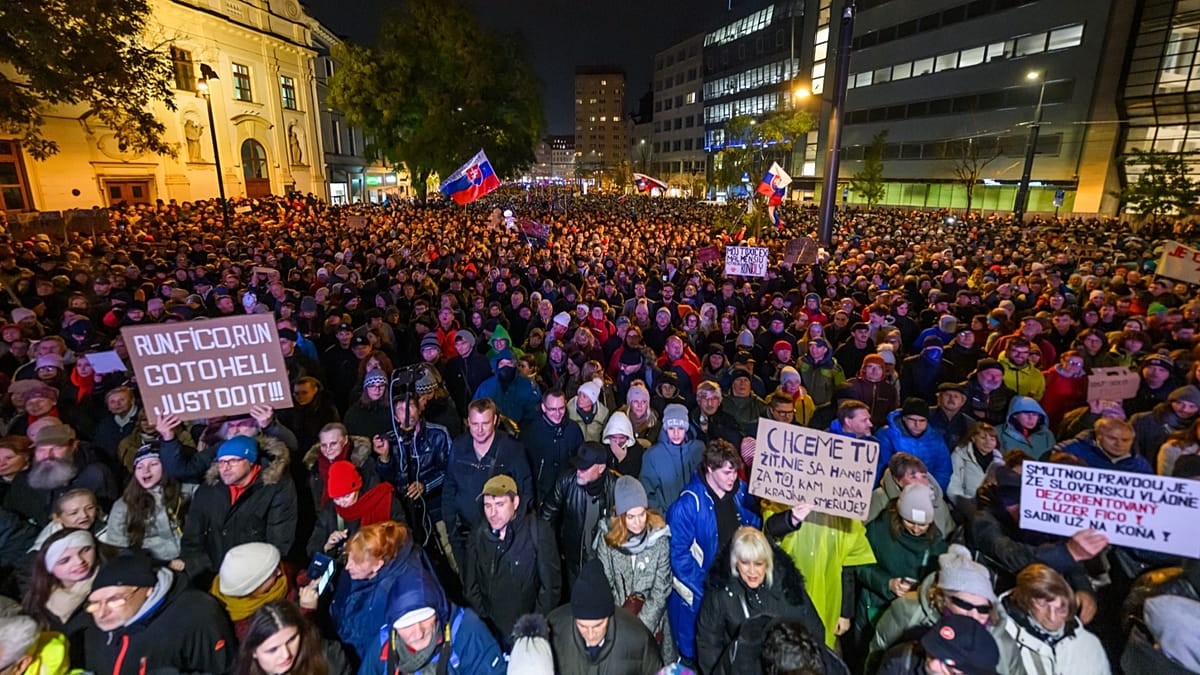
On the anniversary of the Velvet Revolution, tens of thousands of Slovaks took to the streets on Tuesday to demand the resignation of Prime Minister Robert Fico, accusing him of steering the country toward Moscow and eroding democratic norms. The demonstrations, held in Bratislava and other cities, marked the 1989 uprising that ended communist rule in the former Czechoslovakia—a symbolic date for those who see Fico's government as a threat to the country's European path.
The largest gathering took place in the capital's central square, where opposition leader Michal Šimečka of Progressive Slovakia estimated the crowd at around 25,000. Protesters waved EU and Slovak flags, holding banners that read "Run, Fico, run!" and "We are Europe." The mood was a mix of frustration and defiance, with many speakers condemning the government's recent moves to tighten control over the judiciary, media, and culture.
"We're the last ones in the European Union to be negotiating with the Russians... It's a disgrace," said Igor Vico, a 74-year-old doctor who still practices medicine. "We're at the bottom of the world, not just in Europe, and it makes me sad." His words echoed a broader sentiment among protesters who see Fico's rapprochement with the Kremlin as a betrayal of Slovakia's Western alliances.
The protests came a week after Slovakia's parliament rejected a key government-proposed amendment to the penal code, a setback for Fico's coalition, which lost its majority. The defeat has fueled calls for a snap election, though Fico has shown no intention of stepping down. Since returning to power in 2023, he has faced a series of demonstrations, but Tuesday's turnout was among the largest yet.
A government drifting from EU norms
Fico, who has served as prime minister four times over more than two decades, has repeatedly clashed with Brussels during his current term. He opposes military aid to Ukraine and maintains close ties with Russian President Vladimir Putin, a stance that has isolated Slovakia within the EU and NATO. Last year, his government pushed through a constitutional amendment asserting that national law takes precedence over EU law—a move critics say undermines the bloc's legal order.
The government has also drawn criticism for efforts to increase control over media and culture, as well as for curbing LGBTQ+ rights. These measures have alarmed civil society groups and opposition parties, who warn that Slovakia is drifting away from the democratic values it embraced after 1989.
Fico's foreign policy has been a particular flashpoint. In October, Foreign Minister Juraj Blanár visited Moscow for a meeting of the Russian-Slovak Intergovernmental Commission, a trip that angered many Slovaks. This week, the cabinet moved its meeting forward by a day to discuss Blanár's findings and deepening cooperation with Russia—a decision that only added fuel to the protests.
"Russia isn't a partner we should have, after all, they attacked Ukraine," said 15-year-old student Jan Ducho, who attended the Bratislava rally. His generation, born after the fall of communism, is increasingly vocal in opposing any return to Moscow's orbit.
The demonstrations are part of a broader pattern across Central Europe, where governments in Budapest and Warsaw have also tested the EU's limits. Yet Slovakia's geographic position and history make its trajectory particularly significant. As Europe's endless race to counter Russia's hybrid warfare continues, the stakes for Slovakia's democratic future are high.
Protesters have vowed to keep up the pressure, with more rallies planned in the coming weeks. Whether they can force a change in government remains uncertain, but the message from the streets is clear: a significant portion of the Slovak public rejects the Kremlin-friendly course and wants their country firmly anchored in the European project.