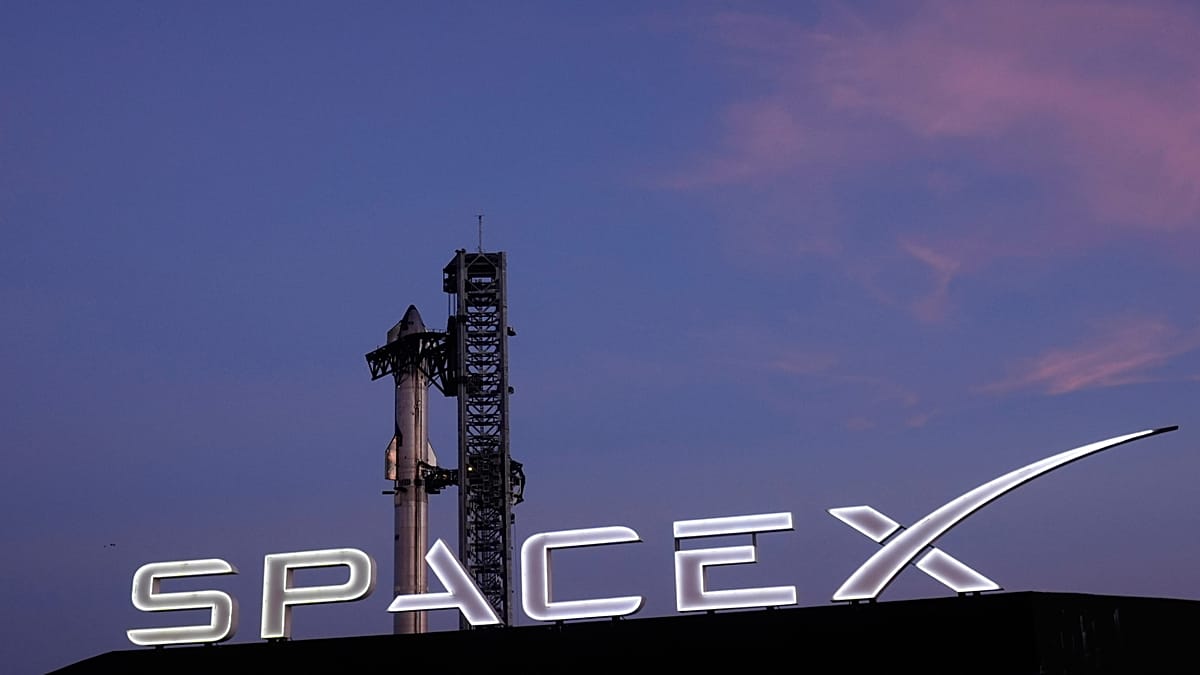
SpaceX, Elon Musk's rocket and satellite company, begins trading on the Nasdaq this Friday under the ticker SPCX, in what is set to be the largest stock market debut in history. The company priced shares at $135 each, raising $75 billion (€64.5bn) and valuing the business at $1.75 trillion (€1.5trn). This comfortably surpasses Saudi Aramco's previous record of $29.4bn set in 2019.
The IPO has drawn extraordinary interest from retail investors, including many in Europe. According to Bloomberg, individual investors placed roughly $100bn (€86.6bn) in orders through platforms such as Robinhood, Fidelity, and SoFi—exceeding the company's fundraising target. Yet beneath the hype, several warning lights are flashing. Here are five risks European investors should weigh before the SpaceX IPO goes live.
1. Is SpaceX Worth $1.75 Trillion?
At a valuation of $1.75tn (€1.5trn), SpaceX trades at roughly 94 times its annual revenue of $18.7bn (€16.1bn) in 2025. By comparison, Nvidia—one of the market's most highly valued technology companies—trades at less than a quarter of that multiple. Morningstar, which values the company at $780bn (€675bn), calls it "significantly overvalued." Goldman Sachs data suggests sustaining the share price would require revenues above $100bn (€86.6bn) by 2030, implying compound annual growth of over 40%.
2. A Valuation Built on a Small Float
Investors should also note the size of the public float. Although SpaceX is valued at $1.75tn, only around 3% to 4% of its shares will initially be available for public trading. Reports suggest more than 75% of the $75bn offering has already been allocated to existing investors and insiders, leaving fewer shares on the open market. According to Morningstar, the limited float and strong demand for AI-related stocks could support the share price early on, even if the company is overvalued. A clearer picture may emerge once lock-up restrictions expire. Some analysts believe the limited float could continue to support the stock, with estimates suggesting between $22bn and $27bn of passive investment could flow into SpaceX once it joins the Nasdaq 100. History offers a note of caution: research by University of Florida professor Jay Ritter found that IPOs between 2012 and 2021 rose an average of 23.6% on their first day but returned just 10.6% over the following three years.
3. Losses, Not Profits
SpaceX's financial results may give investors pause. The prospectus shows rapid growth but persistent losses. The company owns Starlink, its only profitable business, and the AI company xAI, which merged with SpaceX in February. According to the filing, SpaceX carried an accumulated deficit of $41.3bn (€35.76bn) as of 31 March and reported a net loss of $4.27bn (€3.7bn) in the first quarter of 2026, compared with $528mn (€457mn) a year earlier. Much of the recent loss stems from xAI, which recorded an operating loss of about $6.4bn (€5.5bn) in 2025. Morningstar argues the AI unit "poses a material threat of value destruction," noting that Grok has yet to win meaningful market share against rival chatbots. Supporters counter that the losses are a choice, not a structural flaw. Revenue climbed 33% to $18.7bn in 2025, and the underlying launch and satellite business was profitable as recently as 2024.
4. The AI Growth Gamble
Supporters argue investors are paying for future growth rather than current profits. Starlink remains the main revenue source, while xAI is expected to play a larger role. Bulls point to SpaceX's dominant position in rocket launches and satellite communications, arguing the company is uniquely placed to benefit from growing demand for connectivity, computing power, and AI infrastructure. SpaceX conducts more rocket launches annually than the rest of the world combined and counts over nine million Starlink subscribers. Its newest growth driver is the AI data-centre business acquired through the xAI merger. Last Friday, Google agreed to pay SpaceX $920mn (€796.6mn) per month for compute capacity at xAI data centres, in a 32-month deal running from October 2026 through June 2029. That followed a May agreement under which Anthropic pays $1.25bn (€1.08bn) a month to rent the entire output of the Colossus 1 data centre until May 2029, putting combined annualised compute revenue at around $26bn (€22.5bn). Bulls argue this contracted income shows how quickly the company can monetise its infrastructure. Sceptics note that both deals are short-term and dependent on continued AI investment.
For European investors, the SpaceX IPO offers a rare chance to buy into a company that is reshaping space and AI industries. But the risks are substantial: a sky-high valuation, limited shareholder rights, mounting losses, and a heavy reliance on AI growth. As always, due diligence is essential. For more context on the broader market, see our analysis of European markets edging higher ahead of the ECB rate decision.