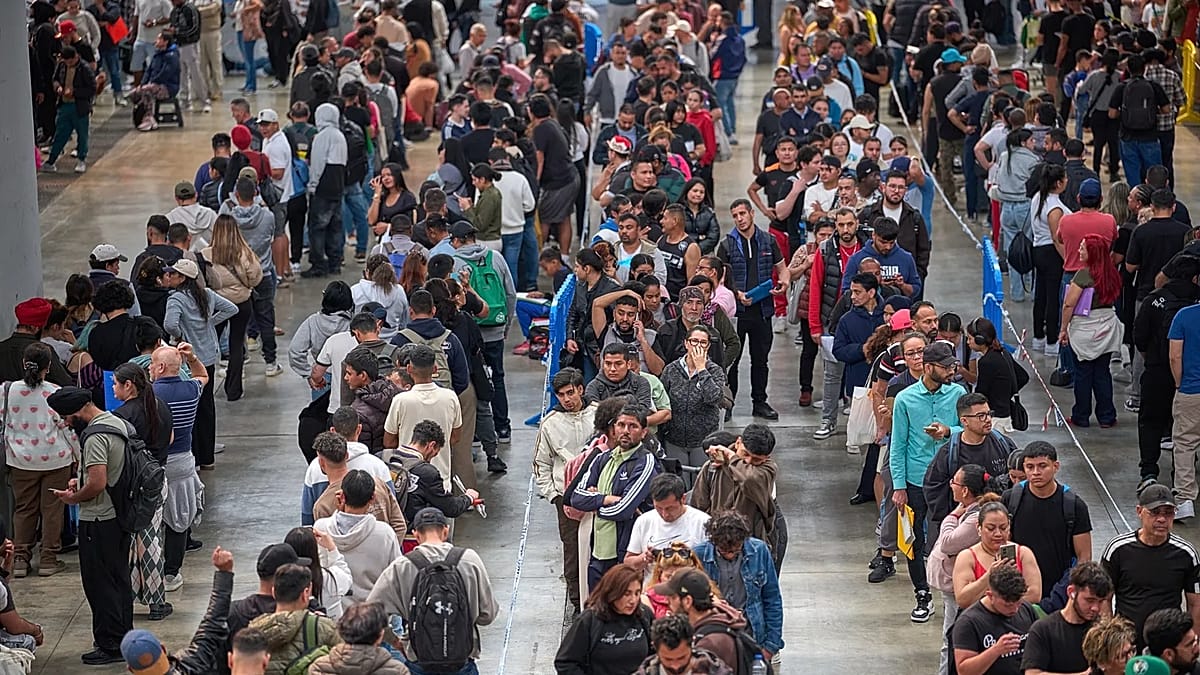
Spain's ambitious regularisation programme for undocumented migrants has drawn over one million applications, far exceeding initial estimates. The scheme, which closed on Tuesday, was originally projected to benefit around 500,000 people, mostly from Latin America, when the left-wing government unveiled it in April.
Prime Minister Pedro Sánchez, speaking at an event in Madrid, described the response as evidence of the need for such a policy. "The more than one million applications submitted show how necessary this recognition of rights and responsibilities was," he said.
A Defiantly Open Policy in a Tightening Europe
Sánchez has positioned himself as a standard-bearer for more open immigration policies, even as many European neighbours—including some Socialist-led governments—adopt tougher measures in response to rising far-right parties. He has long argued that immigrants are essential to sustain Spain's economy, welfare state, and pension system amid an ageing population and rural depopulation.
The number of applications does not guarantee that all will succeed. Applicants must prove they have a clean criminal record and have lived in Spain for at least five consecutive months before 1 January. Authorities have three months to process each case and decide whether to issue a work and residence permit valid only in Spain.
"When we condemn a person to invisibility, I think we make our country a worse country. We all lose," Sánchez said, adding that his government aimed to "offer an opportunity and future" to migrants. "We want the world to view Spain as a country that respects, protects and upholds human rights."
Economic and Human Dimensions
For many applicants, the regularisation offers a path out of precarity. Juana Hernandez, a 59-year-old Cuban who has lived in Spain for two and a half years, had her application approved recently. She told AFP she paid a lawyer roughly €200 to handle the paperwork and received help from a migrant aid association. An English degree holder, she now hopes to work at Madrid's airport.
Mohamed, a 23-year-old Moroccan jobseeker who declined to give his surname, has been in Spain irregularly for about four years. Living in the northern region of Cantabria, he described the administrative process as "relatively easy" and hopes "to be able to work legally, to pay contributions." Legal status, he said, would also protect him from unscrupulous employers who "take advantage" of irregular migrants by paying low salaries or not paying at all.
Spain, historically a land of emigrants, is a key entry point into the European Union for undocumented asylum seekers and migrants, alongside Italy and Greece. Many arrive via the perilous Atlantic route from West Africa to the Canary Islands, though numbers dropped last year after peaking in 2024.
Since April, streams of men, women, and children have queued in streets across Spain to obtain documents and attend appointments, alongside online applicants. Despite fears of service saturation, the process has proceeded largely without major disruption.
Political Reactions and Broader Context
Sánchez, who has presided over one of the world's fastest-growing developed economies in recent years, has highlighted the benefits of immigration for sectors like construction that need workers. Spanish business leaders have welcomed the regularisation drive, but the conservative and far-right opposition have condemned it, arguing it will encourage more irregular immigration.
While acknowledging "tensions" and "challenges" linked to immigration and integration, Sánchez on Tuesday accused the right of "fuelling fear (and) stirring up xenophobic discourse that does not solve any problem."
The scale of the programme underscores Spain's distinct approach within the EU. As other member states tighten borders and debate deterrence, Madrid is betting that legalisation can boost the economy and social cohesion. Whether the policy will achieve those goals—or provoke further backlash—remains to be seen.