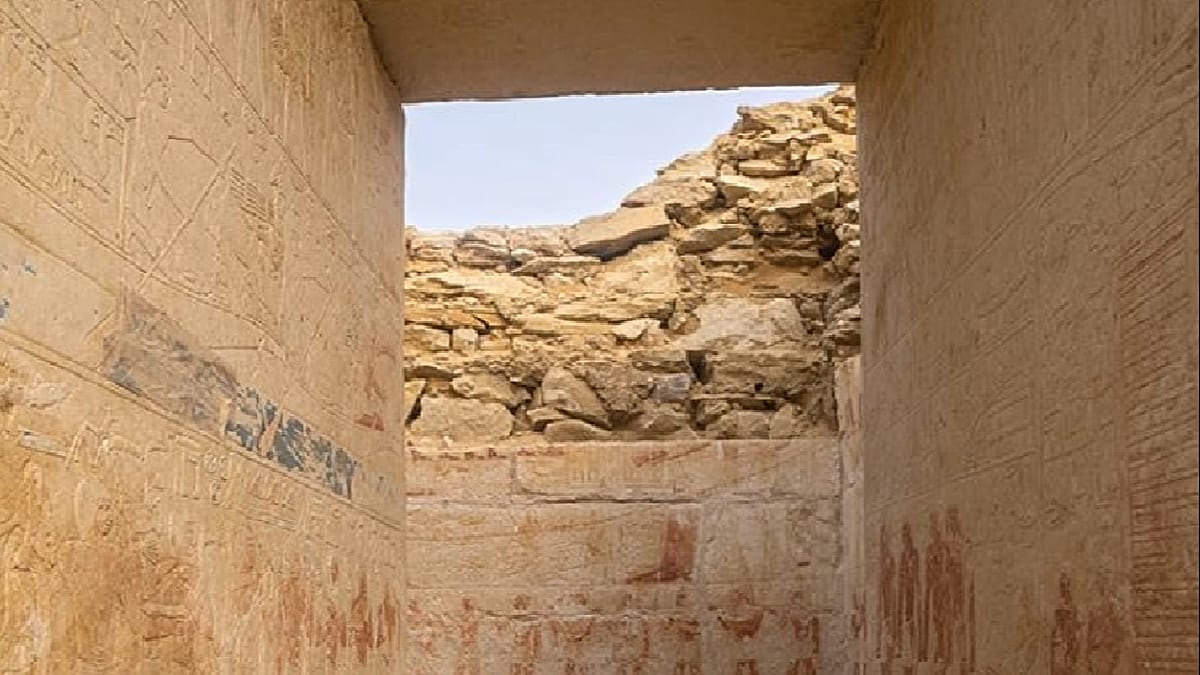
Archaeologists from the Autonomous University of Barcelona (UAB) and Egypt's Supreme Council of Antiquities have uncovered a remarkably preserved tomb at the Saqqara necropolis, southwest of Cairo. The mastaba, dating to the late Fifth Dynasty (circa 2494–2345 BC), was built for a senior official named Yunmen, who served under Pharaoh Djedkare Isesi. It also contains a second chapel for his father, Iti, a lower-ranking provincial official.
The discovery, announced by Egypt's Ministry of Tourism and Antiquities, has been described by the excavation team as both "intriguing and beautiful." The tomb's two funerary chapels are adorned with reliefs depicting agricultural scenes and offering processions, many of which still retain their original pigments—a rarity for monuments of this age.
A window into Old Kingdom life
According to the UAB, the tomb provides valuable information about the social and administrative structures of the period. Yunmen appears to have risen from a provincial background to a high-ranking position in the central government, and his decision to share his burial place with his father reflects the importance of family ties in ancient Egyptian society.
The reliefs also include images of donkeys and other animals, offering a glimpse into the daily activities and economy of the time. The Egyptian authorities noted that the discovery "provides new and valuable information about the architecture, art, and administrative life of ancient Egypt at the end of the Fifth Dynasty."
The site, known as the Mariette necropolis, was first explored by French Egyptologist Auguste Mariette in the nineteenth century but had never been thoroughly documented. The current project aims to reconstruct the topography of Saqqara and understand how the necropolis functioned as a living space, where rituals and construction continued over centuries.
"We are not just looking at tombs," said Josep Cervelló, the Spanish Egyptologist leading the mission. "We are trying to understand how the ancient Egyptians organized this sacred space, how they moved through it, and how they maintained it."
The team's analysis of maps and surface features led them to the previously unknown mastaba, as well as traces of two additional tombs nearby, which they hope to excavate in future seasons. The discovery comes amid a broader resurgence of international archaeological work in Egypt, with European institutions playing a prominent role.
For Spain, the find underscores the country's growing contribution to Egyptology, building on a tradition that includes the work of figures like Eduardo Toda, who helped document the royal mummies in the nineteenth century. The UAB's involvement also highlights the value of cross-border scientific collaboration, a theme that resonates across the European research landscape.
The tomb's exceptional preservation offers a rare opportunity to study the artistic techniques and cultural practices of the Old Kingdom. As Cervelló noted, "The colors are so vivid that you feel the artisans left only yesterday."
While the excavation is still in its early stages, the team is optimistic about what further work will reveal. The site, they believe, could reshape our understanding of Saqqara's development and the lives of the officials who served the pharaohs.
For now, the painted reliefs of Yunmen and Iti stand as a testament to the enduring legacy of ancient Egypt and the meticulous work of modern archaeologists from Europe and beyond.



