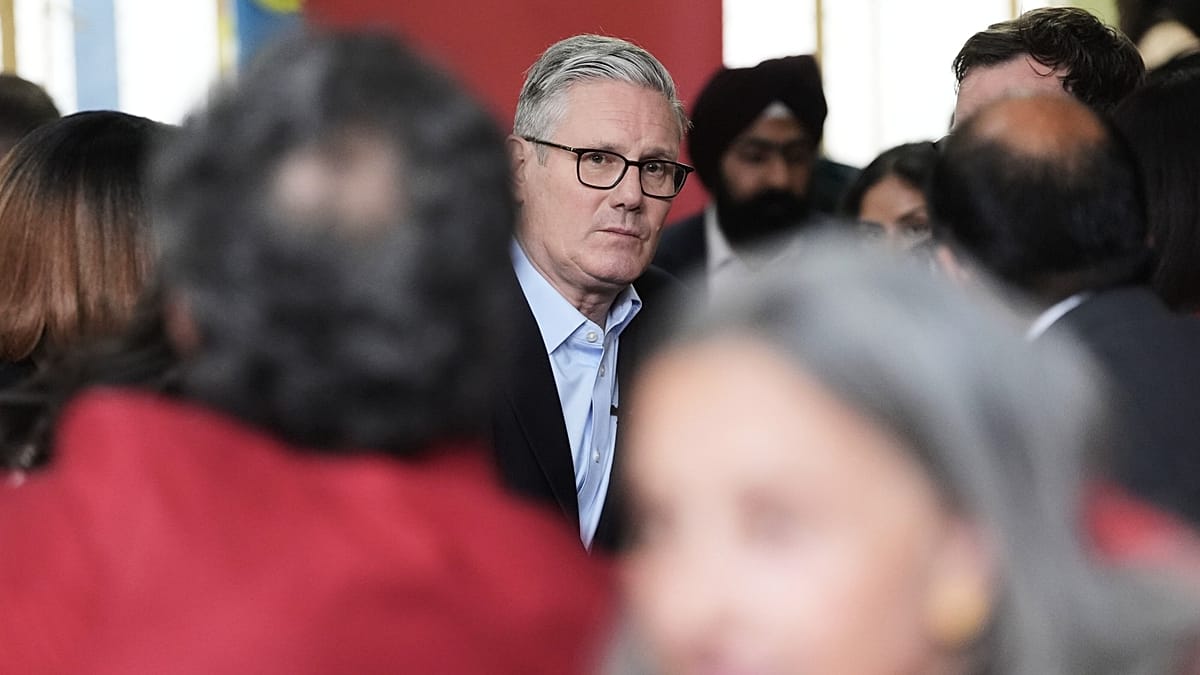
British Prime Minister Sir Keir Starmer is preparing a major speech on Monday aimed at resetting relations with the European Union, following local election results that saw his Labour Party lose hundreds of council seats to Nigel Farage's Reform UK. Yet in Brussels, the mood is cautious: officials welcome the overture but fear that Starmer's political fragility could stall any meaningful progress.
Starmer acknowledged the scale of the defeat on Friday, telling reporters: “The results are tough, they are very tough, and there's no sugarcoating it.” The losses mark a dramatic reversal from the general election less than two years ago, when Labour secured one of the largest parliamentary majorities in British history. The local elections have tested Starmer's leadership as Reform UK surged to around 25% in national polls, leaving Labour trailing behind both the Conservatives and the Greens.
Brussels sees opportunity — and risk
For EU institutions, the prospect of closer ties with London is appealing after a decade defined by the rancorous Brexit divorce. Shared challenges — from the war in Ukraine to the return of Donald Trump to the White House — have already brought the UK and EU closer, particularly on defence. Starmer has played a key role in rallying the coalition of the willing behind Kyiv and has aligned with the EU's cautious stance on Iran, resisting US pressure for escalation.
However, the EU is wary of investing political capital in a leader who may not last. Starmer's personal approval ratings are catastrophic: just 19% of voters approve of his leadership, with a net approval of minus 45%. Betting markets now give his exit before the end of June an effective coin-toss probability. Rumours of potential challengers — including Deputy Prime Minister Angela Rayner, Health Secretary Wes Streeting, and Manchester Mayor Andy Burnham — are rife in Westminster.
“Anything that comes up would still need to be negotiated — and we’ll be careful about going all in with Starmer if he’s out in a few months,” one EU diplomat told European Pulse. The concern is that a weakened UK government could retreat under domestic pressure or be overtaken by events, leaving Brussels with unfinished deals.
The Farage factor
Even if Starmer survives, the longer-term outlook is uncertain. Reform UK has led national polls since early 2025, and bookmakers have them as odds-on favourites to win the next general election, due by 2029. Nigel Farage, who led the Brexit Party, has pledged a harder approach to the EU, including renegotiating the post-Brexit trade deal to strip EU citizens of benefit rights.
“Ever since Brexit, there has been a concern in Brussels about Britain making commitments that it cannot fulfil, especially if they could be reversed by a Farage government,” says Fabian Zuleeg, chief executive of the European Policy Centre. This fear is compounded by the fact that Britain's local elections reveal a nation still divided over Europe, with public opinion now favouring EU membership by a two-to-one margin, yet the political system remains hostage to Brexit hardliners.
Slow reset, lingering suspicion
Beyond the immediate political drama, the EU has found it hard to gauge the UK's commitment to the much-vaunted “reset” Starmer promised upon entering Downing Street. Progress has been slow and constrained by Labour's own red lines: no return to the Single Market, customs union, or freedom of movement. Negotiations have advanced in some areas — defence cooperation, energy links, and a veterinary agreement to reduce trade friction — but headline ambitions remain bogged down in technical disputes over funding, regulatory alignment, and youth mobility schemes.
Talks on UK participation in the EU's €150 billion SAFE defence fund have stalled over financial contributions, while negotiations on student fees and mobility caps have become politically toxic in London. EU officials increasingly argue that London cannot simultaneously demand deeper access to parts of the Single Market while rejecting the obligations that come with it. The old Brexit-era suspicion of British “cherry-picking” has never fully disappeared.
For now, European leaders still see Starmer as serious and pragmatic — infinitely preferable to the chaos of Boris Johnson. But privately, officials worry that his weakening political position could make even modest agreements harder to deliver. As one Brussels insider put it: “The UK needs a stable partner. Right now, it's not clear that Starmer can provide that.”