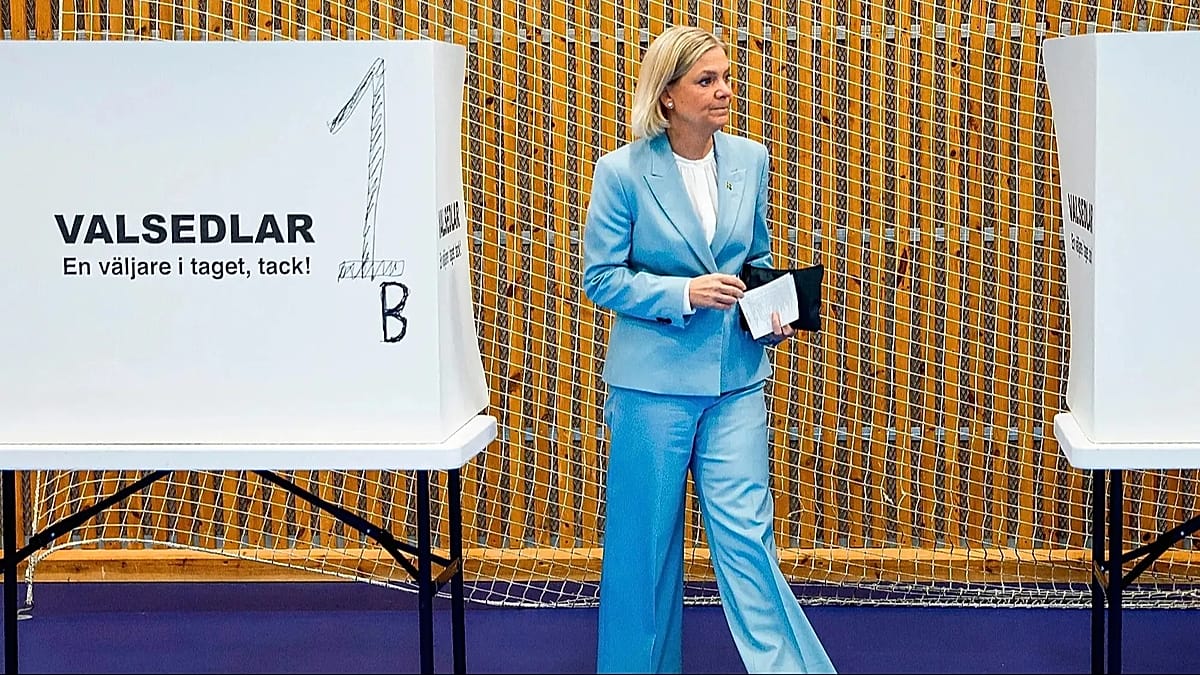
Stockholm — Sweden's centre-left opposition, led by Social Democrat Magdalena Andersson, holds a razor-thin lead in Sunday's parliamentary election, according to preliminary results from the Swedish Election Authority. With 175 seats against 174 for the right-wing bloc in the 349-seat Riksdag, the outcome remains on a knife's edge, setting the stage for protracted coalition negotiations.
The Social Democrats remain the country's largest party with roughly 28% of the vote, but that would be one of their weakest showings in over a century, down from 30.3% in 2022. Prime Minister Ulf Kristersson's Moderates trail with 19.9%, while the anti-immigration Sweden Democrats are third at 17.6%.
Kristersson, who leads a minority coalition of his centre-right Moderate Party, the Christian Democrats and the Liberals, is seeking a second term. His government has relied on parliamentary support from the Sweden Democrats, a party that has steadily grown in influence and now stands on the threshold of formal power.
Should the right-wing bloc prevail, Kristersson has indicated he would bring the Sweden Democrats into government for the first time — a historic breakthrough for a party long ostracised by mainstream politics. After four years of propping up his coalition from outside, direct ministerial roles would mark a dramatic shift in Sweden's political landscape.
Yet the preliminary count suggests the right may struggle to retain power. A centre-left victory would still leave Andersson with a formidable task: forging a viable government with only a one-seat margin, likely requiring support from the Left Party and the Greens, and possibly the Centre Party.
With around eight million eligible voters in a country of 10.6 million, turnout is traditionally high, and more than half of ballots were cast in advance. The final result may hinge on a handful of constituencies, and a recount or postal ballot adjustment could flip the balance.
Far right's long march
The Sweden Democrats, founded in the 1980s with roots in white nationalist movements, have spent years detoxifying their image. Under leader Jimmie Åkesson, they have shifted from fringe to mainstream, focusing on immigration, crime and welfare. Their potential entry into government would resonate far beyond Stockholm, as similar parties gain ground across Europe.
Analysts note that even if the centre-left clings to power, the Sweden Democrats' influence is unlikely to wane. "The party has become a permanent fixture in Swedish politics," said Ann-Cathrine Jungar, a political scientist at Södertörn University. "Whether in government or opposition, they will shape the agenda."
The election has also been dominated by concerns over gang violence, integration and the sustainability of Sweden's generous welfare model. Healthcare promises collide with workforce reality, as both blocs struggle to offer credible solutions to staffing shortages and long waiting times.
Security and defence have also featured prominently, particularly after Sweden's accession to NATO. The recent HIMARS purchase underscores the country's deepening military integration with its Nordic neighbours, a theme that resonates with voters concerned about regional stability.
As the count continues, both leaders have urged patience. "Every vote counts," Andersson told supporters in Stockholm. Kristersson echoed the sentiment, noting that "the final result may not be known until later this week."
Regardless of the outcome, Sweden faces a period of political uncertainty. The narrow margin means that small parties could wield outsized influence, and the next government may be fragile. For the far right, however, the election has already been a success: even if they remain outside the cabinet, their parliamentary strength ensures they will be a force to reckon with.