Europe’s wind industry is enjoying a record year, with 8.8 gigawatts of new capacity installed in the first half of 2026 – a 30 per cent jump compared with the same period last year. That is enough to power roughly seven million European households and displace fossil fuel imports equivalent to 25 LNG tankers annually, according to industry body WindEurope.
Yet every turbine that goes up will eventually come down, and the question of what to do with the components is becoming urgent. Up to 90 per cent of a turbine’s mass – steel, copper, aluminium and concrete – is readily recyclable. The composite materials that make up most of the blades are far trickier.
“Separating the composite materials from the resin requires specialised processes, often involving high temperatures or other energy-intensive treatment methods,” says Eva Julius-Philipp, Director of Environment and Sustainability of Business Area Wind at Vattenfall. “In some cases, these processes can affect the quality and value of the recovered materials, making large-scale recycling more challenging.”
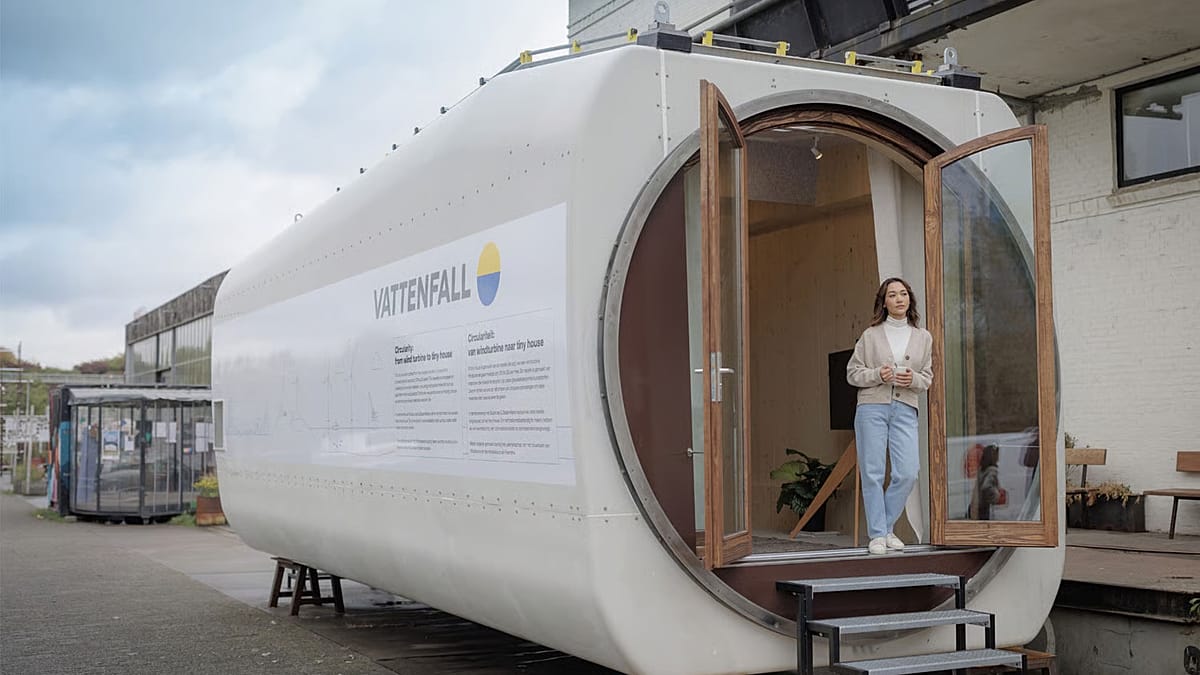
Since Sweden introduced a landfill ban on blades, nacelle covers and nose cones in 2021, Vattenfall has been exploring creative alternatives. One striking example is a tiny house built from a retired nacelle cover – the shell that once protected the mechanical and electrical equipment atop an Austrian wind tower. Measuring four metres wide, ten metres long and three metres high, the compact dwelling now features a kitchen, bathroom and living space, powered by a heat pump, solar panels and a solar water heater. It was showcased at Dutch Design Week in 2024 as part of an initiative to demonstrate low-energy reuse of materials.
From blades to buildings and skis
Blades, too, are finding second lives. After the Danish onshore wind farm Nørre Økse Sø was decommissioned in 2023, its 57 blades were repurposed as the facade of a multistorey car park in Lund, Sweden. That project has inspired a range of inventive uses, from frames for solar panels to alpine skis.
“Projects such as the Tiny House, blade-based building projects and recycled skis are not yet a large-scale solution, however they are intended to help us gain experience, develop new applications and stimulate the market for circular solutions,” says Julius-Philipp. She adds that extending the operational lifetime of existing components through reuse and refurbishment remains the preferred option, provided it is safe.
Wind turbine blades can be between 50 and 100 metres long and are engineered to withstand harsh weather for up to 25 years. That durability is precisely what makes them difficult to recycle: layers of glass fibre, carbon fibre, epoxy resin, balsa wood, metals and fillers are pressed tightly together. Vattenfall aims to achieve 100 per cent circularity for these composite materials by 2030, and is working on new methods of reusing, repurposing, refurbishing and recycling blades.
“When composite materials cannot be recycled at a high value, they can be processed through energy recovery and/or cement co-processing,” says Julius-Philipp. Currently, the company uses mechanical recycling to turn blade material into composite flakes or fillers for new products, while pyrolysis – a thermal process – recovers fibres and other secondary materials.
But technology is not the only hurdle. “Decommissioned blades do not become available in a steady and predictable flow, which makes it harder for recycling solutions to scale economically,” she notes. As the first generation of major European wind farms reaches the end of its operational life in the coming years, the volume of retired blades will rise, increasing the need for solutions that are “scalable, cost-efficient and low in energy use”.
The European Union has not yet imposed a binding ban on landfilling decommissioned blades. Only Austria, Finland, Germany and the Netherlands have their own national bans. WindEurope is now urging Brussels to make such a commitment legally binding across all member states. “What is needed now is a regulatory framework that enables circular value chains and secondary raw materials to scale,” says Julius-Philipp, who hopes the European Commission’s Circular Economy Act, expected later this year, will help provide it.
Manufacturers are also beginning to design blades with end-of-life in mind. Siemens Gamesa’s RecyclableBlades, used at Vattenfall’s offshore wind farm Hollandse Kust Zuid in the Netherlands, use a resin type that dissolves under specific conditions, allowing the fibres to be recovered and reused. Such innovations, combined with the creative repurposing projects emerging across the continent, point towards a future where wind turbines truly live up to their green promise – from the moment they start spinning to the day they are dismantled.