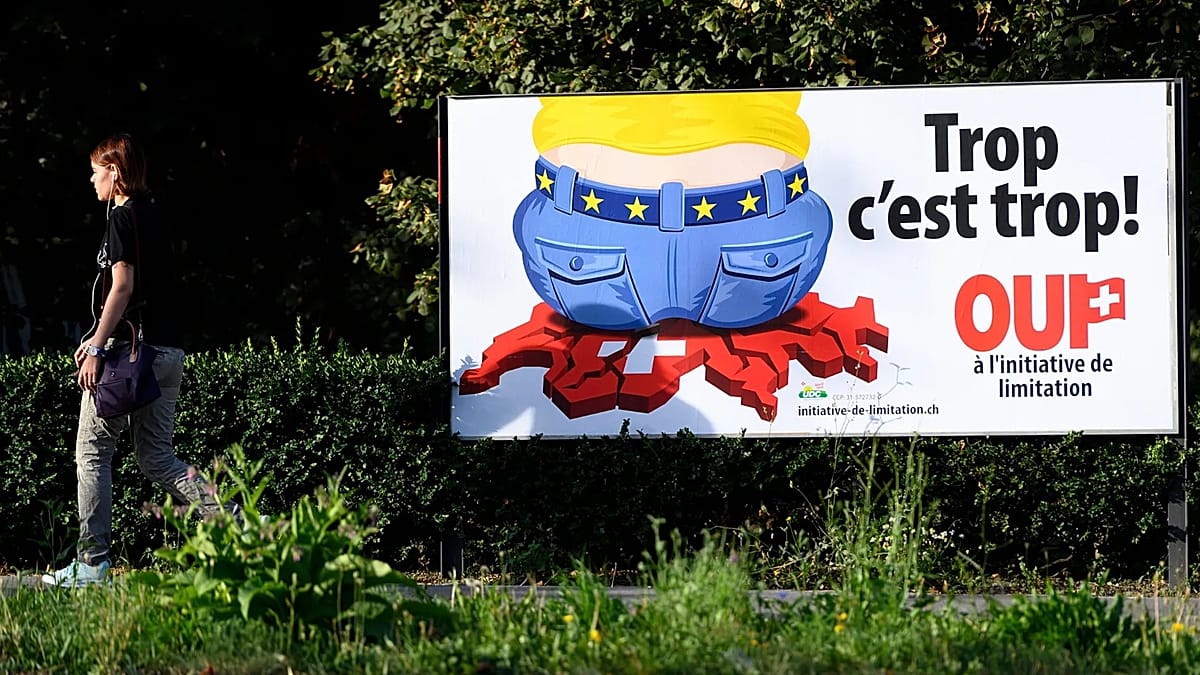
Switzerland is bracing for a closely watched referendum on Sunday, as business leaders and trade unions unite against a hard-right proposal to cap immigration. The initiative, backed by the Swiss People's Party (SVP), seeks to limit the country's population to under 10 million by 2050, currently at 9.1 million. The SVP argues that immigration is 'out of control,' blaming it for overcrowded trains, soaring rents, and urban sprawl.
However, the proposal has drawn broad opposition from the government, parliament, and the business sector. Major employers' organisations and unions have labelled it a 'chaos initiative,' warning it could undermine Switzerland's prosperity. The country's economy relies heavily on foreign labour, particularly from the European Union, in sectors ranging from medical research to construction and healthcare.
Economic Risks and EU Market Access
In the hotel industry, more than half of employees are foreigners, according to Martin von Moos, head of HotellerieSuisse. He voiced concern that the initiative would worsen chronic labour shortages. The Swiss hospitality sector, a key part of the economy, depends on cross-border workers from neighbouring EU countries.
Beyond labour, the initiative threatens to jeopardise major agreements linking Switzerland to the EU, its primary trading partner. The 1999 'agreement on the free movement of persons' is at stake, as last year over half of Switzerland's total exports—worth more than 147 billion Swiss francs (€160 billion)—went to the EU. 'For us, access to the European market is vital,' said Pierre-Yves Bonvin, head of textile machinery manufacturer Steiger, which exports its entire production to the EU. The company, based in Vionnaz, has relocated some production to China but retains high-value-added machinery in Switzerland. More than a third of its 40 employees are foreign nationals.
Bonvin explained that Switzerland lacks training for specialists needed to test and calibrate machines, forcing his company to recruit from France and Germany. 'Without these skills, we could not continue to produce these machines in Switzerland,' he said.
Quotas and Industry Concerns
The SVP has dismissed these concerns, pointing to quotas in its proposal that would allow around 40,000 immigrants per year. But critics argue these quotas are insufficient and risk being skewed. Simon Michel, head of medical technology company Ypsomed and a lawmaker with the right-wing Liberals, predicted that priority would go to hospitals and elderly care, leaving industry last. His company, which makes injection systems for diabetes, needs to recruit around 100 precision mechanics over the next three years for its factory in Solothurn. Even with a substantial apprenticeship programme, Michel said the company cannot train everyone it needs and must turn to France, Germany, or Poland for personnel.
Trade unions have also raised alarms that pressure on exporters could push them to relocate, leading to job losses. Switzerland's largest union, Unia, warned the initiative would weaken labour protections, abolish rules barring discrimination between resident and foreign employees, and 'open the door wide to wage dumping.'
Opinion polls suggest the vote could be tight, despite the broad opposition. The outcome will have significant implications for Switzerland's relationship with the EU, as well as its economic future. For a continent watching closely, this referendum underscores the delicate balance between national sovereignty and integration in the European network.