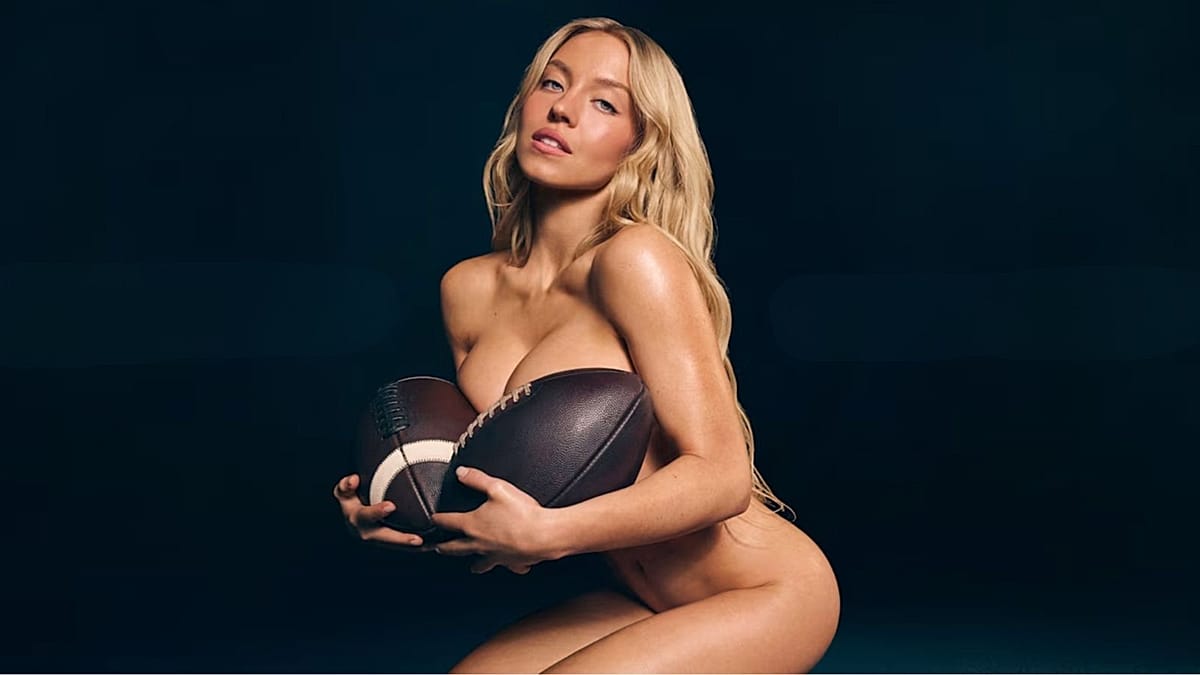
When Sydney Sweeney appears in an advertisement, the internet tends to react. Her latest campaign for Novig, an American sports betting app, has done more than stir social media—it has drawn sharp rebukes from professional female athletes across the globe.
The commercial, which is decidedly NSFW, shows the Euphoria actress posing with minimal clothing, using footballs, a baseball bat, a hockey stick, and a tennis racket to cover herself. As she repeats the word “sports,” the message is clear: Novig is about sports, not politics or other distractions. Sweeney, who is also a strategic partner and equity holder in the company, defended the ad as “a fun idea” that “cuts through the noise.”
But many are not buying it. Critics argue the ad reduces women to objects, using sex to sell a product that has nothing to do with athletic achievement. The backlash has been particularly fierce among female athletes, who see it as a direct affront to their years of dedication and hard work.
Olympians and champions speak out
Ariarne Titmus, the Australian swimmer with four Olympic gold medals, took to Instagram to express her fury. “I can’t describe how infuriated I feel when I watch this,” she wrote. “Not only is it a kick in the face to every woman who has dedicated her life to perfecting her craft, but every woman who enjoys sports for what it really is – teamwork, friendship, dedication, excellence, unity.”
Skye Nicolson, Australia’s world champion boxer, echoed that sentiment, calling the ad a “mockery” of women in sport. “There’s a big difference between looking ‘sexy’ because you do sport compared to using sex to sell ‘sport’,” she said on Instagram. “There is nothing wrong with looking good and doing sport and there’s nothing wrong with embracing your femininity while also being a badass athlete.”
Canadian skier Cassidy Gray, who competed at the 2026 Winter Olympics, posted a viral TikTok response, describing Sweeney’s actions as “idiotic” and “senseless.” She noted that female athletes already struggle to be taken seriously and face constant sexualisation, and that this ad only reinforces those challenges.
British sprinter Amy Hunt used a BBC interview to draw a contrast. “Sydney Sweeney, this is what women in sport look like,” she said after racing at the World Athletics Ultimate Championship. “Muscles. Hard work, blood, sweat, tears. This is a beautiful evening.”
The Female Athlete Project, a community supporting women in sports, issued a statement saying: “We're not entirely sure if Novig or Sydney Sweeney and her PR team have ever watched sports. But honestly, wow. It's incredible they could fit so much misogyny in 40 seconds. Sports has long treated women's bodies as commodities, and this objectification does nothing to support real women in sport.”
Defenders and detractors
Not everyone agrees. Some social media users defended Sweeney, arguing that she is free to do what she wants with her body. “Her body her choice,” one wrote. Others blamed the ad agency rather than the actress, suggesting that another model would have taken the role if she had declined. A few even questioned the outrage, asking whether the criticism would be the same if the ad featured a different celebrity.
Yet the volume of criticism has been overwhelming. More than 200,000 of Sweeney’s Instagram followers have reportedly unfollowed her in the wake of the campaign. Sweeney responded by posting covers from ESPN’s The Body Issue, which feature nude athletes like Serena Williams, Ronda Rousey, and Megan Rapinoe, seemingly to argue that nudity in sports media is not new.
But athletes argue there is a fundamental difference between celebrating the athletic body and using a woman’s body to sell a gambling app. The debate touches on broader questions about the commodification of female athletes, a topic that has gained traction in Europe, where initiatives like Spain's football federation offering fertility support show a growing awareness of the unique challenges women face in sport.
As the controversy continues, it remains to be seen whether Novig will change its approach or whether Sweeney will address the criticism directly. For now, the ad has become a flashpoint in the ongoing conversation about how women’s bodies are used in marketing—and whether the sports world is truly ready to move beyond objectification.