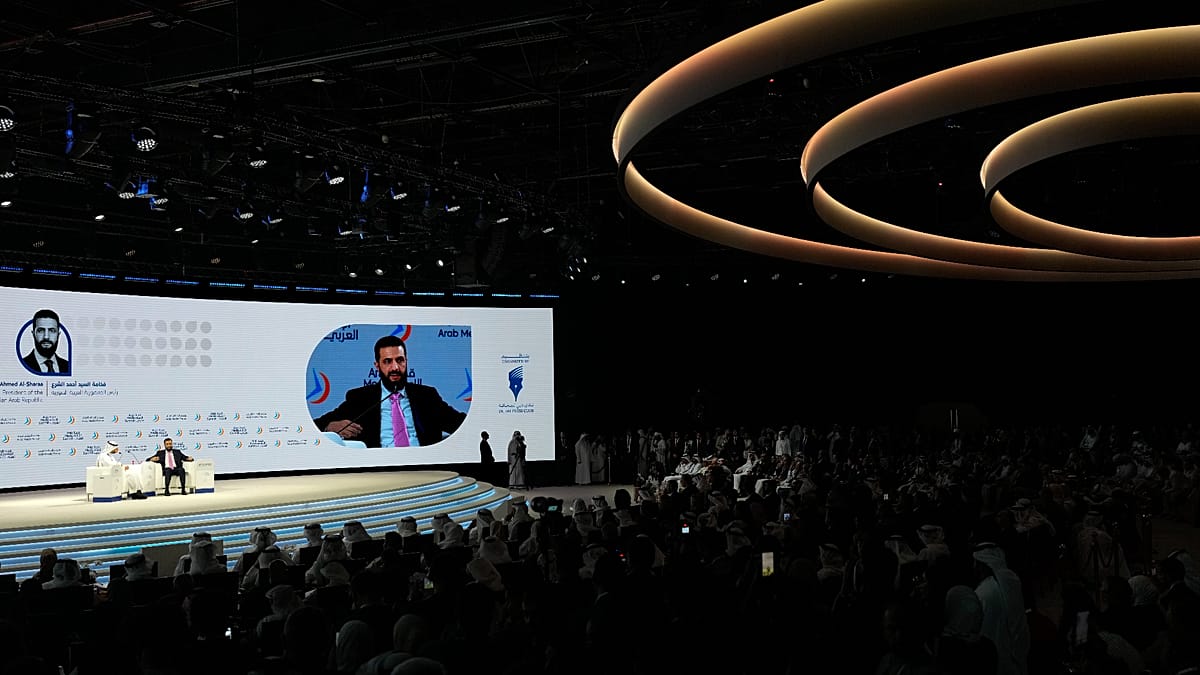
Dubai's World Trade Centre is hosting the largest Arab Media Summit to date, with Syrian President Ahmed al-Sharaa delivering the opening keynote on Tuesday. His appearance marks the first time a Syrian head of state has addressed the event, which runs for three days and features more than 175 sessions, 400 speakers from 23 countries, and eight thematic forums.
In a dialogue titled “Syria of the Future,” al-Sharaa touched on regional tensions, telling Euronews that escalation appears “on the way” but urging states to remain calm and cooperate. His remarks come amid ongoing instability across the Middle East, a theme that resonates beyond the region given Europe's close ties to Arab states on security, energy, and migration.
Cyber-attacks and media economy take centre stage
Beyond the main stage, the UAE provided its most detailed account yet of the cyber-threats it faced this year. Dr Mohamed Al Kuwaiti, head of the UAE Cybersecurity Council, told Euronews that every missile or drone strike on a port, refinery, or airport was mirrored by a cyber-attack on the same target. “Cyber-crimes, cyber terrorism, cyber warfare, all of it came together during this crisis,” he said, calling for an international convention to govern state behaviour in cyberspace. Such a framework would have direct implications for European nations, which are increasingly concerned about hybrid threats from state and non-state actors.
Dubai also unveiled fresh figures for its media sector. Nehal Badri, secretary general of the Dubai Media Council, said media now accounts for 1.4% of the emirate's GDP, up from 0.5% in 2023 when the council set its strategy. The target is 3% by 2033, with registered media companies reaching 25,000. “It's not just attracting the companies to have Dubai as their home, but to retain them,” Badri told Euronews. She opened the council's programme with a session titled “From Dubai: The World Films, Plays and Streams,” reflecting the emirate's ambition to become a global content hub.
Badri, who has worked in the sector for over two decades, noted a shift in narrative control. “The narrative was always other countries telling our stories,” she said. “Now you have institutions that can tell their own stories from Dubai.” The summit's scope has widened considerably since its origins as the Arab Media Forum; it now includes forums on film, gaming, podcasting, and influencers alongside traditional journalism. “We had journalism, multimedia and graphic design only,” Badri added. “Now you have gaming, you have films.”
The Games Forum featured Saifi Ismail of Yalla Group, the first UAE tech firm to list on the New York Stock Exchange, and a panel with the UNDP on the social uses of games. A television panel brought together Gulf drama actors Samira Ahmed, Dawood Hussain, and Mohammed Al Mansoor, while an exhibition of early Gulf broadcast equipment—much of it still operational—drew younger delegates curious about the region's media heritage.
Dr Ali Rashid Al Nuaimi, chairman of the defence, interior, and foreign affairs committee at the UAE Federal National Council, argued that coverage of international relations focuses too heavily on governments. “What we need is to invest in people-to-people diplomacy, and the media should take a lead in playing that role,” he told Euronews. He cited the UAE's relief operation in Nepal, where flooding has affected thousands and the UAE has flown in successive aid consignments since early September. “We have here in the UAE a community of more than 500,000 Nepalese,” he said.
On regulation, Al Nuaimi stressed that the UAE, home to some 200 nationalities, asks only that residents respect the rule of law. “We don't ask people to change,” he said. Mona Ghanem Al Marri, vice chairperson of the Dubai Media Council and president of Dubai Press Club, also addressed the summit, though her full remarks were not immediately available.
The summit's expansion mirrors broader trends in the region's media landscape, which increasingly competes with European and global players. As Dubai positions itself as a bridge between East and West, the event offers a platform for Arab voices to shape their own narratives—a development with implications for how Europe engages with the region. For European readers, the summit underscores the growing importance of Gulf media hubs in setting the agenda on issues from cybersecurity to cultural diplomacy.