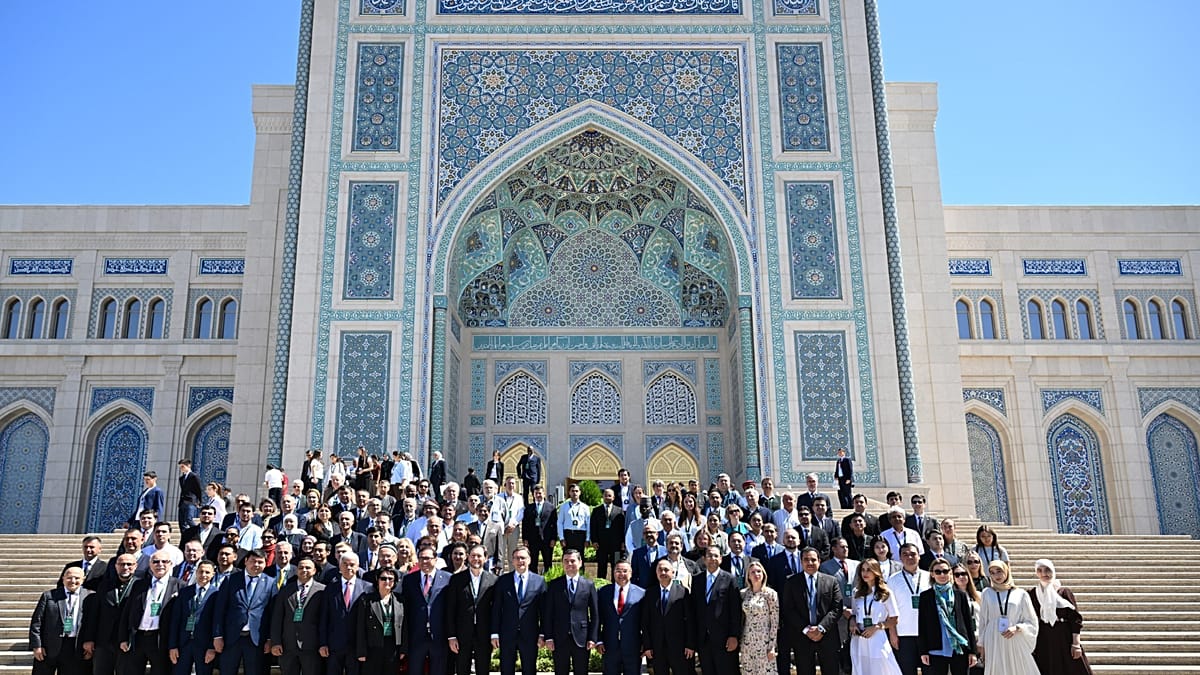
In Tashkent, the International Media Forum “Islamic Civilization: A New Perspective - New Discoveries” brought together nearly 300 journalists, researchers, publishers, filmmakers and technology experts from about 50 countries. The debates, hosted by the Islamic Civilization Center, went far beyond the event itself, focusing on how the history and heritage of Islamic societies are portrayed and how stereotypes can be dismantled.
Knowledge as the antidote to prejudice
Firdavs Abdukhalikov, the centre’s director, set the tone by arguing that misconceptions about Islam should be countered with enlightenment, not confrontation. “In the media space, we should speak not to argue, but to explain,” he said. “The most effective response to Islamophobia is enlightenment. The strongest response to misconceptions is truth. The most effective weapon against ignorance is knowledge.”
Abdukhalikov also called for a wider presentation of the scientific and cultural achievements of Islamic societies, grounded in research and evidence. He linked the forum’s purpose to President Shavkat Mirziyoyev’s 2017 address to the UN General Assembly, where he rejected attempts to associate Islam with violence and proposed a resolution on “Enlightenment and Religious Tolerance”, adopted the following year.
Self-criticism and responsibility
Hasanbey Kondu, head of Turkish publisher Mega Basım, added a nuanced layer. He insisted that distorted perceptions cannot be blamed solely on Europe or the modern West. “Islam is misunderstood and misrepresented, intentionally or unintentionally — and I include Muslims in that,” Kondu said. “It is not enough to blame Europeans or the modern world. As a Muslim, how are you presenting Islam? How have you understood it yourself? Perhaps we need to look first at our own shortcomings.”
That call for self-reflection resonated with the forum’s broader theme of responsibility. Sherzod Asadov, press secretary to Uzbekistan’s president, told foreign journalists that they were not being asked to produce positive spin. “We invite you to see it with your own eyes, talk to people, ask questions and draw your own conclusions,” he said. He also addressed the rise of artificial intelligence in journalism, arguing that while AI can expand a journalist’s capabilities, it cannot replace the core values of truth, impartiality and conscience.
Europe looks east again
The forum also highlighted Central Asia’s growing importance to Europe. Euronews CEO Claus Strunz recalled how the region had long been absent from European public discussion, appearing only in disaster reports or romanticised Silk Road tales. “That was arrogant and blind then,” he said. Institutional ties have deepened, with the first EU-Central Asia summit held in Samarkand in April 2025, upgrading the relationship to a strategic partnership. For Strunz, “It is time to look East again.” But he stressed that greater attention must be grounded in independent reporting. “We are not here to teach them. We are here to inform them.”
Historical ties and new formats
The rapprochement is set against a long history of exchange. Italian researcher Dr Mario Taddei, an expert on Leonardo da Vinci’s manuscripts, described a “Knowledge Silk Road” that carried scientific ideas from China through the Middle East into Renaissance Europe. “We believe that we invented everything, but it’s not true,” he said, citing medieval engineers Al-Muradi and Al-Jazari as examples of that cross-fertilisation.
Another connection emerged through publisher Charlotte Kramer, who presented a project based on the account of Ruy González de Clavijo, the Spanish envoy sent by King Henry III of Castile to Timur, who reached Samarkand in 1404. “We already see a very strong connection from Europe to Central Asia,” she said, pointing to both the Silk Road and diplomatic dialogue.
The forum also showcased how such historical material can be made relevant today, with presentations of books, documentaries, digital avatars and immersive platforms. Hungarian media executive Alpar Kato summed up the approach as bringing together “something modern and an old, traditional story.”
As Europe deepens its engagement with Central Asia, the challenge of accurate representation remains central. The forum’s message was clear: knowledge, evidence and independent journalism are the most powerful tools against misunderstanding.