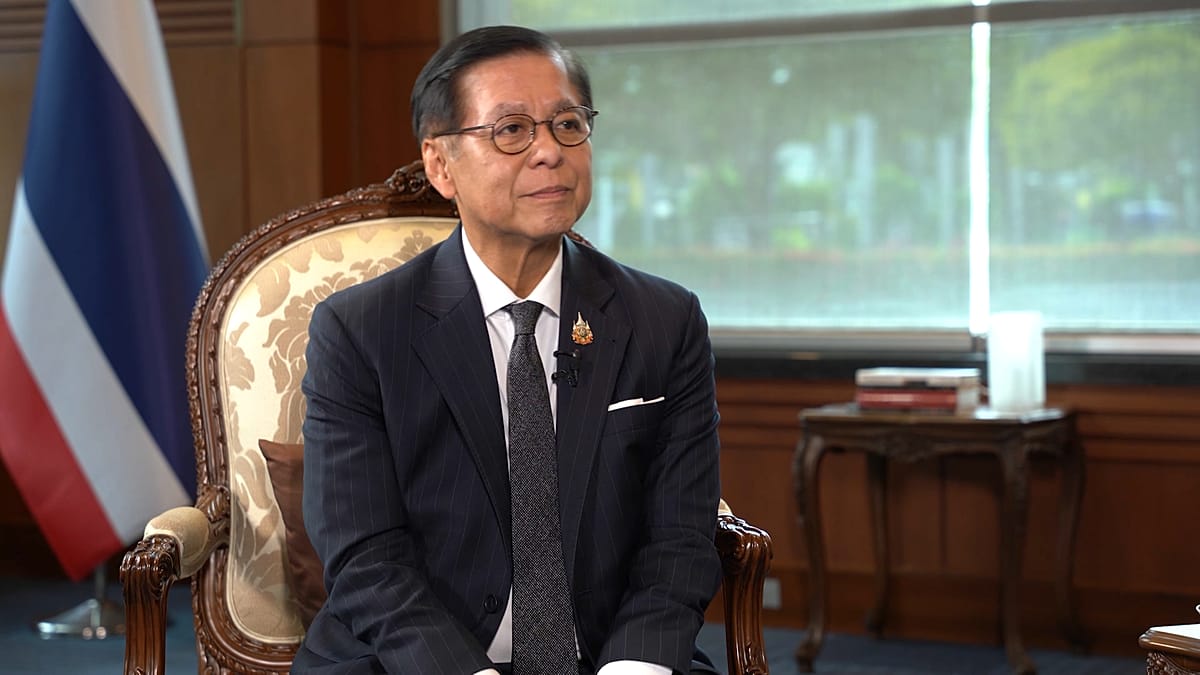
Thailand's deputy prime minister and foreign minister, Sihasak Phuangketkeow, has used a wide-ranging interview with Euronews to warn that the post-1945 architecture of international rules is eroding, and to press the case for a revived multilateralism in which smaller and middle powers are not compelled to pick a camp.
Speaking in Bangkok for the broadcaster's new global programme, the veteran diplomat — who has spent more than four decades in the foreign ministry — said the world is entering a period in which no single state can solve transnational problems alone. His remarks echo concerns voiced in European capitals from Paris to Warsaw about the fraying of the WTO, the UN Security Council and arms-control regimes.
A balancing act between Washington and Beijing
At the centre of Sihasak's message is the intensifying rivalry between the United States and China, which he described as the defining contest of the current era. Both powers, he noted, are friends of Thailand — a country of roughly 70 million people that sits at the crossroads of mainland Southeast Asia.
"We ask our friends not to force us to take sides," he said, adding that refusing to choose is not the same as neutrality, because neutrality does not always serve your interest.
He pointed to the deepening Chinese presence in Thailand's electric-vehicle supply chain, where manufacturers from Shenzhen and Shanghai have poured capital into assembly plants and battery production, as well as to the long-standing American role in regional security, including treaty alliances and naval cooperation.
For European readers, the Thai position will sound familiar. The European Union has spent much of the past decade trying to reconcile its trade and climate agenda with Beijing while depending on Washington for its security guarantee. The balancing act in Bangkok is a sharper version of the same dilemma — and one that European firms with operations in Southeast Asia watch closely.
ASEAN, Cambodia and a gradual opening to Myanmar
Sihasak framed Thailand's strategic objective as the preservation of peace and stability across a region that he characterised as a geopolitically safe zone serving a market of some 700 million people. That stability, he argued, rests heavily on the Association of Southeast Asian Nations, the ten-member bloc that has become the principal forum for pan-Asian diplomacy.
He also signalled that Bangkok is ready to rebuild its relationship with Cambodia after a period of friction, and defended a phased return to regional engagement with Myanmar, whose military government has been largely isolated since the 2021 coup. The approach mirrors the EU's own tentative steps towards re-engagement with parts of the region, though European officials have been more cautious about legitimising the junta in Naypyidaw.
The interview comes as Europe recalibrates its own Indo-Pacific strategy. Brussels has pursued trade agreements with Vietnam, Singapore and Indonesia, and has sought to present itself as a third way for Asian states wary of choosing between Washington and Beijing. Thailand's insistence on open, rules-based channels — and its warning that those rules are weakening — is a reminder that the EU's pitch depends on the credibility of the system it claims to uphold.
Whether multilateralism can be restored, as Sihasak urges, will depend on whether major powers are willing to accept constraints on their own behaviour. That question is as pressing in Brussels and Berlin as it is in Bangkok.