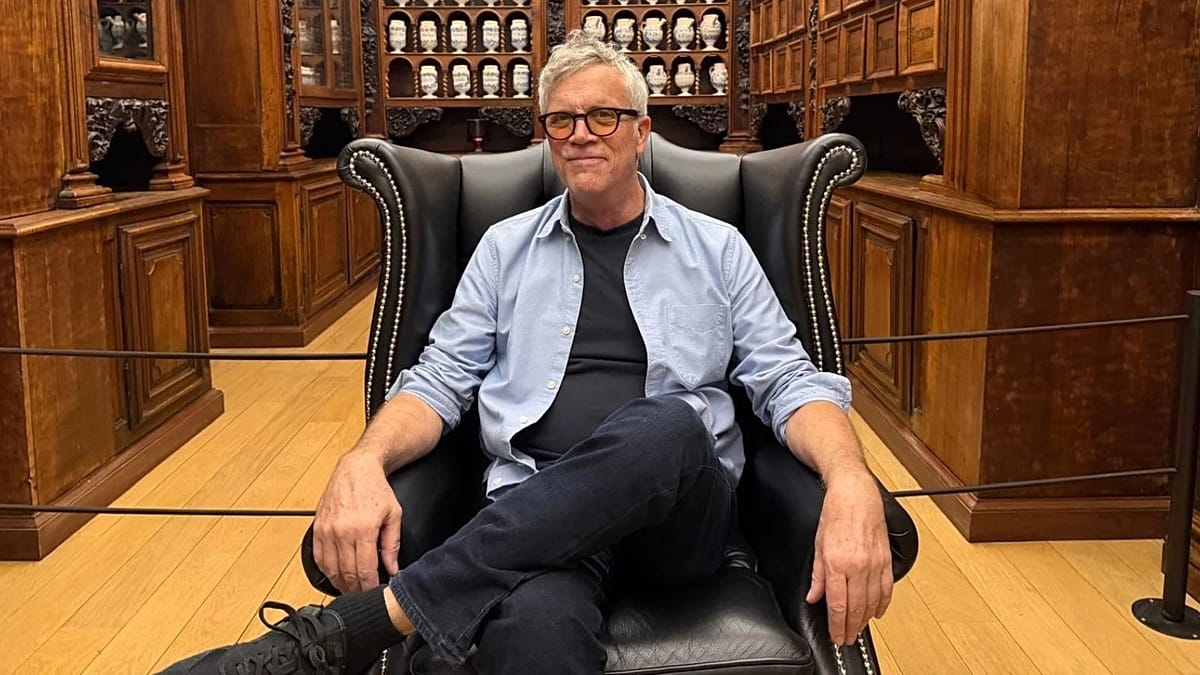
At this year's Lumière Film Festival in Lyon, the birthplace of cinema, one of the most distinctive voices in American independent film took centre stage. Todd Haynes, the director behind Far from Heaven, I'm Not There, Carol, and May December, was in town to present newly restored versions of his first two features: Poison (1991) and Safe (1995). Both films, which have rarely been seen in French cinemas since their original releases, are being screened for a new generation of audiences.
Haynes, who emerged from the New Queer Cinema movement of the early 1990s, has built a career on exploring the emotional fallout of social repression and the hidden desires of marginalised lives. His work often feels prescient, and this visit to Lyon was no exception. In a conversation with Euronews Culture, he reflected on the timeliness of his early films, the state of the film industry, and the importance of protecting creative freedom.
Poison and Safe: films born of crisis
Speaking about the audience reaction to Poison, Haynes noted that nearly every hand went up when the festival asked who was seeing it for the first time. "It was a completely full theatre," he said, "so that just demonstrates a kind of interest and curiosity about what's being shown in Lyon."
Poison was made at the height of the AIDS crisis, a period that Haynes says made such filmmaking essential. "In certain times, those kinds of conditions make creating film and documentary, and protest and organised resistance, essential," he explained. "They drive a kind of urgency that we don't always feel in our medium or our market."
Safe, starring Julianne Moore, is a more oblique response to the same era. It tells the story of a suburban housewife who becomes convinced that her environment is making her ill. Haynes says the film is "inconceivable without the AIDS era as a framework," even though it is set far from the battlefield. The themes of illness, bodily alienation, and the fragility of everyday assumptions remain disturbingly relevant.
During the COVID-19 pandemic, Safe found a new audience, and Haynes received articles about it. "Sadly, these issues remain relevant when we're hit by things that are overwhelming and that challenge every single aspect of the way we lead our lives," he said.
A call to protect freedoms
Haynes was candid about the political climate in the United States and beyond. "It is a time to remember how important it is to protect our freedoms, and our ability to speak freely," he said. He pointed to ongoing battles over reproductive rights and the acceptance of queer and trans communities, noting that "one does feel at times like we're in a replay, if not crashing backwards in battles we've fought."
The director drew on the influence of Jean Genet, the French writer and playwright whose work celebrated the subversive potential of marginality. "For him, his queerness, it came out of a criminal background," Haynes said. "He liked that homosexuality had this criminal aspect to it. He used that as a way of weaponising his critique of dominant culture." Poison, he added, was made at the end of the 1980s, "and we needed a voice like that."
Haynes's comments resonate beyond the United States. Across Europe, debates about LGBTQ+ rights, free expression, and the role of art in public life are intensifying. In Hungary, for example, the parliament recently voted to scrap anti-LGBTQ+ child protection clauses, a move that has drawn both praise and criticism. The fight for cultural and political freedoms is not confined to any one country.
The changing landscape of cinema
Haynes also spoke about the consolidation of media companies and the challenges facing independent filmmakers. "It's distressing when you see the conglomeration of huge media organisations that one might imagine would provide enough revenue and foundation for risk-taking to still occur," he said. "But sadly, that doesn't always happen."
Despite these challenges, Haynes remains committed to the power of cinema to provoke thought and inspire change. His upcoming film, De Noche, is already generating anticipation. At the Lumière Festival, his presence was a reminder that even in difficult times, artists can find ways to speak truth to power.
The festival, which celebrates the history and future of film, is an ideal setting for such reflections. As Haynes noted, it is "a celebration of movies of all kinds, of every genre, of every era." For audiences in Lyon, the chance to see Poison and Safe on the big screen is a rare opportunity to experience the work of a filmmaker who has never shied away from difficult questions.
In an era of political polarisation and cultural backlash, Haynes's message is clear: the freedom to create and to speak openly must be defended. As he put it, "It is a time to remember how important it is to protect our freedoms."