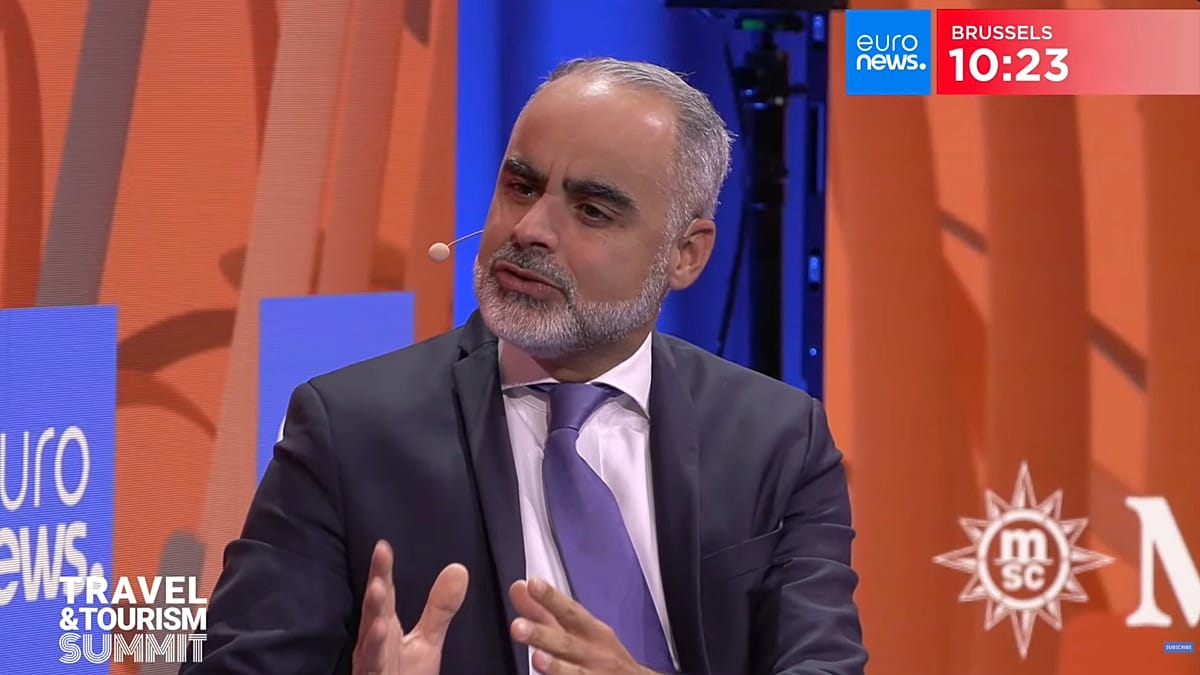
Climate change is no longer just an environmental concern for the tourism industry—it is now a direct driver of travel costs, according to Eduardo Santander, CEO of the European Travel Commission. Speaking at the Euronews Travel & Tourism Summit in Brussels, Santander argued that the effects of a warming planet are being felt in the price of holidays and business trips alike.
“Climate change is very much related to travel costs,” Santander said, pointing to the ways in which extreme weather, shifting seasons, and the need for adaptation are reshaping the economics of tourism. He noted that these higher costs are altering how people perceive and experience travel, with implications for destinations across the continent.
Labour shortages and a changing workforce
Beyond climate, Santander highlighted a persistent challenge for the sector: labour shortages. Several European countries are increasingly dependent on workers from outside the continent to fill roles in hospitality, transport, and tourism services. This reliance, he suggested, reflects broader demographic and economic pressures that are unlikely to ease soon.
The tourism chief also emphasised that Europe remains heavily reliant on intra-European travel. While the United States continues to be a vital long-haul market, the bulk of tourism movement within the region comes from Europeans themselves. This dynamic, Santander argued, makes the sector particularly sensitive to internal economic and environmental shocks.
Santander’s remarks come as Europe’s tourism industry grapples with the dual challenges of sustainability and competitiveness. Recent data shows that six of the world’s top ten tourist destinations are in Europe, underscoring the continent’s enduring appeal. Yet the industry is also bracing for more frequent climate-related disruptions, from wildfires to heatwaves, which can deter visitors and strain local infrastructure.
The link between climate and cost is not abstract. As Europe braces for a record El Niño, experts warn that extreme weather events could become more common, pushing up insurance premiums, maintenance costs, and even food and water prices in tourist hotspots. These pressures are likely to be passed on to travellers, making holidays more expensive and potentially less accessible.
Santander’s comments also resonate with broader concerns about the economic impact of climate change. For instance, a recent warning suggested that a Ukraine grain blockade could add $60 billion to global food costs, illustrating how environmental and geopolitical factors can ripple through economies. In tourism, similar dynamics are at play, as climate-related disruptions to supply chains and energy prices feed into the cost of travel.
The European Travel Commission’s focus on these issues signals a shift in how the industry views its future. Rather than treating climate change as a distant threat, tourism leaders are now integrating it into their business models and strategic planning. Santander’s message is clear: the cost of travel is not just a matter of market forces—it is increasingly a reflection of the planet’s health.
As Europe looks ahead, the challenge will be to balance the economic benefits of tourism with the need to reduce its environmental footprint. For Santander, that means acknowledging that climate change is not an external factor but a central variable in the industry’s equation. “We have to adapt,” he said, “and that adaptation comes with a price.”