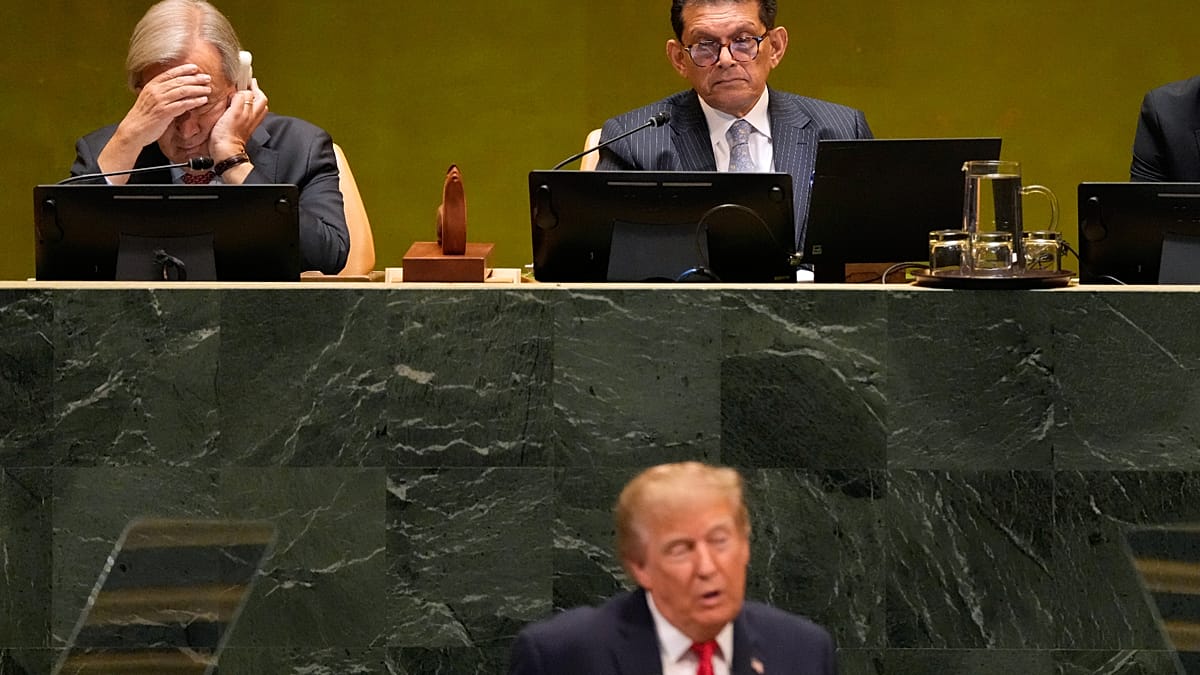
New York — The future of artificial intelligence took center stage at the United Nations General Assembly on Tuesday, where US President Donald Trump and UN Secretary-General António Guterres offered sharply contrasting visions for governing the technology. Their clash set the tone for a week of high-level debates, with European leaders pushing for a cooperative approach that balances innovation with protection.
Guterres, delivering his farewell address to world leaders, used stark language to urge caution. Citing a new UN science report that warns of a small but real risk of catastrophic and irreversible harm, he declared: “Let us resolve that life-and-death decisions must never be surrendered to machines. Killer robots must have no place in our future.” He called for “responsible pacing of AI” and additional safeguards to address risks, echoing concerns he first raised a decade ago.
Less than an hour later, Trump rejected such alarmism. “The United States also totally rejects any attempt to construct a globalist scheme to control for the artificial intelligence being spoken of so much,” he said, adding that the technology should be called “super intelligence” instead. He dismissed warnings as coming from the same people who “said we’ll all be dead in 12 years because of global warming” and now claim “AI is going to kill us all.”
European leaders chart a middle path
Between the two poles, several European leaders argued for a pragmatic, collaborative approach. French President Emmanuel Macron focused on protecting children, urging immediate action: “Let’s not wait for the consequences to come raining down on AI. We must act now to protect our children and our young people.”
Finnish President Alexander Stubb called AI “the most consequential technology in the history of mankind” and stressed that humans must remain in control. “We have a choice. We can compete, cooperate or slow down. For me, cooperation is the best way forward,” he said.
British Prime Minister Andy Burnham, speaking to business leaders on the sidelines, advocated for “a single set of global principles and standards” to unlock AI’s potential while mitigating risks. He said “AI for good” would be a central theme of the UK’s G20 presidency next year.
University of Chicago computer science chair Henry Hoffmann criticized both Trump and Guterres for oversimplifying the debate. “One turns it into a science-fiction movie; the other turns it into a nonissue,” he said. “Both push people to pick a team instead of engaging with the real risks and the possible mitigations.”
The UN Security Council is scheduled to hold a dedicated session on AI on Wednesday, featuring testimony from leading AI developers, including Sam Altman of OpenAI, Dario Amodei of Anthropic, and Clément Delangue of Hugging Face. Their presence underscores the growing urgency to establish guardrails, even as the US-China race intensifies.
For Europe, the stakes are high. As AI reshapes NATO's eastern flank, and with new trade risks affecting energy supplies, the continent is seeking a unified voice in the global AI debate. The coming months will test whether that voice can translate into concrete international agreements.