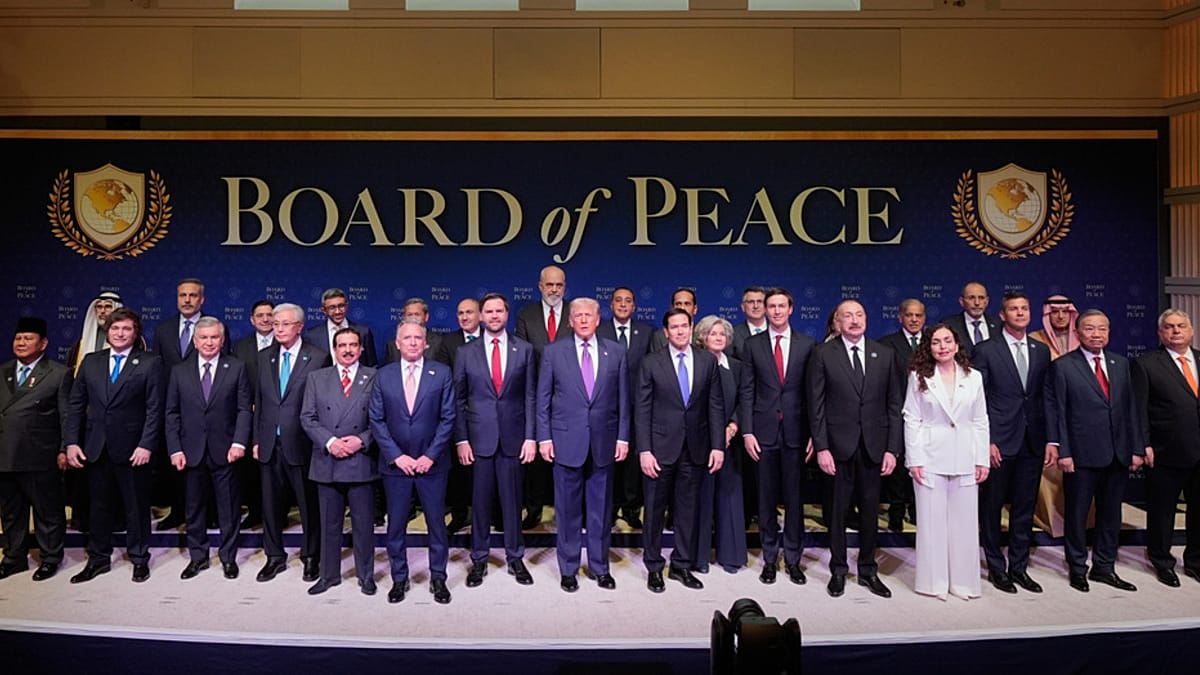
US President Donald Trump has announced what he describes as a "historic deal" brokered by the Board of Peace to disarm Hamas and other armed factions in Gaza, alongside a full Israeli military withdrawal from the territory. The announcement, made via a post on Truth Social on Thursday, comes nine months after a US-brokered ceasefire ended Israel's two-year offensive against the enclave, signed in October last year in Egypt's Sharm el Sheikh.
Trump framed the agreement as a "monumental step" towards a new political order in Gaza. "This agreement is a critical step towards Gaza finally being governed by a new Palestinian government that will work closely with the Board of Peace to help the Palestinian people," he wrote. "At the same time, Israel will have the security it deserves, with Gaza no longer used as a base for terror attacks."
The deal aims to break a long-standing deadlock between Israel and Hamas over the second phase of the ceasefire, which had stalled on the issues of disarmament and reconstruction. Neither Hamas nor Israel has yet publicly confirmed their acceptance of the terms.
Phased implementation and lingering questions
Trump said the agreement would implement his 20-point peace plan in "carefully structured phases," but offered no specific timeline for completion. The plan calls on Hamas to surrender its weapons and dismantle its extensive tunnel network. It also envisions a new technocratic Palestinian government, to be led by former UK Prime Minister Tony Blair, who would oversee Gaza's rebuilding.
Once disarmament is complete, Israel would withdraw its forces and hand over security responsibilities to a new "International Stabilisation Force," which would work alongside Palestinian police to maintain order in Gaza.
US and Board of Peace officials, speaking anonymously under White House guidelines, gave an optimistic assessment but acknowledged the lack of concrete deadlines. They said the Gaza police force would hand over its weapons to the new administration within two weeks. However, this does not include the vast majority of Hamas militants or heavy weaponry, which are expected to be surrendered later in a process that could take between 200 and 350 days, according to a Board of Peace official.
Israel remains deeply sceptical about Hamas's willingness to give up its arsenal or relinquish control of Gaza. A US official said Israel had been consulted at every step and was not being asked to do more than it had already committed to under Trump's 20-point plan, which involves withdrawing its forces and ending airstrikes. The official added that Trump would be "very, very disappointed" if Israel did not adhere to the agreement.
The war, which began after Hamas's 7 October 2023 incursion into southern Israel, has killed at least 73,000 Palestinians, according to Gaza's Health Ministry, including those killed since the ceasefire.
Trump met Israeli Prime Minister Benjamin Netanyahu at the White House on Tuesday, but neither leader disclosed details of their discussions, which came amid their joint military campaign against Iran. Earlier this month, Hamas announced it had dissolved its government in Gaza and was preparing to transfer power to a UN-backed technical committee as part of the ceasefire deal.
The announcement comes as European diplomats remain divided over how to address the Israeli-Palestinian conflict, with EU ambassadors deadlocked on sanctions for Israeli settlements. The bloc's stance on the region continues to be a point of contention among member states.
Meanwhile, the broader geopolitical landscape is shifting, with Trump set to host both Zelenskyy and Netanyahu in a dual diplomatic test. The US president's approach to the Middle East and Ukraine remains closely watched by European capitals.