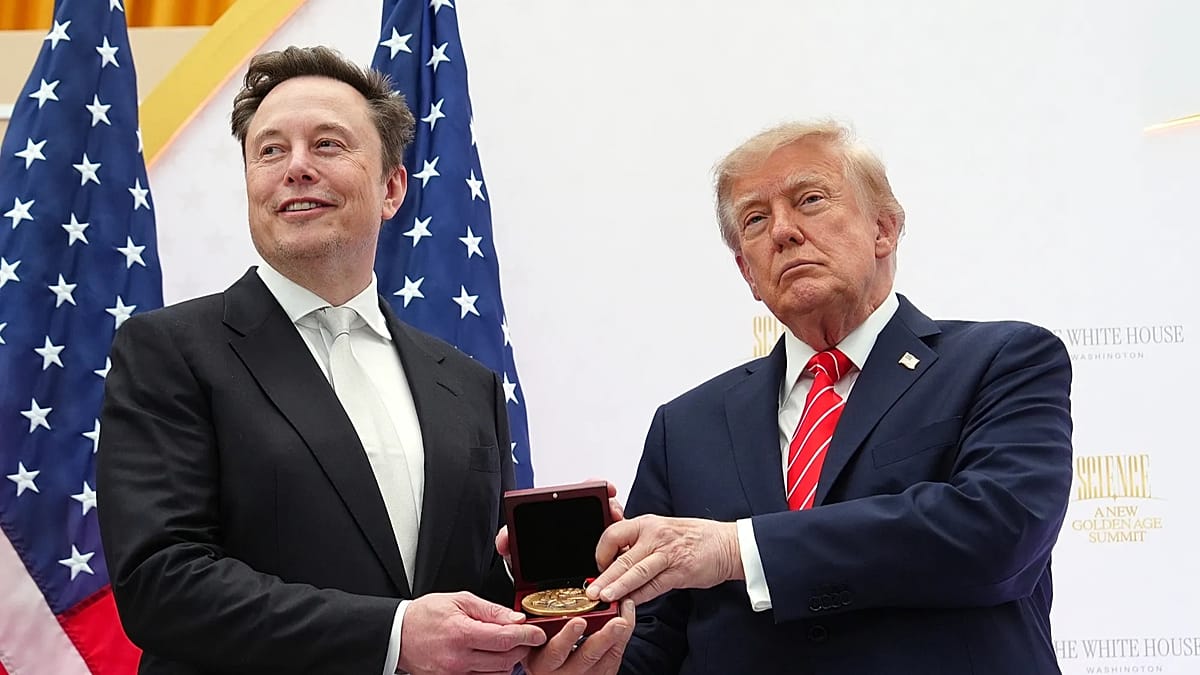
In a ceremony at the Institute of Peace in Washington, D.C., President Donald Trump presented the National Medal of Science to Elon Musk, alongside other technology luminaries including Google co-founder Sergey Brin, Nvidia CEO Jensen Huang, and AMD chief Lisa Su. The event, held on Thursday, celebrated what Trump described as the "exciting advance of science and technology in the golden age of America."
Turning to Musk, Trump lavished praise on the Tesla and SpaceX chief, calling him an "industrial titan" and "our modern-day Thomas Edison." He added: "Few Americans in history have done more to advance America's national interest than Elon in one field after another. His genius and determination have made science fiction into reality."
The president's warm words, however, mask a relationship that has been anything but steady. Over the past year, Musk and Trump have swung between close collaboration and public acrimony. Musk joined Trump's campaign in its final stretch and later took a high-profile role as de facto leader of the Department of Government Efficiency (DOGE), tasked with slimming down the federal bureaucracy. But their alliance fractured when Musk criticised Trump's signature spending bill, the "One Big Beautiful Bill," sparking a bitter and very public feud.
Back in the fold
Despite the fallout, Musk has recently re-entered Trump's inner circle. Reports indicate that Musk is set to co-direct "Project Meridian," a Department of Defense initiative examining the future of warfare. The project aims to identify the weapons and technologies the US military will need, and to propose "actionable solutions to start developing, testing and fielding these capabilities."
This latest honour underscores the cyclical nature of their alliance. For European observers, the spectacle of a president awarding his country's highest scientific honour to a businessman whose companies dominate electric vehicles, space launch, and satellite internet carries broader implications. Musk's ventures—Tesla, SpaceX, and Starlink—have deep ties to European markets and regulators. His recent decision to rename SpaceXAI to SpaceXSI, adopting Trump's "super intelligence" terminology, has already stirred interest, including a surge in Slovenian .si domain registrations.
The award also highlights the growing influence of tech billionaires in US policy circles, a trend that resonates across the Atlantic. European leaders have watched with a mix of fascination and concern as Musk's political manoeuvring has at times intersected with European affairs. His role in the reported shaping of US decisions via his Grok chatbot has raised eyebrows in Brussels, where digital governance and the rule of law remain central concerns.
For now, Musk's rehabilitation appears complete. The National Medal of Science is a lifetime achievement award, and Trump's comparison to Edison—an inventor who transformed modern life—places Musk in rarefied company. Whether the relationship endures is another matter. As the president himself noted, "You're my friend and all of that," a phrase that hinted at the conditional nature of their bond.
For Europe, the episode serves as a reminder that the US tech landscape is increasingly shaped by personal alliances at the highest political level. With Musk's companies operating extensively in Europe—from Tesla's Gigafactory near Berlin to Starlink's satellite services over Ukraine—the stability of his political connections in Washington will continue to have ripple effects on the continent.