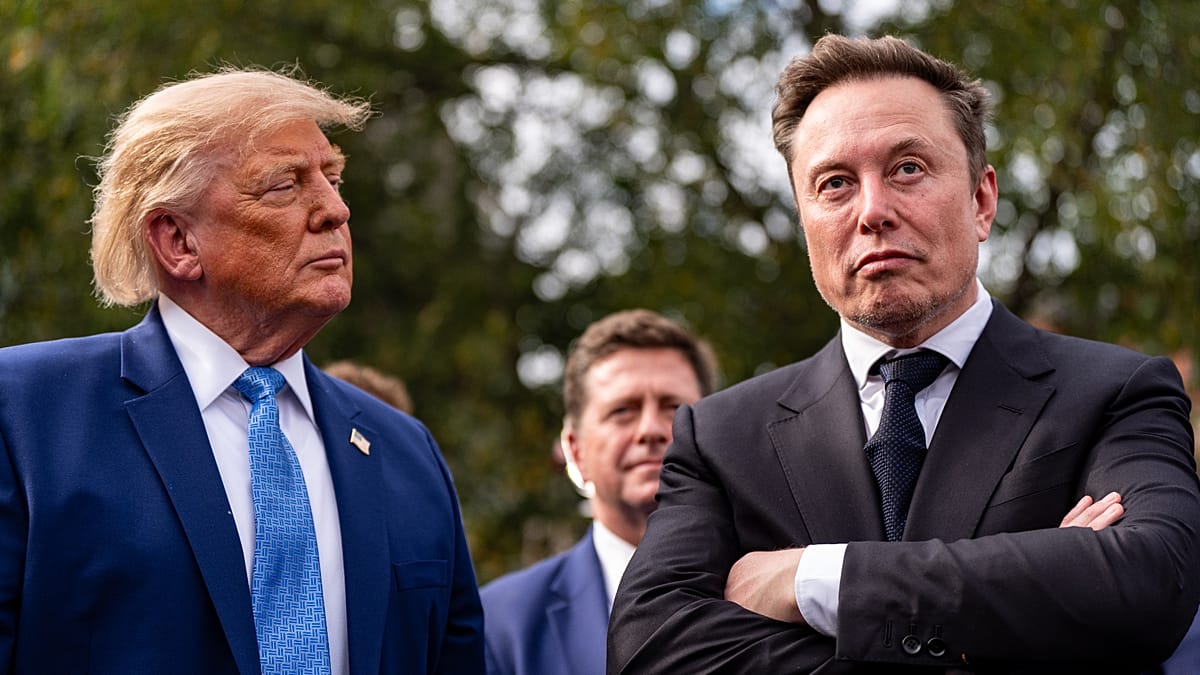
In December 2025, Elon Musk held a secret meeting with US President Donald Trump at the White House, where Trump spent hours querying Musk's AI chatbot Grok about his presidency and legacy. According to Time magazine, one question was particularly striking: how would Venezuelans react if US forces captured President Nicolás Maduro?
An official present at the meeting told Time that Grok responded by describing Maduro as a repressive and deeply unpopular dictator, predicting that many Venezuelans would celebrate his downfall. When US forces did capture Maduro in January 2026, large celebrations erupted across Venezuela, seemingly validating the chatbot's assessment. Trump reportedly came away from the experience convinced that Grok was "ingenious."
The meeting took place seven months after Musk stepped down from his role at the Department of Government Efficiency (DOGE), yet its timing aligns with a period of intense US-Venezuelan tensions. In December, the Trump administration was conducting Operation Southern Spear against drug cartels, had imposed a maritime blockade, and had designated Maduro's government as a "Foreign Terrorist Organization." Behind the scenes, the administration was also drafting transition plans in case they decided to oust Maduro and seize the country's oil and mineral wealth.
Time's report suggests that Grok may have been the decisive factor in Trump's decision to proceed with the capture. This revelation comes amid a broader surge in AI adoption across the US government, with tools like Google's Gemini and Musk's Grok being used in public services such as Medicare, government job applications, and even defence systems, including integration into fighter jets. OpenAI's ChatGPT, Meta's Llama, and Anthropic's Claude have also been approved for certain government functions.
The report lands in the same week that Musk returned to an official government role for the first time since leaving DOGE. On Wednesday, US Defense Secretary Pete Hegseth named Musk, Anduril founder Palmer Luckey, and former Republican House Speaker Newt Gingrich to co-lead a new Pentagon study on the future of warfare. The appointment has raised concerns about conflicts of interest, as both Musk and Luckey run companies with substantial defence contracts. Musk's SpaceX is already building satellite networks for Trump's planned Golden Dome missile defence shield.
AI's growing influence on foreign policy
The use of AI in high-stakes decision-making is not confined to the United States. European governments are also exploring AI applications in defence and diplomacy, but with a more cautious approach. The EU has proposed a voluntary AI accord, contrasting with Brussels' binding rulebook, which aims to regulate AI use while fostering innovation. This divergence highlights the transatlantic debate over how much autonomy to grant AI systems in sensitive areas.
For European observers, the Maduro episode raises troubling questions about the reliability of AI advice in geopolitical crises. While Grok's prediction proved accurate in this instance, critics warn that AI models can be biased, lack context, and may not fully grasp the complexities of international relations. The European Parliament has been vocal about the need for human oversight in AI-driven decisions, particularly in security and defence.
Meanwhile, the Pentagon's new study on future warfare, co-led by Musk and Luckey, is likely to further integrate AI into military strategy. This development is being watched closely in European capitals, where defence planners are grappling with similar questions about AI's role in conflict. The Pentagon's new study could set precedents that influence NATO's approach to AI in the coming years.
The broader context of US-Venezuela relations also has European implications, as the EU has historically maintained a diplomatic stance on Venezuela, supporting dialogue and democratic processes. The US military operation and subsequent capture of Maduro have been met with mixed reactions in Europe, with some governments expressing concern over the precedent of unilateral action.
As AI continues to permeate government functions, the line between human judgment and machine advice becomes increasingly blurred. The Time report serves as a stark reminder that even the most powerful leaders may be swayed by algorithms, a prospect that European policymakers are keen to address. The EU's cross-border emergency communications network is one example of how Europe is building resilience against such dependencies, ensuring that critical decisions remain grounded in human oversight.
For now, the full extent of Grok's influence on Trump's decision-making remains unclear, but the implications are profound. As AI tools become more sophisticated, their role in shaping global events will only grow, making it imperative for governments—both in Washington and in European capitals—to establish clear guardrails.