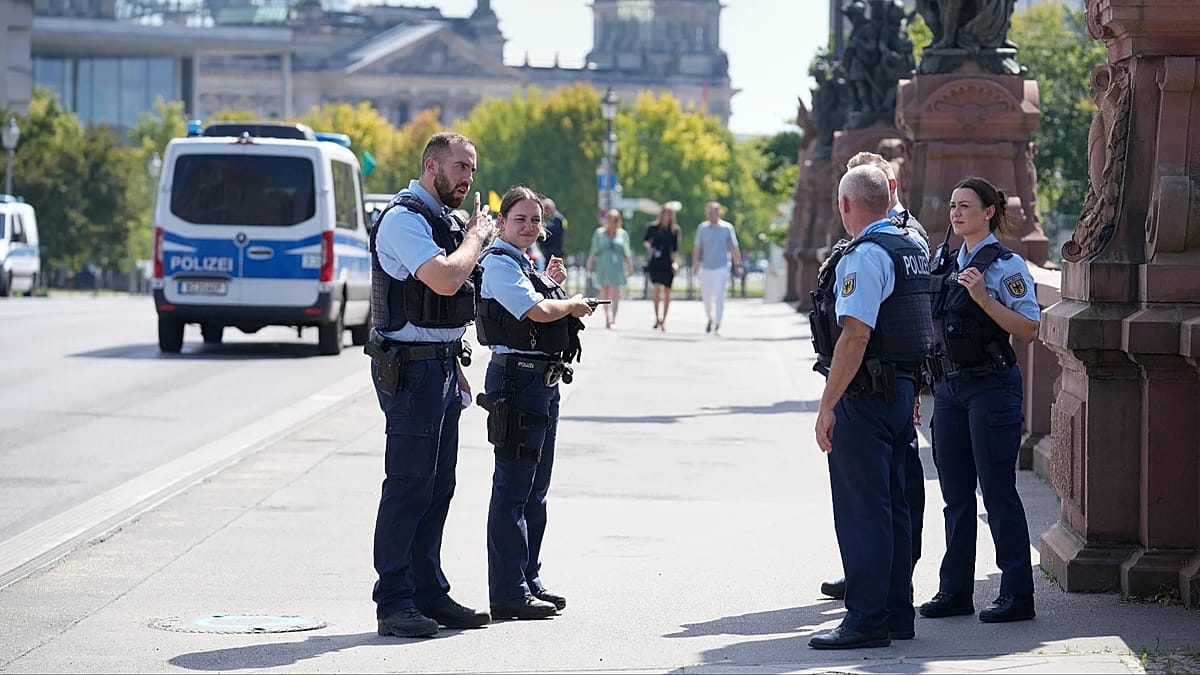
The European Commission has tabled plans for a bloc-wide communication network that would let police, firefighters and other first responders stay in contact when they cross national borders. The proposal, unveiled on Wednesday, is designed to replace the patchwork of national radio systems that currently go silent at frontiers, complicating joint operations during disasters or security incidents.
Under the current setup, emergency services in the 27 EU member states rely overwhelmingly on radio for mission-critical communications. But those secure channels are typically national in scope, and they stop working the moment a responder steps into a neighbouring country. Brussels argues that this is no longer acceptable in a union where crises rarely respect borders.
“When crisis strikes, our first responders must be able to communicate instantly across agencies, across borders, across Europe,” said Magnus Brunner, the EU commissioner for internal affairs, as he presented the plan.
From radio to broadband
The proposed “EU Critical Communication System” would encourage member states to move their emergency communications from radio to broadband technologies such as 5G. Most countries are already planning such upgrades, the Commission notes, but the EU wants to ensure that the resulting national systems can interoperate.
To achieve that, Brussels would set up a central hub to coordinate traffic between national networks, and a monitoring centre to track cyber security threats and provide support to member states. The system would also rely on EU satellites as a backup if terrestrial networks fail, for instance during a power blackout.
Broadband offers a significant upgrade over radio: responders could share live video, text messages and geolocation data in real time, typically using a smartphone. The plan does not mandate a specific device, leaving procurement decisions to national authorities.
EU officials cited wildfires, counter-terrorism operations, drone threats and search-and-rescue missions in the Mediterranean as scenarios where the technology could prove decisive. Military forces would also be allowed to use the system if they choose.
Real-world failures
Brunner pointed to concrete examples where the current system has let Europeans down. During the massive wildfire this summer in Belgium’s High Fens nature reserve, which borders Germany, “the moment a first responder had to cross the border, their radio actually stopped working,” he said.
He also recalled a shooting in the Netherlands that occurred just 200 metres from the Belgian border, triggering a cross-border police chase “where every minute counted.” Yet the Dutch operational centre in Maastricht could not directly alert its counterpart in Liège, on the Belgian side, and therefore officers on the street.
The Commission said the critical components of the system would be developed by European companies. Officials speaking on condition of anonymity listed Airbus, Italy’s Leonardo and Austria’s Frequentis among firms that have taken part in a pilot. The satellite backup could come from the EU’s Iris² constellation, a project currently under development.
The proposal is part of a broader push to strengthen European resilience, a theme that has gained urgency amid cross-border threats and hybrid attacks. It also echoes concerns raised by the UN about protecting radio bands essential for weather and climate monitoring, though the EU plan focuses on emergency communications.
If adopted, the system would be rolled out gradually, with full interoperability expected by 2036. The Commission will now seek feedback from member states and the European Parliament before finalising the legislative proposal.