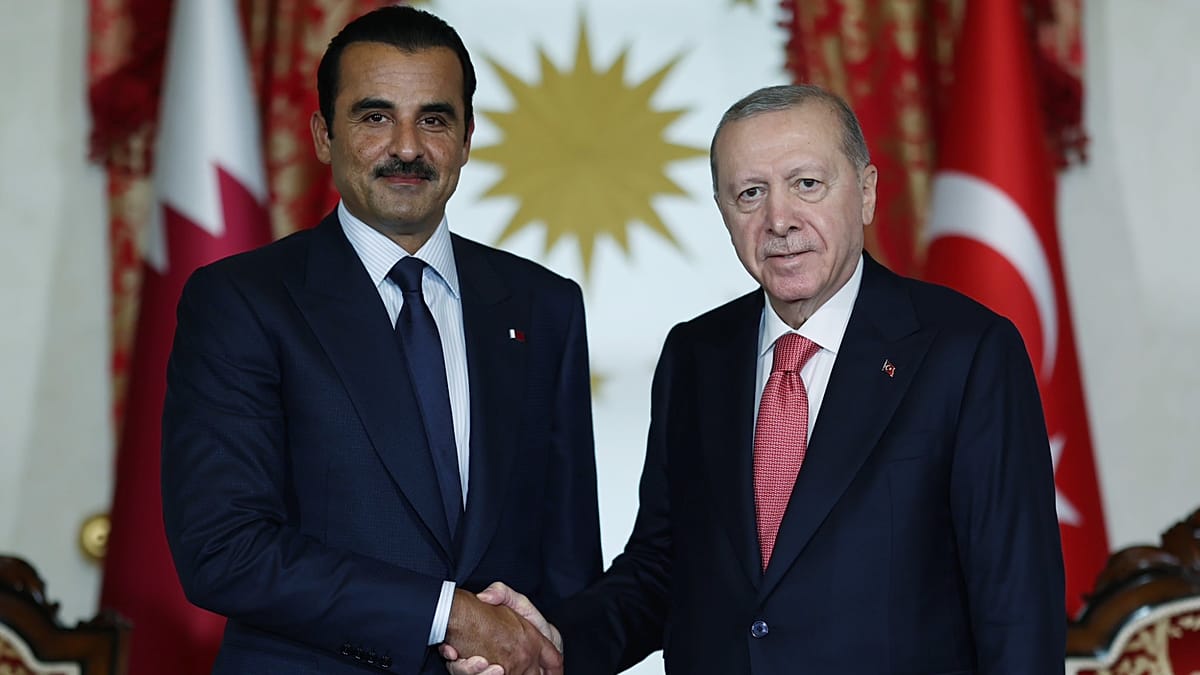
Turkey and Qatar signed a landmark mutual defence agreement on Friday, cementing a strategic partnership that both sides say will strengthen collective defence and regional stability. The deal, concluded during a meeting of the Supreme Strategic Committee in Istanbul, commits the two countries to adopt a unified position in the face of any external armed attack targeting either party.
Turkish President Recep Tayyip Erdogan and Qatar's Emir Sheikh Tamim bin Hamad Al Thani co-chaired the talks, which also produced a series of bilateral accords covering trade, energy, diplomacy, education and culture. A joint statement said the defence agreement aims to "bolster collective defence and achieve regional security and stability," and that the two sides would hold consultations on security threats, conduct joint military exercises, cooperate in defence industries, and exchange personnel training.
Erdogan's office said the pact would "add a new dimension to the brotherly ties between the two countries." In remarks reported on X, the Turkish president said the two nations would continue working together "to prevent the resurgence of war in the Gulf region and establish a basis for dialogue and achieve peace."
The leaders also discussed Israel's military operations in Gaza and the humanitarian situation there, as well as efforts toward normalisation in Syria and recent developments in Libya. The meeting comes as regional defence alignments are being redrawn at remarkable speed, triggered by the Iran war and by signals from Washington that it is adjusting its long-standing security posture in the Middle East.
A new map of defensive alliances
Turkey, Qatar, Saudi Arabia, Pakistan and Indonesia have been shaping a new network of defence pacts over the past few months. In August, Turkey, Pakistan and Saudi Arabia signed the "Mecca Joint Defence Agreement," a regional pact under which the three countries would come to each other's aid if one came under attack. That agreement, ratified by the Turkish parliament last week, links NATO member Turkey—which fields the alliance's second-largest military—with Pakistan, the Muslim world's only nuclear-armed state, and Saudi Arabia, the Gulf's leading power. Ankara has stressed that the pact is not directed at any other country and remains open to other states, including Egypt.
Also in August, Pakistan and Kuwait signed a joint defence and military cooperation agreement. The flurry of bilateral and trilateral deals reflects a broader trend: Gulf nations still regard the US security umbrella as central, but they are diversifying their defence strategies in an era of "no war, no peace" and shifting American priorities.
The Turkey-Qatar agreement is the latest in this series of realignments. Qatar has long hosted a Turkish military base, and the two countries have coordinated closely on regional issues, including Libya and the Gulf crisis of 2017-2021. The new pact formalises and deepens that cooperation, giving it a mutual-defence dimension that goes beyond previous arrangements.
For European observers, the development carries implications beyond the Gulf. Turkey is a NATO member and a key actor in the Eastern Mediterranean, the Middle East and North Africa. Its expanding defence ties with Gulf states could affect European security calculations, particularly as the EU seeks to engage more with the region. The EU and Qatar have already planned defence talks in Doha to deepen security cooperation, and Brussels has been exploring ways to bolster its own defence industrial base, as MEPs have warned about funding and red tape hampering start-ups in the sector.
Erdogan's statement that Turkey and Qatar will work to "prevent a renewed outbreak of war in the Gulf region" underscores the preventive intent of the agreement. But the rapid expansion of regional defence pacts also raises questions about the future architecture of Middle East security, and about how Europe fits into that picture. As Washington recalibrates its commitments, European capitals may need to decide whether to engage with these new alliances or watch from the sidelines.
The agreement was signed in Istanbul, a city that has become a hub for Turkish-Qatari diplomacy. The two leaders also oversaw the signing of economic and cultural agreements, reflecting a relationship that extends well beyond security. For Qatar, the pact with Turkey provides an additional layer of protection in a volatile neighbourhood; for Turkey, it reinforces its role as a security provider in the Gulf and beyond.