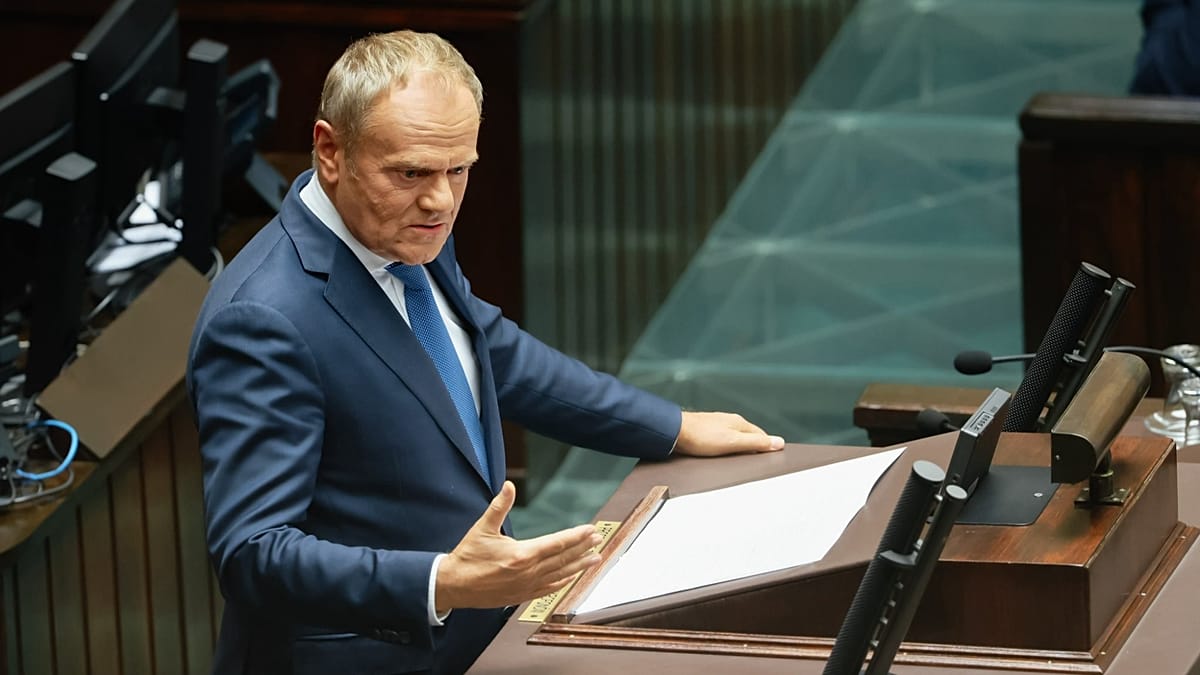
Polish Prime Minister Donald Tusk delivered a stark warning to parliament on Tuesday, saying that intelligence services have concluded Russia is preparing hybrid attacks, including drone and missile strikes, against countries that support Ukraine, with Poland explicitly named as a target. Speaking in the Sejm, Tusk described the coming months as the most critical phase of the war so far, and urged Poles and European allies to brace for "serious events."
"It is a scenario involving serious events and requiring us to be focused, serious and, above all, mentally ready to pass difficult tests," Tusk said. He stressed that such tests "certainly lie ahead for all Poles," and that the period until early spring would be decisive, as "according to all sources, it is late autumn and winter that will be the most critical phase of the Russian-Ukrainian war so far."
A new kind of drone
Tusk pointed to a significant and worrying development: Russia is now mass-producing jet-powered drones that fly at much higher speeds and altitudes before diving onto their targets. He noted that few countries are effectively prepared to counter them, adding that "this is work we, too, have to do." The prime minister announced he would travel to Ukraine to discuss with President Volodymyr Zelensky how to cooperate within the anti-ballistic coalition and make use of Ukraine's expertise and capabilities in this area.
He also referenced the energy truce that US President Donald Trump had previously suggested but that has not materialized. "Since then, there have been many attacks, including on energy infrastructure in Ukraine. We must therefore assume this will continue, which also has consequences for Poland, as these attacks are increasingly targeting installations very close to our border crossings with Ukraine," Tusk said. Russia's aim, he added, is to destroy Ukraine's economy and logistics on as large a scale as possible. "For now, Ukraine's," he added pointedly.
Six cities under threat
The Polish leader said that constant, high-frequency strikes are expected on six key Ukrainian cities, along with the destruction of stockpiles of essential supplies and railway infrastructure. He recalled that in recent weeks, Russian forces have destroyed more than 300 Ukrainian railway locomotives.
Turning to the threat against NATO members, Tusk said that "in the assessment of intelligence services, Russia's plans also include hybrid strikes with drones and missiles on states supporting Ukraine, including Poland." Such possibilities have been mentioned for some time, but now, he stressed, the information is already "highly consistent and, unfortunately, persuasive."
He described the likely nature of these attacks: "so-called 'accidental'" strikes aimed at paralyzing or weakening NATO members' motivation to invoke alliance provisions in the event of aggression. "There is a real risk that the territory of one or several NATO countries on the eastern flank may be entered by drones or other types of missiles, which may even cause destruction. And the official narrative will be that this is an accident and that there is no reason for anyone to contemplate any response from NATO," he said.
Russia's objective, according to Tusk, is "to weaken NATO's overall cohesion and, above all, to convince NATO countries that Article 5 is more theoretical than practical." Such "accidental" strikes may be repeated, he warned.
Call for unity
Tusk also addressed Russia's strategy of seeking political change in some European countries, pointing to upcoming elections and the presence of openly pro-Russian forces. He appealed to politicians across the spectrum, specifically addressing MPs from the Confederation party, "under no circumstances to take part, whether inadvertently or deliberately, in promoting narratives that Russia cares deeply about."
"Whipping up hostility towards the European Union, towards our allies, towards Ukrainians, is directly implementing Russia's strategy. Everyone must finally understand this," he underlined.
In closing, Tusk called on all present in the Sejm to "speak with one voice, take joint decisions, hesitate no longer and show that, regardless of political views, we are all patriots in a moment of trial" when it comes to the security of borders, Polish airspace and people's homes. He noted that some politicians in Europe "are just waiting for an alibi" so that, in the event of conflict, they can argue: "We will not die for Poland, we will not perish for Latvia or Lithuania."
The warning comes amid heightened tensions on NATO's eastern flank. Recent incidents, such as NATO jets downing a drone over Lithuania, underscore the growing risk of escalation. Poland has already scrambled jets in response to Russian strikes near its border, as reported earlier. Meanwhile, Russian attacks continue to devastate Ukrainian cities, including Odesa and Sumy, and have killed civilians on a bus in southern Ukraine, as detailed here.