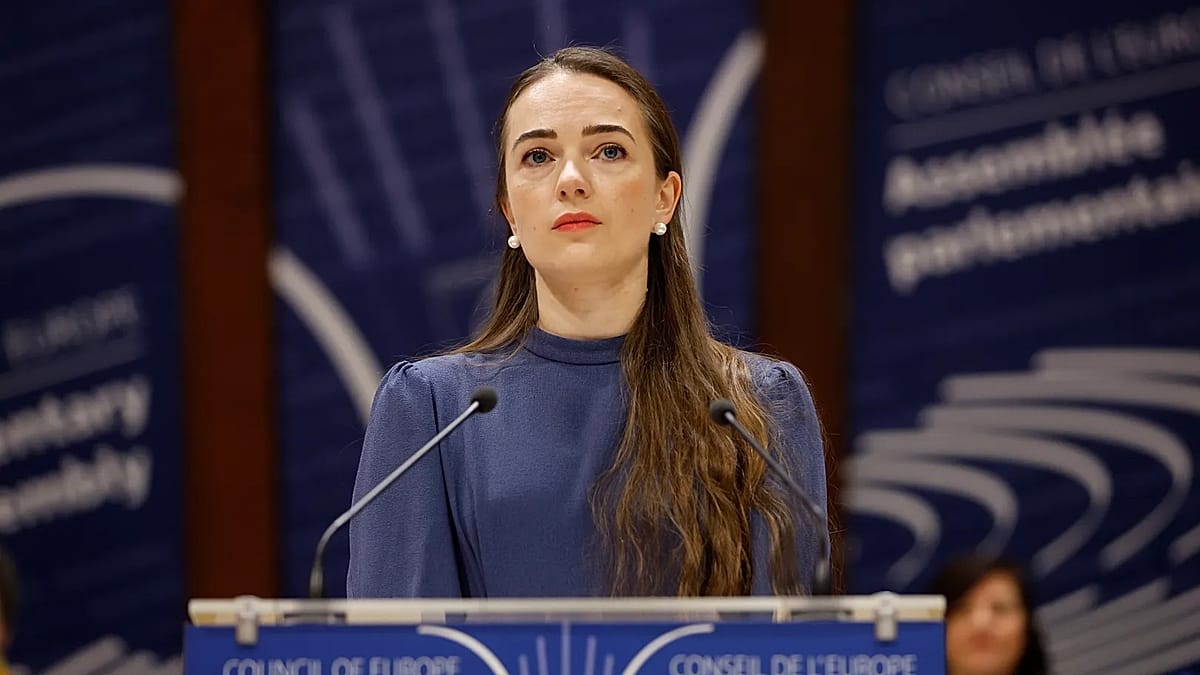
STRASBOURG — Ukrainian human rights defender Oleksandra Matviichuk accepted the European Order of Merit in the European Parliament on Tuesday with an emotional plea: after three centuries under Russian domination, Ukraine is finally returning to its European home — but at an immense cost.
“For three centuries, we were in the shadow of the Russian Empire. And I’m here to say, Europe, we are back,” Matviichuk declared. “We are paying the highest price for this.”
Matviichuk, who heads the Centre for Civil Liberties — the organisation awarded the 2022 Nobel Peace Prize — is among the first recipients of the European Order of Merit. The honour recognises her “significant contribution to European integration and the promotion and defence of European values”.
A warning to the continent
In her address to MEPs and fellow laureates — including former German Chancellor Angela Merkel and former Polish President Lech Wałęsa — Matviichuk issued a stark warning. She argued that Russian President Vladimir Putin’s full-scale invasion of Ukraine was never merely about Ukraine itself.
“He sees Ukraine as a bridge to Europe,” she said. “His logic is historical, and that is why people in other European countries, they are safe only because Ukrainians are still resisting and don’t let the Russian army move further.”
This, she stressed, is “why Ukraine is an integral part of European security.”
Matviichuk’s remarks come as the EU’s military chief recently reaffirmed that Ukraine remains Europe’s top security priority, even as the bloc grapples with internal divisions over enlargement and defence spending.
She painted a grim picture of the global order. “The world order based on the UN Charter and international law has collapsed. These dramatic times test all of us,” she told the chamber.
Her warning echoes the broader sense of urgency felt across the continent. In recent weeks, Russia has intensified its nighttime strikes on Ukraine, targeting eight regions in a single night, further straining Ukraine’s already battered energy grid and civilian infrastructure.
Matviichuk’s appearance in Strasbourg also highlighted the cultural and political reorientation of Ukraine. For decades, the country was caught between Moscow and Brussels; now, its civil society is firmly anchored in European institutions. The symbolism of receiving the award in the European Parliament, with the EU flag behind her, was deliberate.
“The global storm is approaching,” she said. “But Ukraine is an integral part of European security.”
Her speech resonated with many in the audience who see Ukraine’s struggle as a test of the EU’s own commitment to its founding values. As Hungary signals a potential shift on Ukraine’s EU accession talks, Matviichuk’s message was clear: the price Ukrainians are paying is not just for their own freedom, but for the security of the entire continent.