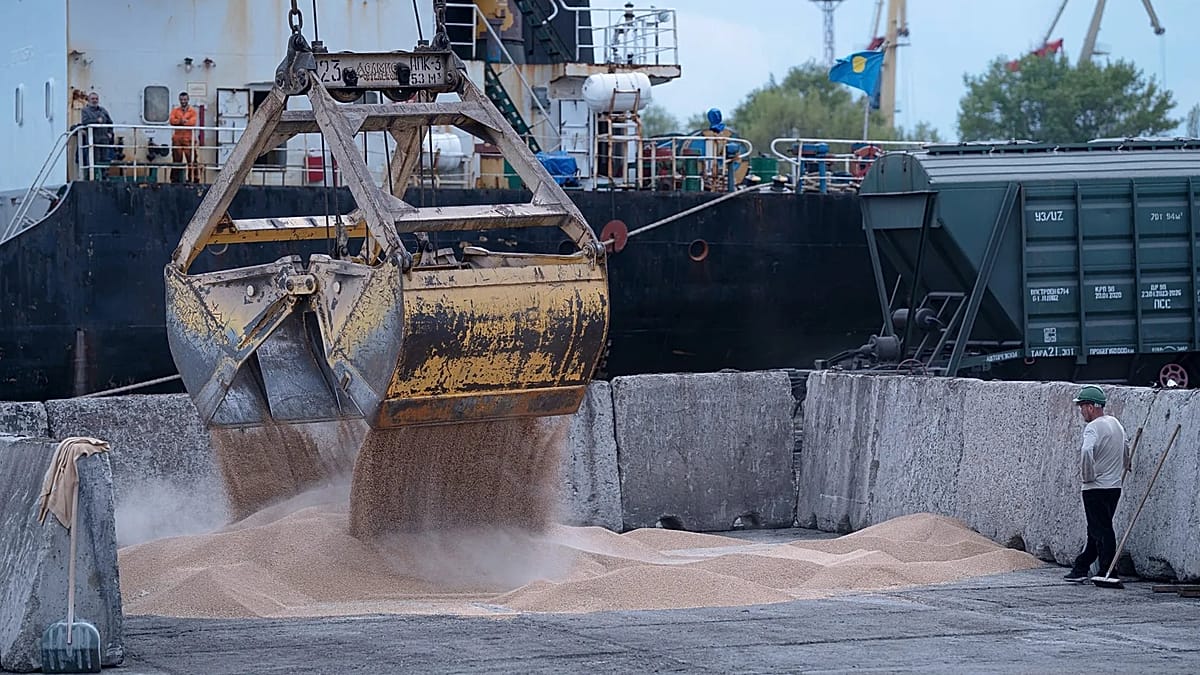
Kyiv has escalated its diplomatic pressure on Israel after a second vessel carrying grain allegedly stolen from Russian-occupied Ukrainian territories approached the port of Haifa. Ukraine's foreign minister, Andrii Sybiha, summoned Israel's ambassador on Tuesday morning to deliver a formal protest note and demand action.
Sybiha stated that 'friendly Ukrainian-Israeli relations have the potential to benefit both countries' but warned that 'Russia's illegal trade with stolen Ukrainian grain should not undermine them.' He expressed frustration over Israel's response to a previous incident in April, when the Russian bulk carrier Abinsk unloaded nearly 44,000 tonnes of stolen wheat in Haifa despite Kyiv's warnings. 'It is difficult to understand Israel's lack of appropriate response to Ukraine's legitimate request regarding the previous vessel that delivered stolen goods to Haifa,' Sybiha added.
The vessel in question, the Panama-flagged Panormitis, is reportedly carrying over 6,200 tonnes of wheat and 19,000 tonnes of barley. According to Ukrainian investigative journalist Kateryna Yaresko from the SeaKrime project, the grain was loaded via transfers from other ships at the Port of Kavkaz in Russia's Krasnodar region, with a large portion originating from the occupied Ukrainian city of Berdyansk on the Sea of Azov.
Diplomatic Tensions and Legal Disputes
Israel's foreign minister, Gideon Sa'ar, responded to Sybiha's public statements on social media, urging Kyiv to refrain from conducting diplomatic relations on X or in the media. Sa'ar insisted that 'evidence substantiating the allegations have yet to be provided' and noted that Kyiv had not 'even submit a request for legal assistance before turning to the media and social networks.' He added, 'The matter will be examined. Israel is a state that abides by the rule of law with independent law enforcement authorities. All Israeli authorities will act in accordance with the law.'
Ukrainian diplomatic sources told Axios that Israel had 'essentially shrugged off' Kyiv's demands regarding the Abinsk incident. One source described the situation as 'a slap in the face given the strategic goodwill Ukraine has extended—from designating the IRGC as terrorists to criminalising antisemitism.'
This dispute comes amid broader tensions between Ukraine and Israel, which have maintained cautious relations since Russia's full-scale invasion in 2022. Israel has refrained from providing direct military aid to Kyiv, seeking to balance its ties with Moscow. However, the geopolitical landscape has shifted following the US-Israel conflict with Iran, which began in late February. Ukrainian President Volodymyr Zelenskyy notably did not visit Israel during his Middle East diplomatic tour, though both countries have expressed willingness to strengthen ties against a common adversary, Iran.
Ukraine, often called Europe's breadbasket, is a major exporter of corn, wheat, and oats to the European Union. Before the war, it exported between 5 and 7 million tonnes of grain annually. Kyiv estimates that Russia has stolen at least 15 million tonnes of Ukrainian grain since 2022, using a 'shadow fleet' to export and sell it, thereby financing the war. An investigation by Israeli outlet Haaretz found that at least four shipments of stolen Ukrainian grain have been unloaded in Israel this year alone.
The Panormitis is currently in waters near Haifa, according to marine traffic monitors. Ukrainian officials have indicated they are tracking the vessel and are not willing to 'let this slide,' as confirmed by US media reports. The incident has broader implications for European security, as it underscores the challenges of enforcing sanctions and preventing the financing of Russia's war through illicit trade. European leaders, including Spanish Prime Minister Pedro Sánchez, have warned that inaction on Israel's part undermines the EU's credibility on Ukraine, as noted in a recent analysis.
As the situation develops, Kyiv is likely to continue pressing Israel to block the cargo, while Israel maintains its position that legal procedures must be followed. The outcome could set a precedent for how stolen Ukrainian grain is handled in international ports, affecting efforts to curb Russia's war financing.