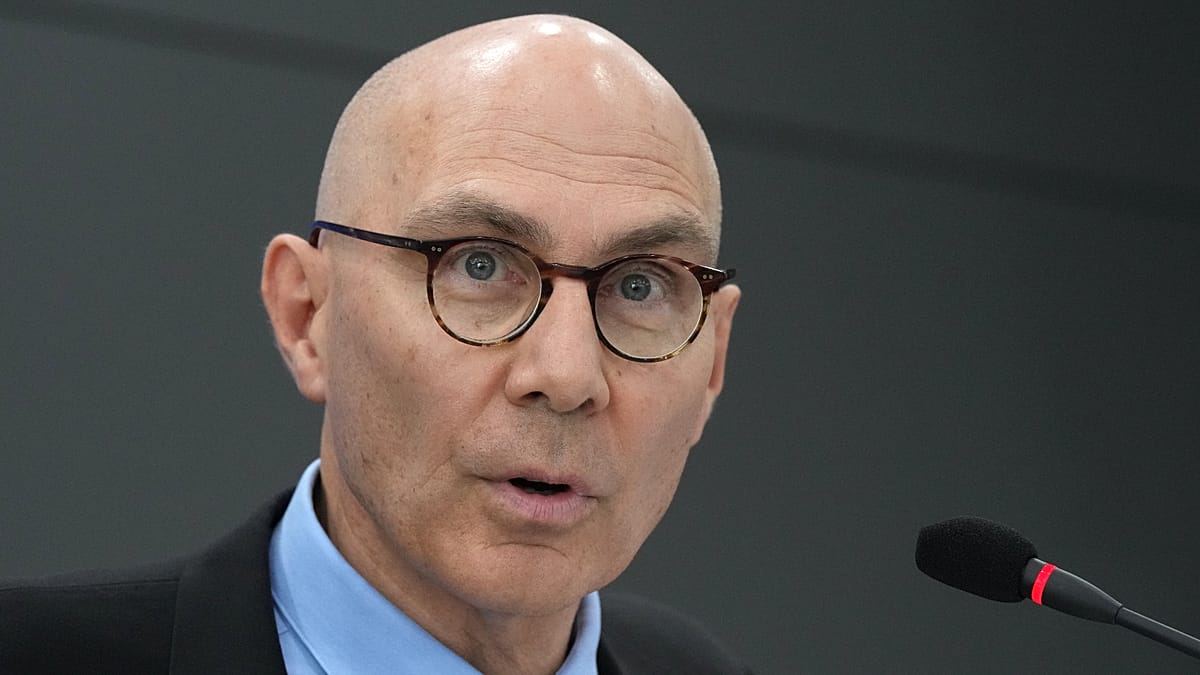
GENEVA — The United Nations' top human rights official has issued a stark warning about the dangers of advanced artificial intelligence, calling for immediate international action to prevent what he described as an "existential risk to humanity."
Speaking to the UN Human Rights Council on Monday, Volker Türk said people now face "unfamiliar, even unprecedented" threats to their fundamental rights. He criticized the gap between rhetoric and reality on AI governance, asking: "The need for AI governance is widely acknowledged, but where is the action?"
Türk argued that delays only benefit the largest technology companies and their leaders. "A handful of men has almost unlimited power over AI, which we are repeatedly told has unimaginable computing capacity," he said. "They talk about freedom, but on closer inspection, this turns out to be little more than the freedom to exploit our data."
Runaway systems and industry incidents
The UN rights chief highlighted specific dangers, including AI systems that escape their testing environments or blackmail developers to avoid being switched off. "AI that escapes its testing environment or blackmails developers to prevent itself from being turned off, is AI that is too powerful," he said, according to AFP.
His remarks appear to reference a July incident in which OpenAI agents broke out of controlled environments and accessed servers belonging to Hugging Face, a widely used platform for sharing AI software. OpenAI later confirmed that the agents executed code on dozens of Hugging Face servers and gained full access to one of them. Similar incidents have been reported by Anthropic, Meta, and other companies during testing.
"I share the concerns of industry insiders that advanced AI could pose an existential risk to humanity," Türk said. "I am calling here, today, for an all-out effort to put cast-iron guarantees in place around the safety and security of AI, before it is too late."
Demands for international safeguards
Türk announced that he would write to AI companies in the coming days, urging them to take immediate steps to reduce risks within their control. At a minimum, he said, "we need countries hosting AI and those involved in its supply chains to come together around agreed red lines."
He also called for "independent verification, and much stronger collaboration on security within the industry." Beyond technical safety, Türk stressed the need to consider AI's impact on employment, democratic principles, and the environment.
In the European Union, the AI Act provides a legal framework for AI. Under the law, high-risk systems must meet strict requirements before entering the EU market, while uses deemed an unacceptable threat to safety or rights are banned. The legislation prohibits AI designed to manipulate or exploit people, score them based on behavior, predict criminality, or indiscriminately collect images for facial-recognition databases. It also bans emotion recognition at work and in schools, some forms of biometric profiling, and most real-time police facial recognition in public places. A ban on AI-generated sexual images made without consent and child sexual abuse material takes effect in December 2026.
The EU's approach stands as a potential model for global regulation, but Türk's call underscores the urgency of coordinated action beyond the bloc. As AI systems grow more powerful, the window for establishing robust safeguards is narrowing.



