Russia's ruling United Russia party has secured a commanding lead in the country's parliamentary elections, according to early results published by state media on Monday. The vote, which concluded on Sunday, was overshadowed by a wave of Ukrainian drone attacks on Moscow and a series of cyberattacks targeting election infrastructure.
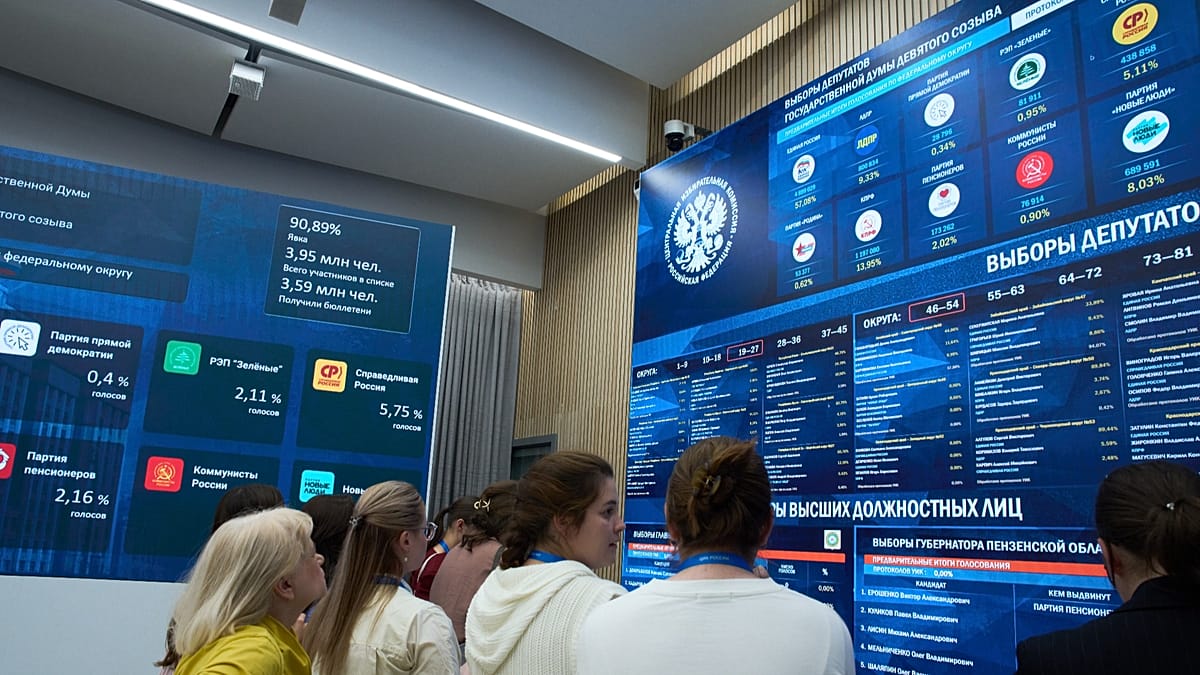
With just over 71% of ballots counted, United Russia had taken 57.5% of the vote, according to Russian news agencies. The Communist Party trailed with 14%, while the nationalist LDPR garnered 8.7%. Projections from the state news agency TASS indicate that the ruling party is on track to retain its two-thirds majority in the 450-seat State Duma, a supermajority that allows it to amend the Russian constitution.
First election since full-scale invasion
This was the first parliamentary election since Moscow launched its full-scale invasion of Ukraine in 2022. The political landscape was heavily constrained: no party opposing the war was allowed to compete. Russia's Supreme Court removed the anti-war Yabloko party from the ballot weeks before the vote, ensuring that all candidates were loyal to the Kremlin's agenda.
Voting also took place in Ukrainian territories that Russia has occupied and illegally annexed, a move widely condemned by Kyiv and Western governments. Turnout figures were closely watched as a potential barometer of public sentiment towards a conflict that has become Europe's deadliest since World War II.
Massive drone attack on Moscow
The final day of voting was marked by one of the largest Ukrainian drone attacks on Moscow since the war began. Moscow Mayor Sergei Sobyanin reported that around 1,600 drones were launched, with 450 aimed directly at the capital. The attacks killed two people and set an oil refinery ablaze, according to officials.
Images from the outskirts of Moscow showed a gaping hole in a multi-storey apartment building and black smoke billowing from what appeared to be an industrial facility. Ukrainian President Volodymyr Zelenskyy praised the strikes, saying that "our long-range responses had a very significant impact in the Moscow region last night."
In response, Russia's defence ministry vowed to "intensify" its strikes on Kyiv, accusing Ukraine of attempting to "disrupt the democratic will of Russian citizens." The ministry said in a statement that "in response to the Kyiv regime's attacks on civilian targets within Russia, the Russian army will continue and intensify its high accuracy strikes against military targets in Kyiv."
The escalation comes as diplomatic efforts to end the war have failed to curb mutual attacks. Zelenskyy spoke by phone with US President Donald Trump, who has recently urged Kyiv to halt its strikes on Russian refineries. The two leaders are expected to meet in New York in the coming days.
Cyberattacks on election infrastructure
Russia's electoral chief, Ella Pamfilova, said that election infrastructure had been subjected to a sustained campaign of cyberattacks. She did not attribute responsibility but described the attackers as "highly professional, well-coordinated groups using artificial intelligence tools."
"Over the past period, more than 1,000 waves of DDoS attacks have been recorded against infrastructure in Russia that is specifically involved in the electoral process," Pamfilova was quoted as saying by Russian news agencies. Distributed denial-of-service (DDoS) attacks overwhelm systems with internet traffic, rendering them inoperable.
The combination of drone strikes and cyberattacks underscores the extent to which the war in Ukraine has permeated Russian domestic politics. As the Kremlin celebrates its electoral victory, the conflict continues to shape every aspect of life in Russia, from the ballot box to the battlefield.
For more on the broader context of the war, see our coverage of recent Russian strikes across Ukraine and the new US sanctions on Russian energy revenues.