As negotiations between the United States and Iran proceed behind closed doors in Switzerland, both sides have exchanged public threats, highlighting the fragile nature of the peace process. The talks, aimed at ending a conflict that has destabilized the Middle East and rattled global markets, are intended to trigger a 60-day period to resolve long-standing issues between the two nations.
US President Donald Trump took to his Truth Social platform on Sunday to warn Iran, stating that if it does not prevent Hezbollah from causing trouble in Lebanon, the US would renew strikes. 'If they don’t, we’ll hit Iran very hard again, just like we did last week, only harder,' Trump wrote. This came as the negotiations opened against a backdrop of recent clashes between the Israeli army and the Iran-backed Hezbollah militant group in southern Lebanon.
Iran's chief negotiator, Mohammad Bagher Ghalibaf, responded sharply, cautioning the United States to be careful with its statements. 'Our armed forces are ready to respond,' Ghalibaf said, adding, 'Don't they think that if their threats had any effect, they would not have reached today's state of desperation? We do not take American threats into account.' He further warned that Iran would act in a different manner if provoked.
Lebanon Remains a Sticking Point
The memorandum of understanding signed between the US and Iran on Wednesday stipulates a cessation of hostilities on all fronts, including in Lebanon. However, Israeli Prime Minister Benjamin Netanyahu reiterated his government's position that Israeli forces would remain in southern Lebanon as long as necessary to protect northern residents and prevent Iran from acquiring nuclear weapons. 'We will remain in the security zone in southern Lebanon for as long as necessary to protect the cherished residents of the north and all the citizens of Israel... Nothing will alter that commitment,' Netanyahu stated.
Hezbollah chief Naim Qassem rejected any Israeli security zone in Lebanon, calling the presence of Israeli troops on Lebanese land impossible. The talks are further complicated by Iran's closure of the strategic Strait of Hormuz in response to recent Israeli attacks on Lebanon. Foreign ministry spokesman Esmaeil Baqaei wrote on X that entering the negotiation phase for a final agreement is impossible unless the war in Lebanon ends.
By Sunday evening, there were no reports of Israeli strikes or continued fighting, with some residents of southern Lebanon cautiously returning to their homes. The situation remains tense, with the US and Iran locked in a delicate diplomatic dance.
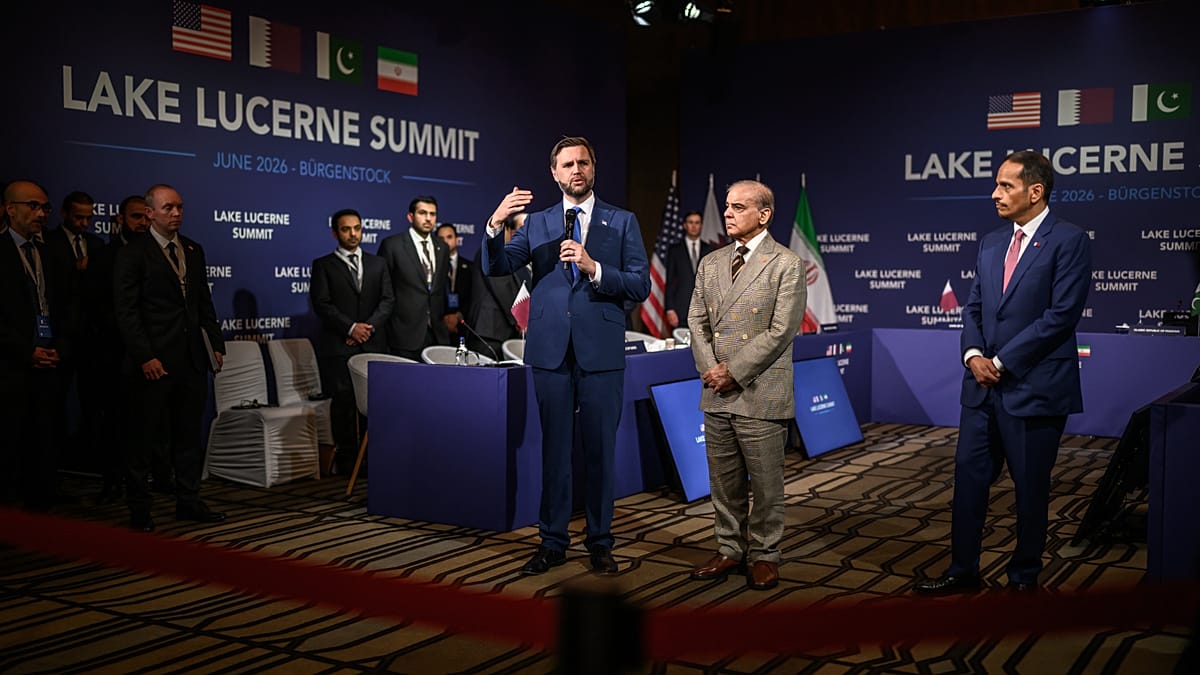
US Vice President, who is in Switzerland alongside negotiators Jared Kushner and Steve Witkoff, hailed the talks as a historic meeting and expressed hopes of turning a new leaf with Iran. 'The question before us now is how much more can we accomplish together? Can we turn over a new leaf? Can we change relations in the Middle East permanently? Or do we go back to doing things the old way, which is not our preference, but it's certainly very much something that can happen,' Vance said.
The US is seeking to lock Iran into negotiations over its nuclear program, amid concerns it may be used for military purposes—a claim Iran denies. Vance also wants Tehran to commit to keeping open the Strait of Hormuz, a critical waterway through which about a fifth of the world's traded oil passes. Iranian state media reported on Sunday that the nuclear program was not discussed, though this was not independently verified.
Iranian President Masoud Pezeshkian stated that Tehran would not relinquish its right to enrich uranium, while repeating Iran's denial that it seeks nuclear weapons. The outcome of the talks in Switzerland remains uncertain, with both sides trading threats even as they negotiate.