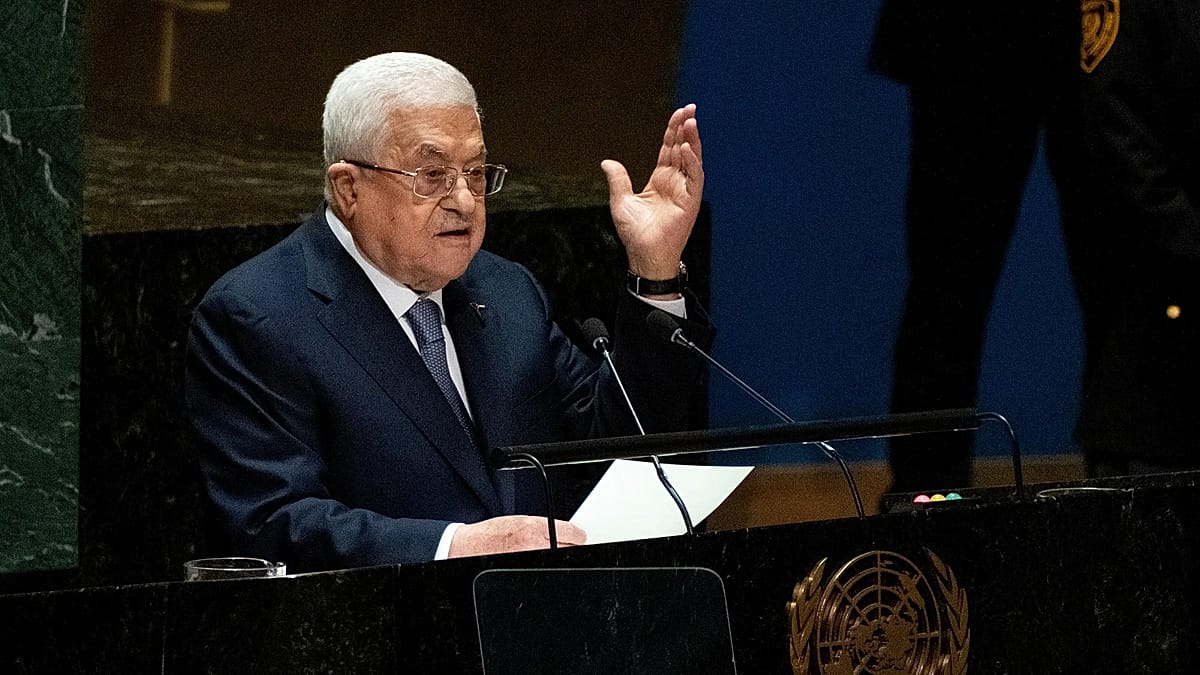
The United States has again refused to grant a visa to Palestinian President Mahmoud Abbas, preventing him from attending next week's UN General Assembly in New York. The decision, confirmed on Thursday, marks the second consecutive year that Washington has barred the Palestinian leader from the annual gathering.
The Palestinian foreign ministry issued a sharp rebuke, describing the measure as "an unjustified measure that runs counter to efforts to rebuild trust, develop Palestinian–US relations, and create the necessary political climate for implementing the two-state solution and achieving peace and stability."
The visa denial extends beyond Abbas himself. Dozens of other Palestinian Authority officials who had planned to travel with him have also been refused entry. According to the Times of Israel, one notice cited Section 212(a)(3)(B) of US immigration law, which bars visas for individuals linked to terrorist activities or organisations. The State Department said the restrictions were a consequence of the Palestinians' failure to meet commitments to reform and to pursue peace with Israel, and that they would remain in place.
Despite the ban, Palestinian representation at the UN will not vanish. Diplomats already accredited to the United Nations will speak for the Palestinian Authority during the high-level session, and Abbas is expected to address the assembly by video, as he did last year. The State Department has also maintained a waiver allowing the Palestinian Mission to the UN to continue operating from New York.
European reactions and diplomatic context
The renewed visa denial comes at a politically delicate moment. Several key nations are expected to formally recognise a Palestinian state during this year's General Assembly. In 2025, France, the United Kingdom, Australia, Luxembourg, Belgium, Portugal, Malta, and Canada all extended recognition. Four of the five permanent Security Council members now recognise Palestine.
European governments have previously criticised Washington's stance. Last year, Spanish Prime Minister Pedro Sánchez called the visa decision "unjust," writing on X that "Palestine has the right to make its voice heard at the United Nations and in all international forums." His comments reflect a broader European sentiment that the US move undermines diplomatic efforts.
The UN General Assembly is expected to vote again on a measure that would allow Abbas to participate remotely, a mechanism first used last year. That vote would not require a US visa, but it would symbolically challenge Washington's policy.
The decision also complicates US relations with European allies who have pushed for a more balanced approach to the Israeli-Palestinian conflict. The tensions between European and US foreign policy have been evident at recent international summits, and this visa dispute adds another layer of friction.
For the Palestinian Authority, the ban is a significant diplomatic setback. It prevents Abbas from personally lobbying world leaders on the sidelines of the General Assembly, a key opportunity for any head of state. The video address, while a workaround, lacks the immediacy and weight of an in-person appearance.
The US State Department's statement framed the decision as part of a broader policy of holding Palestinian leaders accountable. "As a consequence of their failure to reform, contrary to their commitments to the United States, and their ongoing activities that undermine the prospects for peace, the United States will extend sanctions that deny visas to PLO members and PA officials," the department said.
Critics argue that such measures are counterproductive. By barring Abbas, Washington risks alienating Palestinian moderates and strengthening the hand of hardliners. European diplomats have privately expressed concern that the move could further erode the already fragile prospects for a two-state solution.
The General Assembly session is expected to feature a series of votes on Palestinian statehood and related resolutions. The outcome of those votes will be closely watched in European capitals, where support for Palestinian self-determination has grown in recent years.
As the UN meeting approaches, the question of who speaks for the Palestinians—and where—has become a symbol of the broader diplomatic impasse. The US decision ensures that Abbas will again be a distant observer, not a participant, in the world's most important diplomatic forum.