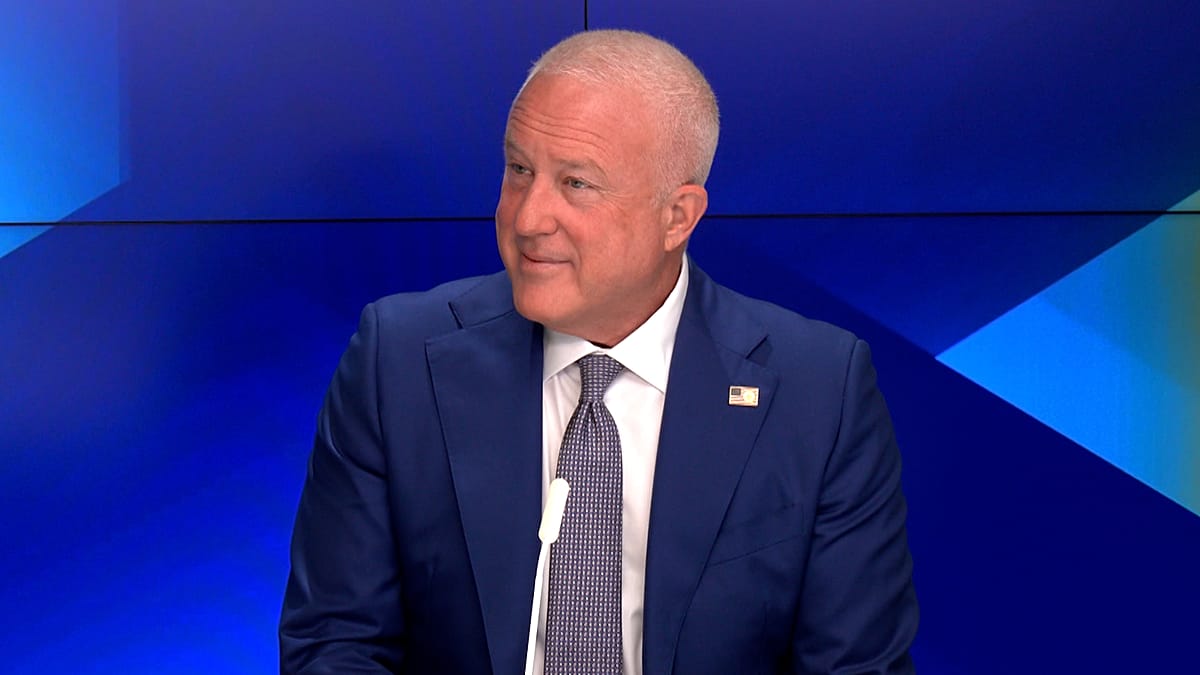
Washington's envoy to Brussels has declared an end to the transatlantic standoff over Greenland, saying a weekend agreement between the United States, Denmark, and Greenland's government has resolved the dispute over the Arctic island's security.
Bill White, the US Ambassador to Belgium, told Euronews' Europe Today programme on Monday that the deal, announced after talks involving the three parties, had eased tensions that had been building since President Donald Trump renewed his interest in acquiring the territory. "I told everybody to relax, take a deep breath. It will all be fine. And yesterday, it was announced that it's all fine," White said.
The agreement, which has been cautiously welcomed by leaders on both sides of the Atlantic, comes after months of friction triggered by Trump's repeated suggestions that the US should take control of Greenland, a semi-autonomous Danish territory. The president has argued that the island is vital to American national security and has warned that if Washington does not act, China or Russia could gain a foothold.
What the deal actually says
Details of the agreement remain thin, but Trump, writing on his Truth Social platform, said it grants the US "permanent control over security" on Greenland. He also claimed that no US "adversary" would be allowed to maintain a military base on the island or make "sensitive investments in Greenland without our express written approval."
The wording suggests a significant expansion of American influence over the territory's defence and economic affairs, though it stops short of the outright annexation that Trump had at times seemed to hint at. Danish and Greenlandic officials have framed the deal as a cooperative security arrangement rather than a concession to Washington.
Danish Prime Minister Mette Frederiksen, speaking on Sunday en route to the United Nations General Assembly in New York, where the agreement is expected to be formalised, said she looked forward to "the prospect of a good agreement" for Greenland, Denmark, and the US. Greenland's Premier Jens-Frederik Nielsen welcomed the deal, saying it was "to the benefit of us all" and would "ensure and strengthen" security on the island. He added: "We must take good care of Greenland, stand together around what matters most, and remain firm that we must always be treated with respect."
European reaction and the wider context
The agreement eases a diplomatic rift that had unsettled European capitals, where Trump's rhetoric on Greenland was widely seen as an affront to Danish sovereignty and to the principle of territorial integrity. Many EU leaders had bristled at the president's threats, with some describing them as crossing a line. The European Commission, under Ursula von der Leyen, had already signalled its commitment to the region: in early September, von der Leyen visited Greenland and unveiled a €200 million investment package, a move widely interpreted as an attempt to counter US pressure. In her State of the Union address last week, she noted that the EU "stood up for Greenland when it was threatened."
White, however, sought to play down the friction, likening the US-EU relationship to a marriage. "Sometimes you have to do a little tough love, and tough love is actually very effective," he said.
The deal also comes amid broader shifts in transatlantic relations, with Washington's approach to Europe under Trump often characterised by transactional demands and public pressure. The resolution of the Greenland dispute may offer a template for managing other contentious issues, though sceptics note that the lack of published details leaves room for future disagreements.
For Greenland, the agreement is likely to have significant implications. The island, rich in minerals and strategically located along emerging Arctic shipping routes, has long been a point of interest for major powers. The deal's provisions on investments could affect future economic partnerships, including those with European and Asian investors. Some observers have drawn parallels to the broader US-Denmark security arrangement, which has been seen as a model for balancing American interests with European concerns.
As the UN General Assembly convenes, the formal signing of the agreement is expected to be a key moment for all three parties. For Denmark, it represents a delicate balancing act: maintaining its sovereignty over Greenland while accommodating US security demands. For the US, it secures a strategic foothold in the Arctic without the political and legal complications of outright acquisition. And for Greenland, it offers a measure of stability and investment, though the island's leaders have been careful to stress that they will not be treated as a pawn in great-power politics.
The coming weeks will reveal whether the deal holds and whether it can withstand the test of implementation. For now, the immediate crisis has passed, and the transatlantic relationship, at least on this front, appears to be back on an even keel.