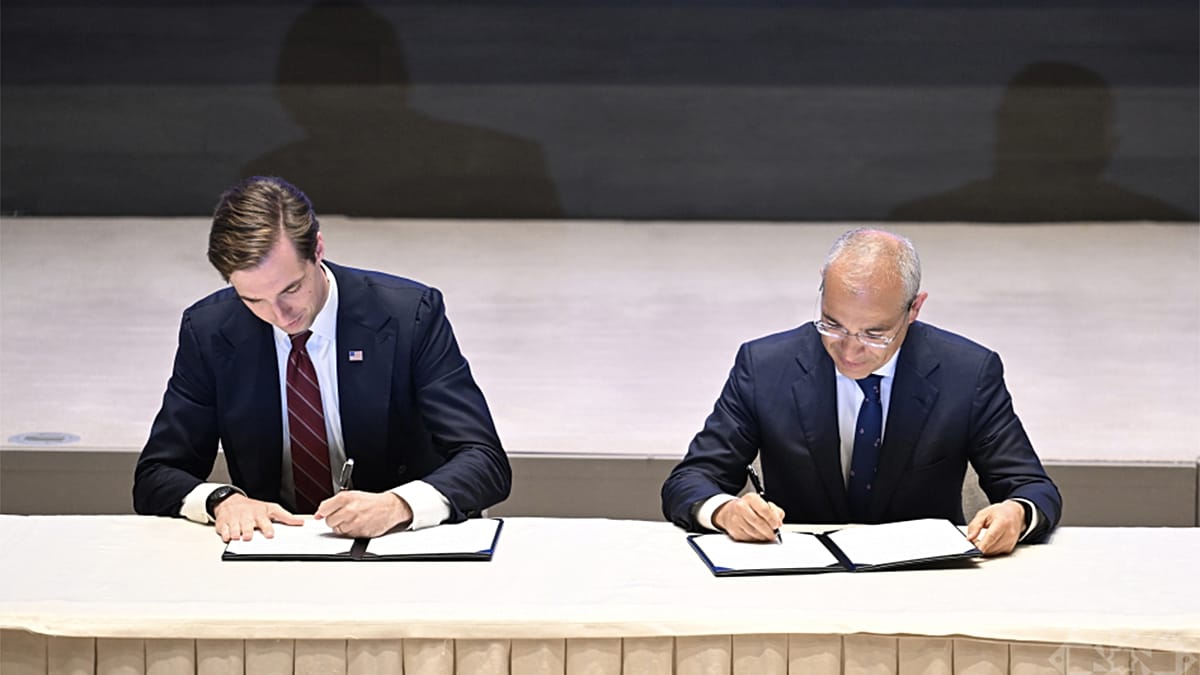
Washington is seeking a direct stake in Azerbaijan's pipeline and energy infrastructure, a senior US official declared in Baku on Thursday, signaling a strategic push to embed American interests in a region historically shaped by Russian and Chinese influence.
Speaking at the inaugural Azerbaijan–US Economic Dialogue, Assistant Secretary of State for Economic, Energy and Business Affairs Caleb Orr outlined ambitions that extend well beyond traditional hydrocarbons. “The United States wants a greater role in the pipeline infrastructure and the other energy infrastructure that Azerbaijan is building,” he said.
Orr also highlighted Washington's support for Azerbaijan's emergence as a transit hub, specifically endorsing the Middle Corridor — the trade and transport route linking Asia and Europe via the Caspian region. “We expect to help Azerbaijan grow its role as the central node of the Middle Corridor for energy transit, going to Europe and to the rest of the world,” he added.
From Peace Deal to Investment Surge
The economic dialogue follows a diplomatic breakthrough on 8 August 2025, when President Trump hosted Azerbaijani President Ilham Aliyev and Armenian Prime Minister Nikol Pashinyan at the White House. The two leaders signed a joint declaration committing to a peaceful relationship after more than three decades of conflict — a deal brokered in Washington rather than Moscow or Brussels, which had previously been the primary political capitals managing the Armenia-Azerbaijan relationship.
As part of the agreement, the US pledged to help construct a major transit corridor, named the Trump Route for International Peace and Prosperity (TRIPP), connecting Azerbaijan to its Nakhchivan exclave through Armenian territory. This corridor is expected to reshape regional trade dynamics and further integrate the South Caucasus with European markets.
Azerbaijan's Minister of Economy Mikayil Jabbarov credited strong political ties for the deepening economic relationship. “Due to the leadership of President Aliyev and President Trump, indeed we have very strong and flourishing political relationship,” he told Euronews.
Four Strategic Priorities
According to Jabbarov, bilateral cooperation now focuses on four strategic areas. The first is regional connectivity, encompassing trade, transit, and the Middle Corridor. He described it as a natural area for collaboration, extending to energy infrastructure, logistics networks, and the Alat Free Economic Zone — a purpose-built business hub south of Baku on the Caspian coast, designed to attract foreign investment and position Azerbaijan as a regional trade centre.
The second priority is energy security and critical minerals. While US energy majors ExxonMobil and Chevron are already active in Azerbaijan's sector — ExxonMobil signed a memorandum of understanding for new exploration during last year's Baku Energy Week, and Chevron inked a study agreement at this year's event — critical minerals represent a new frontier. “Critical minerals is a new add-on to our bilateral cooperation,” Jabbarov said, noting significant potential in developing supply chains and exploring new discoveries.
The third area is investment, with the US aiming to deepen its foothold in Azerbaijan's economy beyond energy. The fourth is AI and digital infrastructure, reflecting Baku's drive to diversify beyond hydrocarbons. “We believe that AI is a field and an area which has an impact on all fields of economic development,” Jabbarov stated.
Orr underscored the strategic importance of the relationship: “We think that Azerbaijan is a critical producer of energy for the world right now. And the United States really benefits from this relationship, and it's one that we expect to grow significantly over the next few years.”
The deepening US-Azerbaijan ties come as European nations seek to diversify energy sources following Russia's invasion of Ukraine. The Middle Corridor offers an alternative route for Caspian energy to reach European markets, bypassing both Russian and Iranian territory. For Brussels, the corridor represents a strategic priority, though its development has been hampered by infrastructure gaps and geopolitical complexities. Washington's direct involvement could accelerate progress, but also introduces a new layer of competition with Moscow and Beijing, both of which have long cultivated influence in the region.
As Azerbaijan positions itself as a central node in Eurasian energy and trade networks, the US push for a direct stake in its pipelines signals a broader realignment of economic and geopolitical interests in the South Caucasus — one that European capitals will be watching closely.