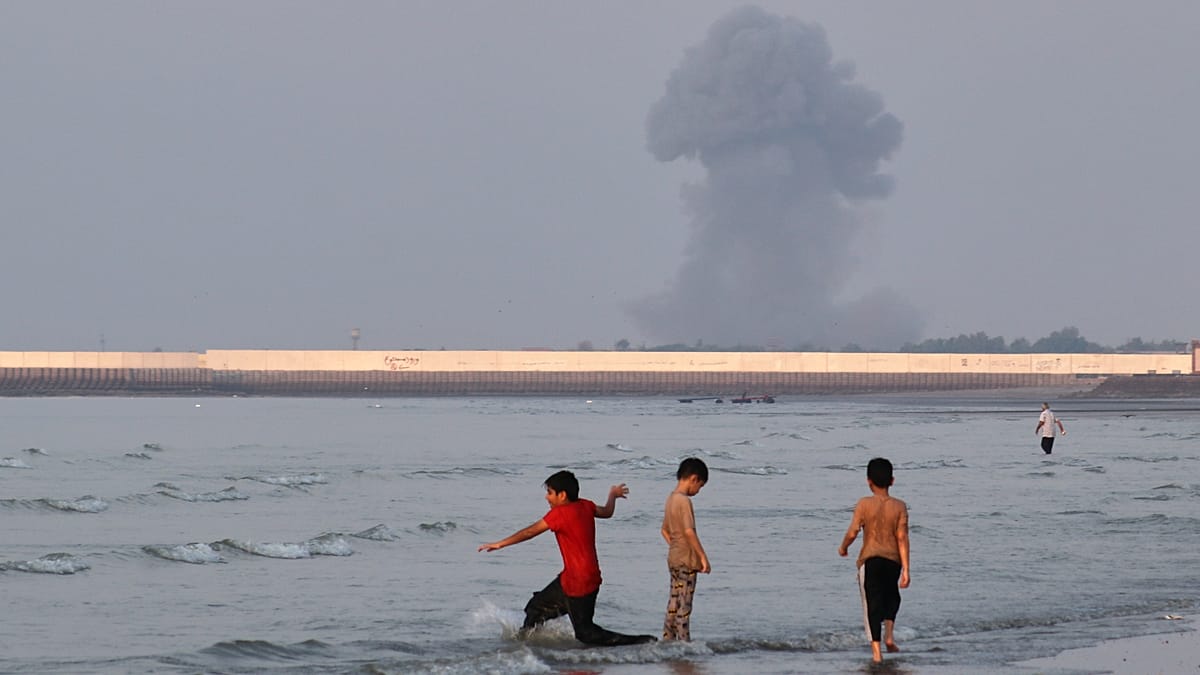
For the third consecutive night, United States forces launched strikes on Iranian military targets early Tuesday, deepening a confrontation that now threatens shipping in the Strait of Hormuz. US Central Command reported hitting sites in Bushehr, Chah Bahar, Jask, Konarak, Abu Musa, and Bandar Abbas during a five-hour operation. President Donald Trump described the action as “another major attack” and told reporters in the Oval Office that the US is “knocking out all of their offensive capability” and reimposing a blockade on the strategic waterway.
Iran responded by striking Bahrain and two tankers linked to the United Arab Emirates in the Strait of Hormuz. The UAE Defence Ministry confirmed that one mariner was killed and eight others wounded. Iran’s Revolutionary Guards claimed responsibility, stating the vessels “ignored repeated warnings.” They also said they had launched missile and drone strikes on Bahrain, targeting “weapons support warehouses, a satellite communications center and the residential building for US forces.”
Strait of Hormuz at the centre of the crisis
The Strait of Hormuz, through which roughly a fifth of the world’s crude oil and natural gas once passed in peacetime, has become the focal point of the escalating US-Iran conflict. Trump announced that the US would impose a 20% fee on all shipping transiting the strait, framing the charge as reimbursement for American protection. In a post on Truth Social, he declared the US would be known as the “Guardian of the Hormuz Strait.” This follows earlier threats to blockade the waterway, which have already disrupted global energy markets and drawn concern from European capitals reliant on Gulf oil and gas.
The European Union, which imports a significant share of its energy from the region, has watched the standoff with growing alarm. EU foreign ministers are scheduled to discuss the crisis later this week, with some member states calling for a de-escalation and a return to diplomatic channels. The bloc has previously supported the 2015 Joint Comprehensive Plan of Action (JCPOA) and has sought to maintain dialogue with Tehran even as Washington has taken a more confrontational stance.
Despite the intensifying military exchanges, Trump insisted that a diplomatic resolution remains possible. “Yeah, I think a deal is possible. Sure, I do,” he told reporters. He claimed that a memorandum of understanding reached last month had been “built to test” Iran, but that Tehran had failed to honour it. Iran’s Foreign Ministry spokesman Esmaeil Baqaei countered that the June agreement, which had formed the basis for negotiations and lifted the US blockade, was now “in crisis.”
The conflict has also drawn in regional actors. Bahrain, a small Gulf state that hosts the US Fifth Fleet, has become a target of Iranian retaliation. The Gulf country urged citizens to take shelter as air raid sirens sounded. Meanwhile, the UAE, a key US ally and a major hub for global shipping, has seen its vessels directly attacked. The strikes on the tankers mark a significant escalation, as they threaten the commercial lifeline of the Gulf states and the broader global economy.
For European readers, the implications are clear: any prolonged disruption to the Strait of Hormuz could send energy prices soaring, reignite inflation, and strain the continent’s post-pandemic recovery. The EU has already been diversifying its energy sources, including through increased imports of liquefied natural gas from the United States and Qatar, but the bloc remains vulnerable to shocks in the Gulf. The crisis also tests Europe’s ability to act as a diplomatic mediator, a role it has often played in the past but which has been sidelined by the Trump administration’s preference for unilateral action.
As the US and Iran continue to trade blows, the prospect of a wider regional war looms. Trump’s rhetoric, while leaving the door open to a deal, has also been belligerent. “We’re hitting them very hard. And it’ll continue, and we’ll see what happens,” he said. For now, the Strait of Hormuz remains a flashpoint, and Europe watches closely, aware that its own stability is tied to the outcome.